The Hebrew Alphabet
Even though the letters themselves are very different than the Latin letters you’re reading right now, Hebrew and English writing do share a common point of origin in the Phoenician script. The Phoenicians were a sea-faring Semitic people who spread across the Mediterranean from about 1500 BCE to about 300 BCE. Their writing system traveled with them, and it’s the source of quite a few modern alphabets (including Latin, Cyrillic, Hebrew, Arabic, and Greek).
Around the 10th century BCE, the Paleo-Hebrew alphabet developed from the Phoenician system. About 500 years later, the Hebrews abandoned Paleo-Hebrew in exchange for the Aramaic alphabet (also a descendant of Phoenician writing). Hebrew has been written with modified Aramaic letters ever since.
Hebrew is written from right to left, and originally it only included consonants. Four of these consonants (alef, he, waw, yod) were used to indicate the presence of certain long vowels, but it wasn’t until the Middle Ages that a full vowel system (niqqud) was added. The Masoretes, a group of Jewish scholars whose Masoretic Text is the oldest complete copy of the Tanakh in Hebrew, developed their system of niqqud around 750 CE in Tiberias. The Masoretic Text is written in this Tiberian vocalization, and it differs from other vocalizations (including modern Israeli Hebrew).
Consonants
A few of the consonants (kaf, mem, nun, pe, tsade) have a “regular” form and a “final” form, which is only used at the end of a word. Two of the consonants, ayin and alef, can be especially difficult for English speakers. An alef is a glottal stop (the weird thing your throat does between the two syllables in “uh-oh”), and an ayin is a pharyngeal fricative (the awkward sound that comes from pressing the back of your tongue against your pharynx). In modern Israeli Hebrew, and in my own pronunciation, the ayin is also just a glottal stop.

Vowels
The vowels are diacritics added to the consonants. Alefs are used below as placeholders for the niqqud, except for the shureq, which only appears with a waw.
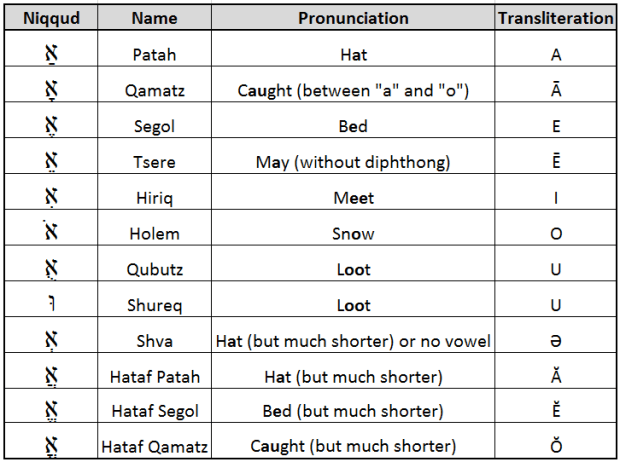
This pronunciation guide for both the consonants and vowels is based on my understanding of the Tiberian vocalization used in the Masoretic Text. It’s not perfect, but I’m not a Masorete.
Begadkefat Letters
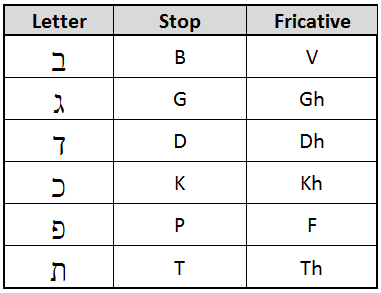
Six letters have alternate pronunciations based on where they appear. These are bet, gimel, dalet, kaf, peh, and tav – bgdkpt; in other words, begadkefat. When they appear after consonants, or when doubled, they’re pronounced as stop consonants, and they turn into fricatives when they’re placed after vowels.
 Translate the Torah