The Generations of Yishma’el
This little seven-verse story is cleansing after that last fifteen-chapter one.
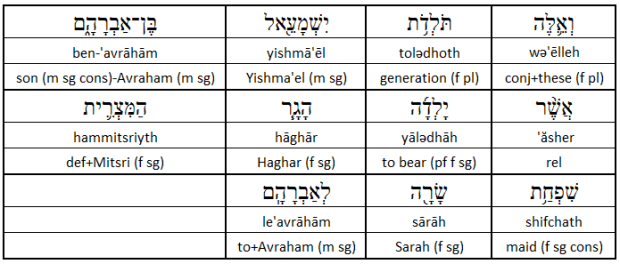
Genesis 25:12 – These are the generations of Yishma’el son of Avraham, whom Haghar the Mitsri, maid of Sarah, bore to Avraham.
Genesis 25:13 – These are the names of Yishma’el’s sons, by their names and according to their generations: Nevayoth the firstborn, Qedhar, Adhbe’el, Mivsam…

Genesis 25:14 – …Mishma, Dhumah, Massa…

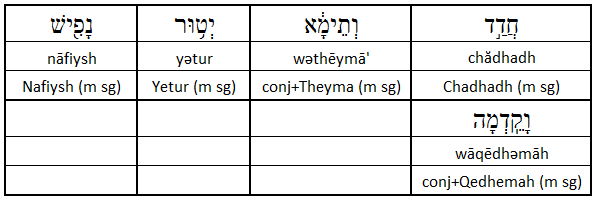
Genesis 25:15 – …Chadhadh, Theyma, Yetur, Nafiysh, and Qedhemah.
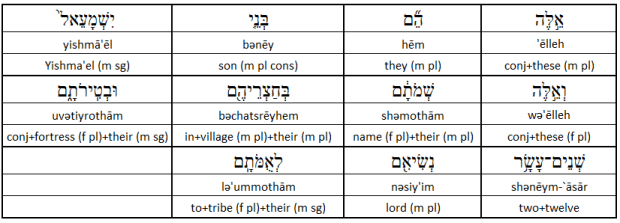
Genesis 25:16 – These are the sons of Yishma’el, and these are their names according to their villages and fortresses: twelve lords of their tribes.
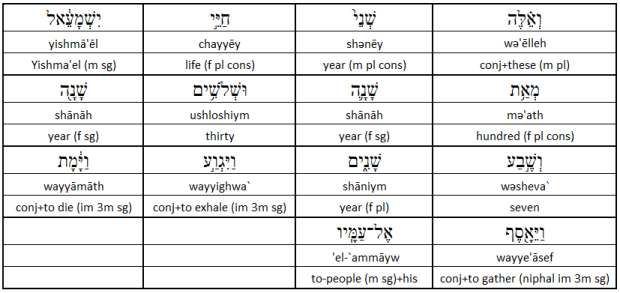
Genesis 25:17 – Yishma’el lived 137 years. He breathed out, died, and was gathered to his people.
Genesis 25:18 – His sons settled from Chawilah to Shur near Mitsrayim, in the direction of Ashur. He died in the presence of all his brothers.
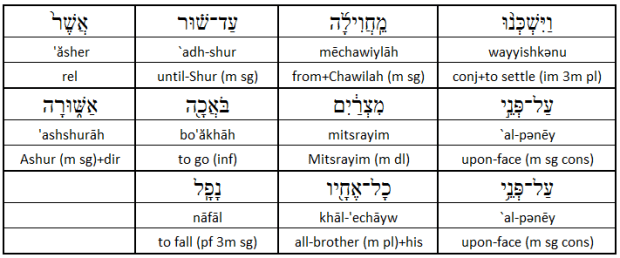
This is often translated in more modern versions as something like “they lived in open hostility against their brothers.” That seems to be indicative of some later bias against the descendants of Yishma’el, who are typically identified with certain groups of Arabs. Really, the Hebrew just says “al-peney khal-echayw nafal”, “he fell upon the face of all his brothers.” Nafal is usually translated as “to fall”, but it has other idiomatic uses, like “to settle.” The phrase “al-peney” has been used heavily throughout Genesis so far – it literally just means “upon/before/over the face of”, and is a way of expressing “before/in front of.” There’s no indication of hostility here – it seems more geographic than anything else.
While my Greek is god-awful (unlike my Hebrew, which is more demigod-awful), it’s worth noting that the Septuagint (a ~2200 year-old Greek translation) also translates this without any mention of hostility. The relevant part is, in Greek, “kata prosopon panton ton adelfon autou katokesen”, which comes out to something like “against face of all his brothers he stood.” It’s a pretty literal translation of the Hebrew into Greek, interpreting “nafal”, “to fall”, as “stand.”
The Vulgate, a 4th Century Latin translation, does so similarly – “coram cunctis fratribus suis obiit”, or “before all his brothers he died.” This interprets “nafal” as indicating death – this is the route I’ve chosen, as the first part of the verse uses a plural third person while the second part uses a singular.
I’m not sure when the hostility nuance was added in – the KJV, about 400 years old, is based on a Latin text and also translates as “he died in the presence of all his brethren.”
Full Text
These are the generations of Yishma’el son of Avraham, whom Haghar the Mitsri, maid of Sarah, bore to Avraham.
These are the names of Yishma’el’s sons, by their names and according to their generations: Nevayoth the firstborn, Qedhar, Adhbe’el, Mivsam, Mishma, Dhumah, Massa, Chadhadh, Theyma, Yetur, Nafiysh, and Qedhemah. These are the sons of Yishma’el, and these are their names according to their villages and fortresses: twelve lords of their tribes.
Yishma’el lived 137 years. He breathed out, died, and was gathered to his people. His sons settled from Chawilah to Shur near Mitsrayim, in the direction of Ashur. He died in the presence of all his brothers.
 Translate the Torah