The Generations of Terach
Well, this is a huge one, and it took me absolutely forever to work through. This is the story of Terach’s children and grandchildren, specifically Avram/Avraham and Lot, as well as the childhoods of Avram’s sons Yisma’el and Yitschaq.
I’ve noticed that as I go along with this, my Hebrew gets both better and sloppier. There are handfuls of small mistakes that I know have popped up below as I’ve worked though the story, but for now, I’m not going to bother with an edit until I finish the whole thing. Enjoy!
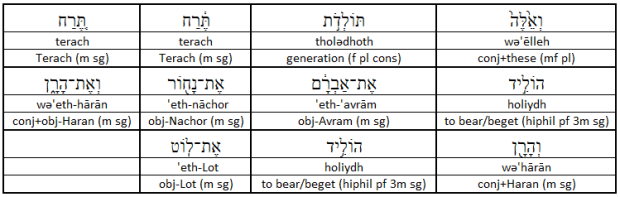
Genesis 11:27 – These are the generations of Terach. Terach fathered Avram, Nachor, and Haran, and Haran fathered Lot.
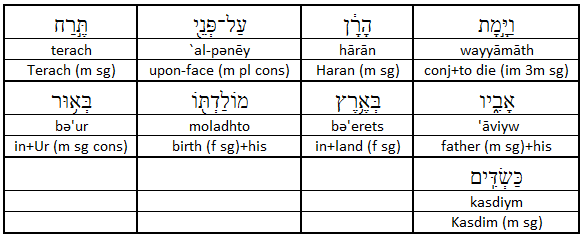
Genesis 11:28 – Haran died in the presence of his father Terach in Ur Kasdim, the land of his birth.
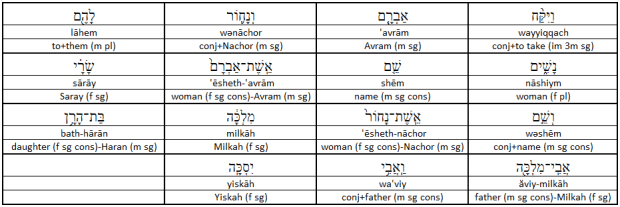
Genesis 11:29 – Avram and Nachor took wives. Avram’s wife was named Saray, and Nachor’s wife was named Milkah. She was the daughter of Haran, who fathered Milkah and Yiskah.
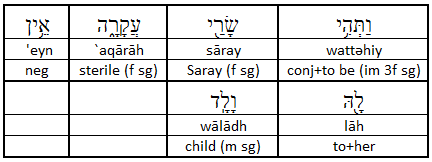
Genesis 11:30 – Saray was barren, and she had no children.
Genesis 11:31 – Terach took his son Avram, his grandson Lot son of Haran, and his daughter-in-law Saray, and they left Ur Kasdim for the land of Kena’an, and they dwelled at Charan
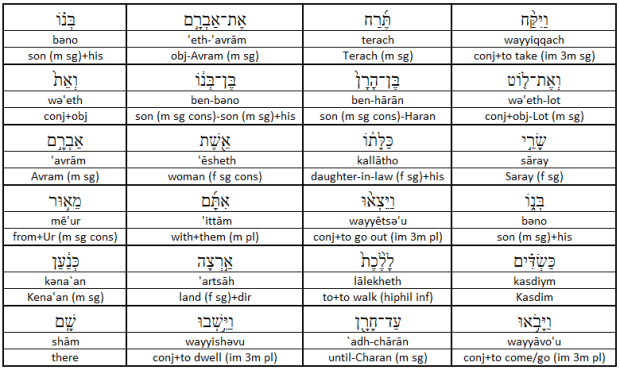
Genesis 11:32 – Terach was 205 years old when he died in Charan.

Genesis 12:1 – “Leave your land and your kindred,” Yahweh said to Avram. “Go from your father’s house to the land that I will show you.”
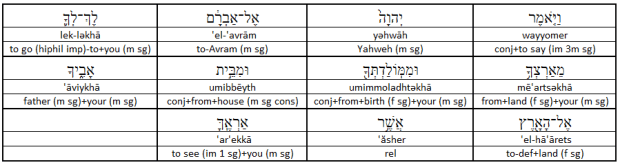
Genesis 12:2 – “I will make you a great nation. I will bless you, and I will magnify your name. You will be a blessing.”

Genesis 12:3 – “I will bless those who bless you and curse those who curse you. Through you, all of the tribes of the earth will be blessed.”

The first word translated here as “curse” literally means something like “to be/make light”, as in small, trifling, or easy.
Genesis 12:4 – Avram left, as Yahweh told him, and Lot went with him. He was seventy five years old when he left Charan.
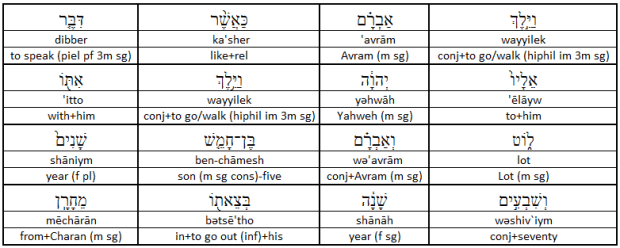
Genesis 12:5 – Avram took his wife Saray and his nephew Lot, and all the property and people they had gathered in Charan, and they left for the land of Kena’an.
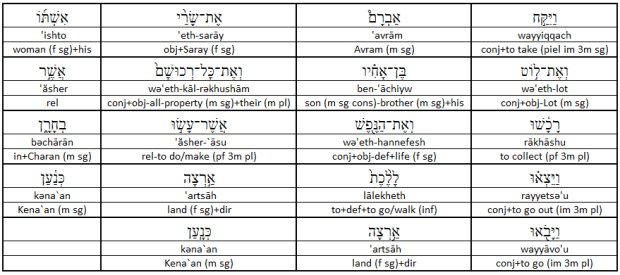
Genesis 12:6 – Avram passed through the land until he came to Shekhem and the terebinths of Moreh. The Kena’ani were in the land at that time.

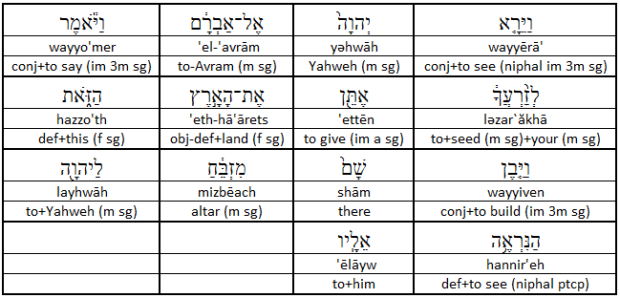
Genesis 12:7 – Yahweh appeared to Avram. “I will give this land to your seed,” he said. Avram built an altar to Yahweh who had appeared to him.
Genesis 12:8 – He moved from there towards the mountains to the east of the House of El, and he set up his tent with the House of El on the west and Ay from the east. He built an altar to Yahweh there, and he called on the name of Yahweh.
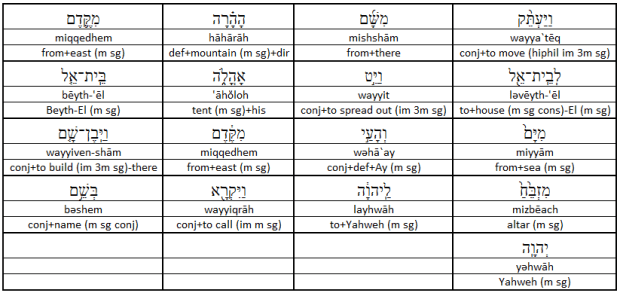
A bit of an anachronism here – the House of El (Beyth El or Bethel, as it’s usually transliterated) hasn’t yet been named. Also, the sea is used as a marker of direction here, as the Mediterranean is to the west of Canaan (Kena’an).
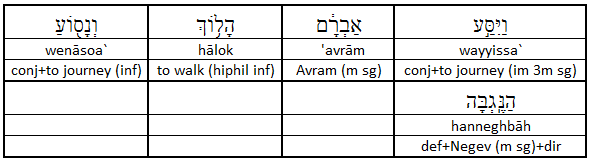
Genesis 12:9 – Avram then journeyed towards the Neghev.
Genesis 12:10 – There was a heavy famine in the land, and Avram went down to Mitsrayim to stay there.
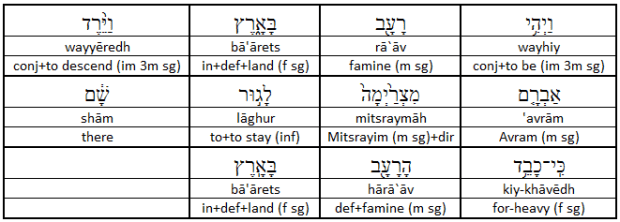
Mitsrayim, or Egypt.
Genesis 12:11 – “I know that you are a beautiful woman,” he said to his wife Saray as they approached Mitsrayim.
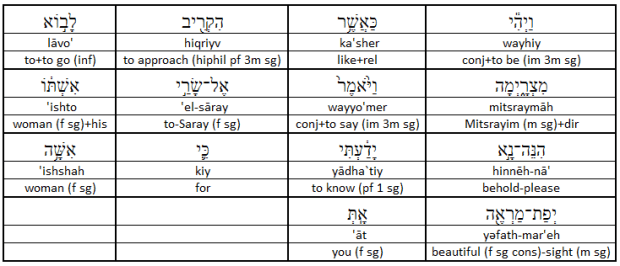
Genesis 12:12 – “When the Mitsrim see you, they will say ‘This is his wife’, and they will kill me but let you live.”
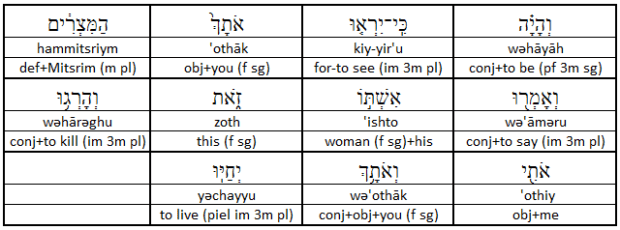
Genesis 12:13 – “Say that you are my sister. For your sake, they will be good to me and let me live.”
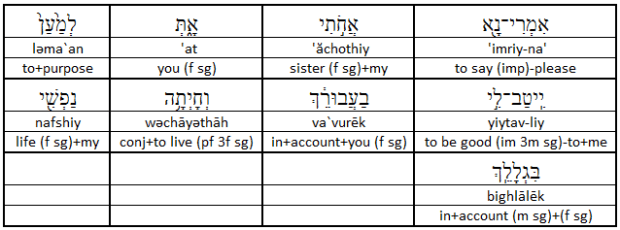
Genesis 12:14 – When Avram went into Mitsrayim, the Mitsrim saw that his wife was very beautiful.

Genesis 12:15 – The princes of Par’oh saw her, and they praised her to him, and they took her to his house.
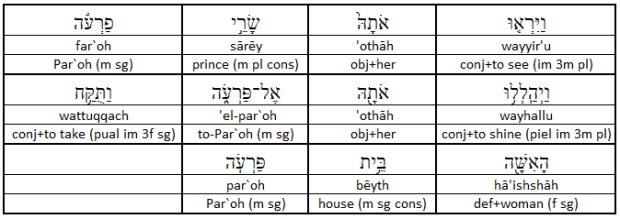
Par’oh, or Pharaoh. The verb here for “praise” means “to be clear/shine.”
Genesis 12:16 – They were good to Avram for her sake, and they gave him sheep, cattle, donkeys, slaves, maids, and camels.
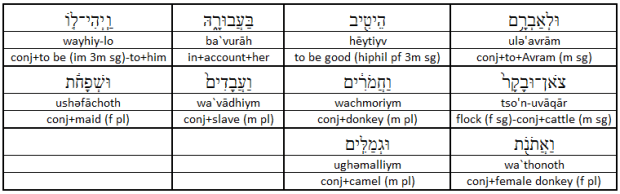
The Hebrew specifies both male and female donkeys.
Genesis 12:17 – Yahweh struck Par’oh and his house with a great plague on behalf of Avram’s wife Saray.
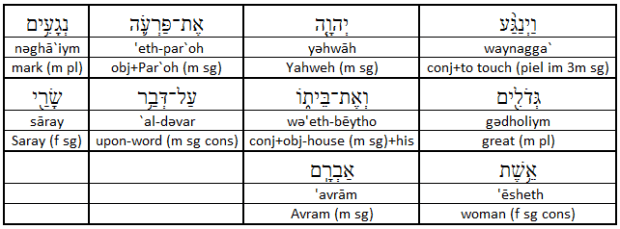
Davar, “word”, is often used more generally as just “thing.”
Genesis 12:18 – Par’oh called for Avram. “What have you done to me?” he asked. “Why didn’t you tell me that she’s your wife?”
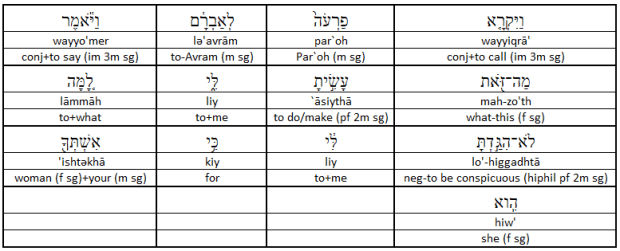
Genesis 12:19 – “Why did you say that she’s your sister? I took her as my wife. Now, take your wife and go.”
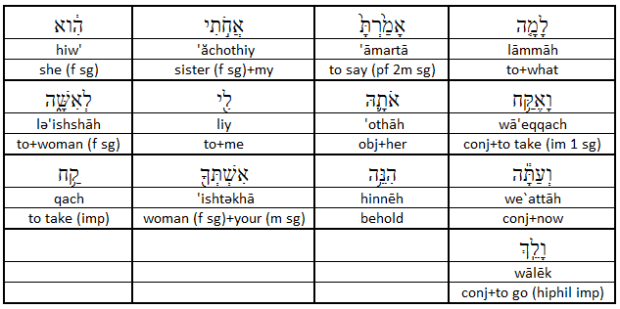
Genesis 12:20 – Par’oh commanded his men, and they sent Avram away with his wife and all of his possessions.
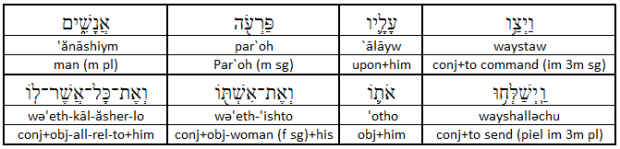
Genesis 13:1 – He went up from Mitsrayim to the Neghev with his wife, all of his possessions, and Lot.
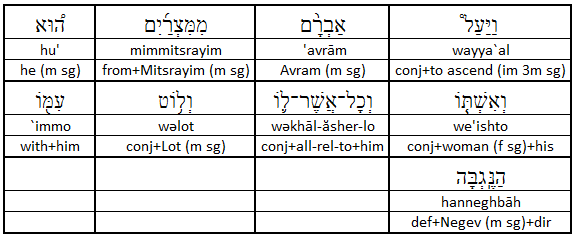
Genesis 13:2 – He was very rich in cattle, silver, and gold.
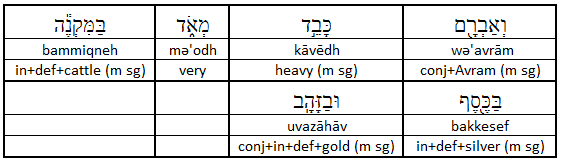
Interesting way to make your fortune.
Genesis 13:3 – He journeyed from the Neghev towards the House of El, coming to the place where his tent had been before, between the House of El and Ay…
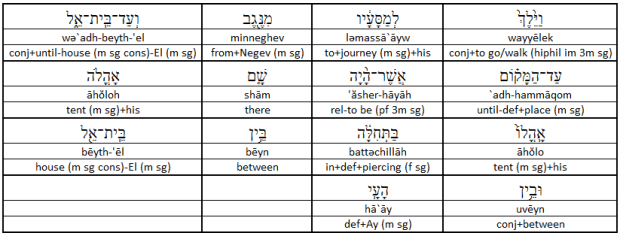
“In the piercing”, or “in the beginning.”
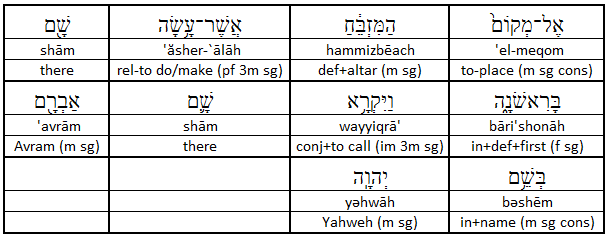
Genesis 13:4 – …to the place where he had made the altar, and he called upon the name of Yahweh.
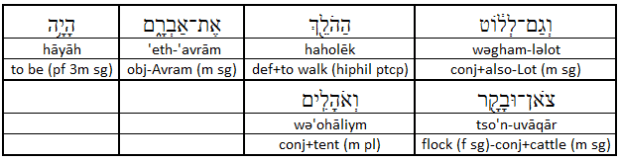
Genesis 13:5 – Lot was traveling with Avram, and he also had sheep, cattle, and tents.
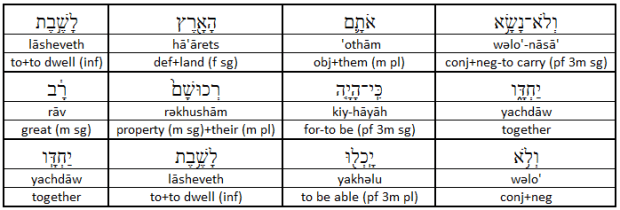
Genesis 13:6 – The land couldn’t support them living together, for their possessions were great, and they were unable to dwell together.
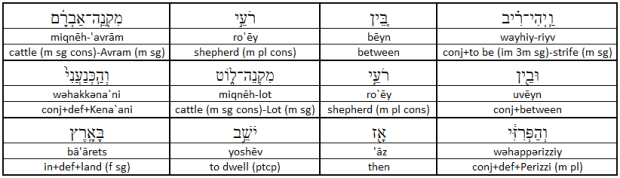
Genesis 13:7 – There was strife between Avram’s shepherds and Lot’s shepherds, and the Kena’ani and the Perizzi were also dwelling in the land.
Genesis 13:8 – “There shouldn’t be strife between me and you and between my shepherds and yours,” Avram said to Lot. “We are brothers.”
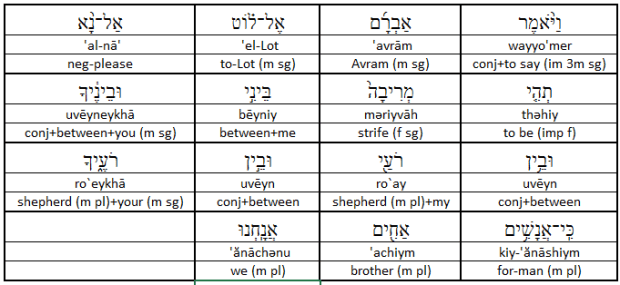
Genesis 13:9 – “Isn’t all of the land before you? Separate from me. If you go to the left, I will go to the right. If you go to the right, I will go to the left.”

Genesis 13:10 – Lot looked up, and he saw that the whole plain of Yarden towards Tso’ar was watered like the garden of Yahweh and the land of Mitsrayim, before Yahweh destroyed Sedhom and Amorah.
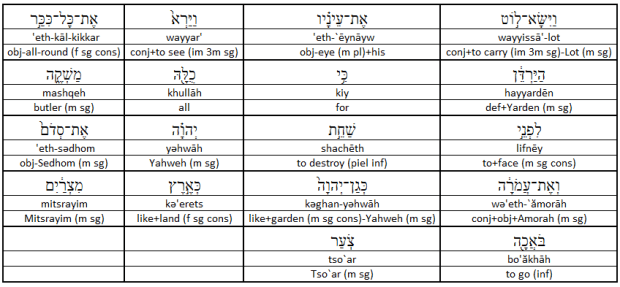
The word “mashqeh” is a butler or cup bearer, from the word “to water/give drink.” All the land was “butlered” or watered.
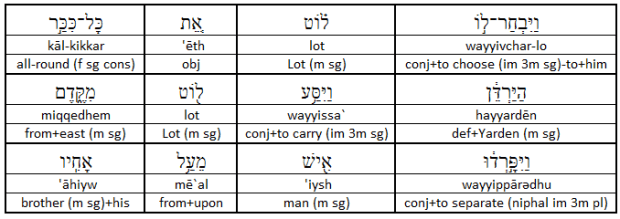
Genesis 13:11 – He chose the plain of Yarden, and he traveled eastward, separating from his brother.
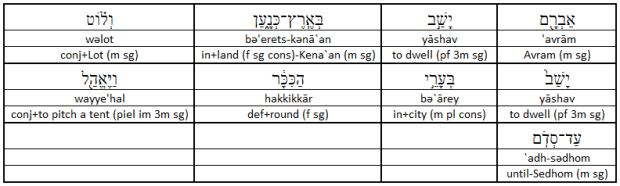
Genesis 13:12 – Avram dwelled in the land of Kena’an, and Lot dwelled in the cities of the plain, and he camped near Sedhom.
Genesis 13:13 – The men of Sedhom were evil, and they were great sinners before Yahweh.

Genesis 13:14 – “Look up,” Yahweh said to Avram after Lot had separated from him. “Look out from the place where you are, to the north, to the south, to the east, and to the west”
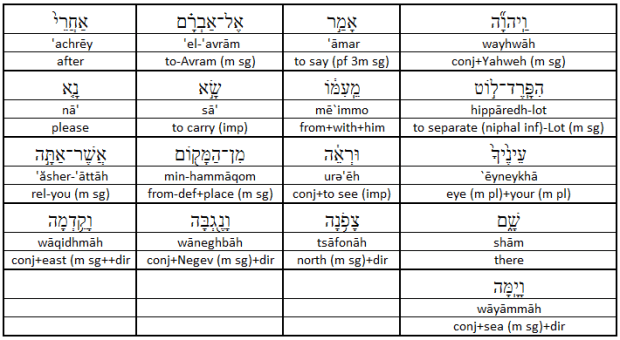
I’ve used the cardinal directions, but it’s literally “to Tsafon, to the Neghev, to Qedhem, and to Yam.” Tsafon is a mountain to the north in Turkey where the god Ba’al lives, the Neghev is the desert that makes up the southern part of Israel, Qedhem is the word for “ancient” or “precede”, referring to the East, and Yam is the sea (the Mediterranean).
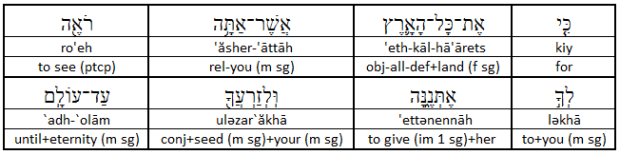
Genesis 13:15 – “I will give all the land you are seeing to you and your seed forever.”
Everything the light touches is our kingdom, Simba.
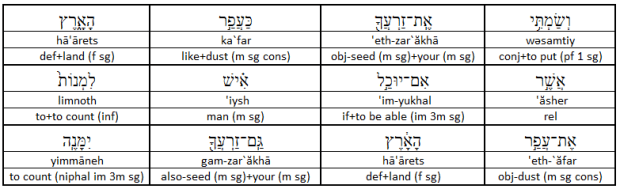
Genesis 13:16 – “I will make your seed like the dust of the land. If anyone can count the dust, then they could also count your seed.”
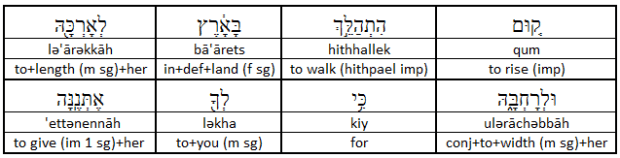
Genesis 13:17 – “Rise. Walk the length and width of the land, for I am giving it to you.”
Genesis 13:18 – Avram packed his tent, and he went to dwell at the terebinths of Mamre in Chevron, and he built an altar to Yahweh there.
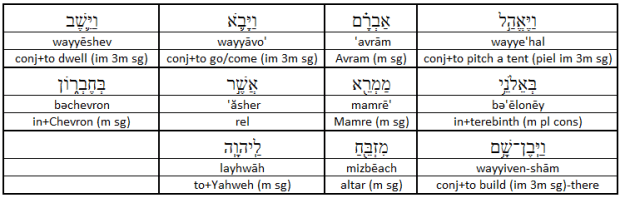
“Chevron” is usually transliterated as “Hebron.”
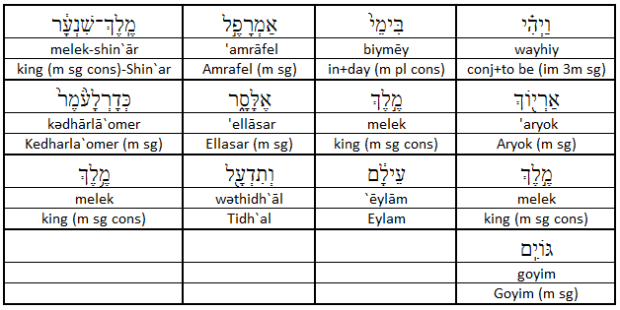
Genesis 14:1 – At that time, Amrafel king of Shin’ar, Aryok king of Ellasar, Kedharla’omer king of Eylam, and Tidh’al king of Goyim…
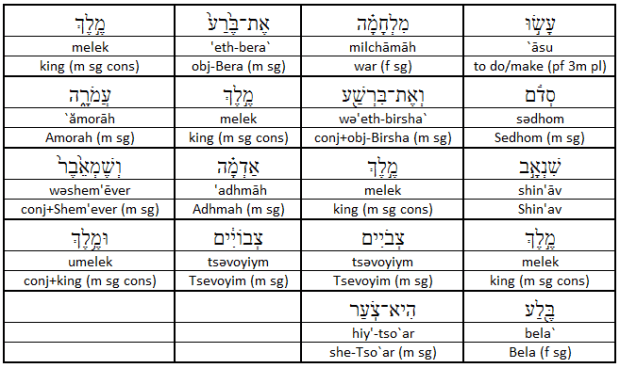
Genesis 14:2 – …made war against Bera king of Sedhom, Birsha king of Amorah, Shin’av king of Adhmah, Shem’ever king of Tsevoyim, and the king of Bela, which is Tso’ar.
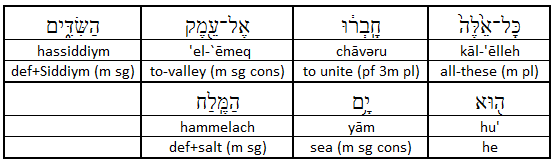
Genesis 14:3 – They all united in the valley of Siddim, at the Sea of Salt.
Genesis 14:4 – They had served Kedharla’omer for twelve years, and in the thirteenth year they rebelled.

Genesis 14:5 – In the fourteenth year, Kedharla’omer and the kings who were with him attacked the Refa’im in Astarte of the Horns, the Zuzim in Ham, the Emim in the Plain of the Two Cities…
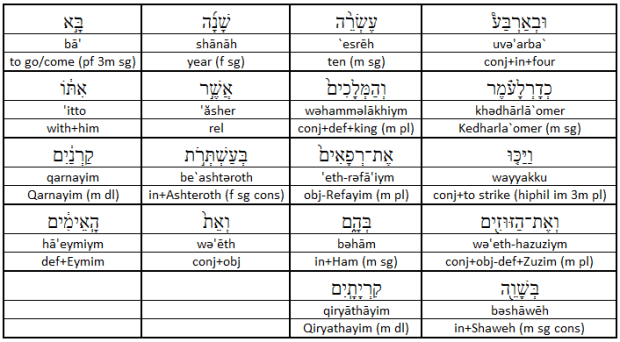
Usually these placenames are just transliterated, but I like to translate when possible. The first, Ishtar of the Horns, refers to the goddess Ishtar, usually written in Hebrew as Ashtoreth and appearing in the construct above as Ashteroth. The vowels in the Hebrew variation of the name come from the convention of using the vowels in the word “bosheth” (“shame”) when referring to gods that are not Yahweh. This turns Astarte, the Greek variant of Ishtar, into the Hebrew “Ashtoreth.”
The other translated name is Shaweh Qiryathayim, with “shaweh” (“plain” or “valley”) added to the dual form of “qiryat” (“town”).
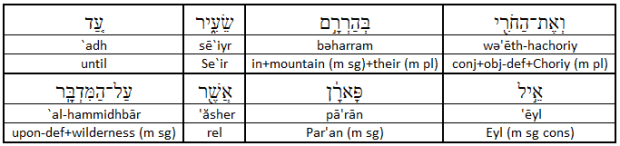
Genesis 14:6 – …and the Choriy at their Mount Se’ir, as far as the terebinth of Par’an in the wilderness.
Genesis 14:7 – They returned, and they went to the Eye of Judgment, which is Qadhesh, and they attacked the entire field of the Amaleqi, and also the Emori who were dwelling in the Valley of the Palms.
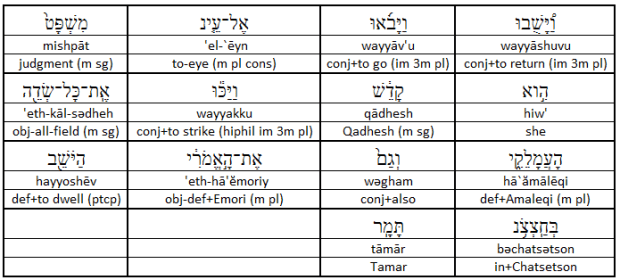
“Arrows of the Palms” was difficult to figure out. “Tamar” is just “palm” or “date tree”, but “chatsatson” is related to the word for “arrow” and “to divide.” Going by the “divide” meaning, I’ve decided to use “valley”, but I’m not terribly confident in that (I just like the way “Valley of the Palms” sounds).
Genesis 14:8 – The kings of Sedhom, Amorah, Adhman, Tsevoyim, and Bela which is Tso’ar went out and made war in the valley of Siddim…
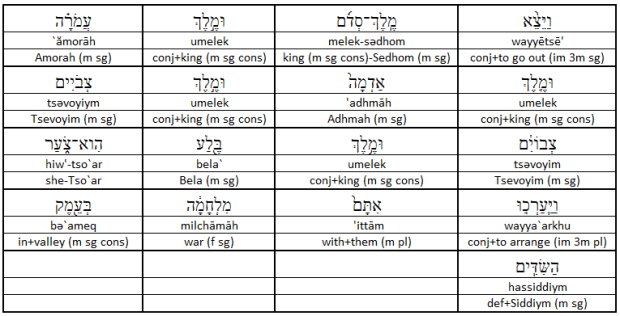
Genesis 14:9 – …against Kedharla’omer king of Elam, Tidh’al king of Goyim, Amrafel king of Shin’ar, and Aryok king of Ellasar – four kings against five.
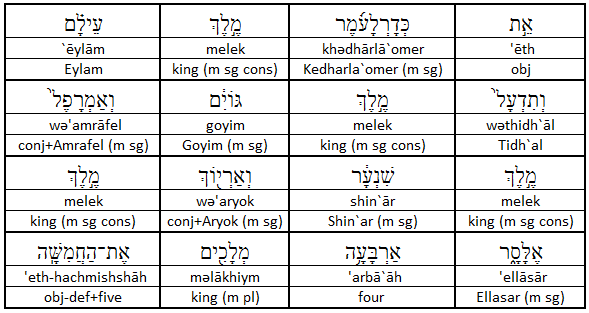
Genesis 14:10 – There were tar pits in the valley of Siddim, and the kings of Sedhom and Amorah fled. They fell there, and those who remained fled to the mountains.
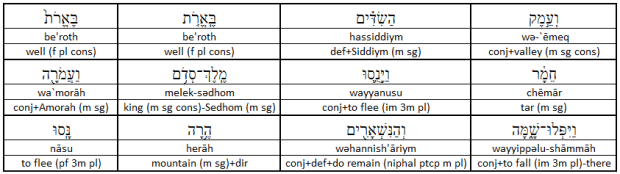
Genesis 14:11 – Kedhorla’omer and his allies took all the property and food of Sedhom and Amorah, and then they left.
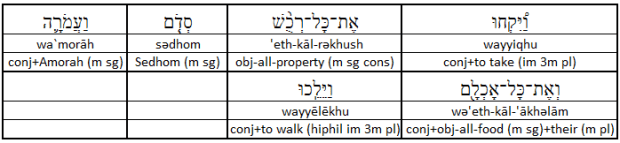
Adding in Khedorla’omer and the other kings as it can be a bit difficult to follow all of the “theys.”
Genesis 14:12 – They also took Avram’s nephew Lot and all of his possessions, because he was living in Sedhom.

Genesis 14:13 – A refugee came and told Avram the Ivri, who was dwelling at the terebinths of Mamre the Emori, the brother of Eshkol and Aner, his allies.
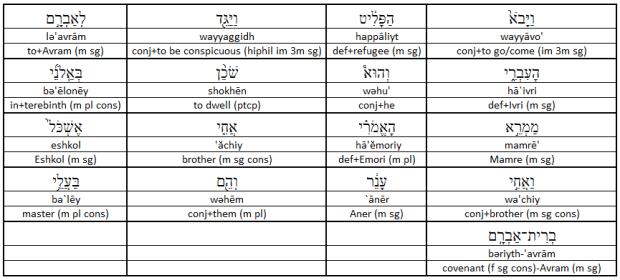
“Ivri” here is “Hebrew”, taken from Ever/Eber, one of the descendants of Shem. All of Ever’s/Eber’s descendants are, broadly speaking, the Hebrews. Eshkol, Aner, and Mamre are “masters of a covenant of Avram” – in other words, his allies.
Genesis 14:14 – Avram heard that his nephew had been taken captive, and he brought 318 trained men from his house and pursued the captors as far as Dan.
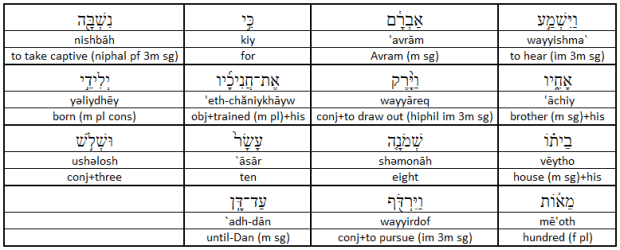
Here’s another anachronism – Dan, named for the tribe of Dan, refers to a region that has not yet been named, as Dan himself hasn’t been born yet in the chronology of the story. Of course, the other interpretation is that the stories throughout the Torah exist to give an explanation for the names of places in Canaan and elsewhere.
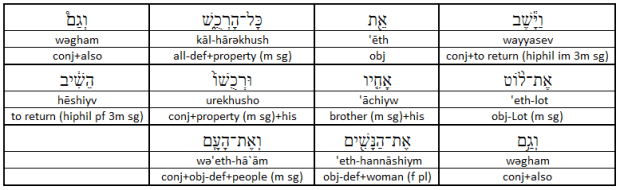
“Brother” can be generally used for “relative”, and I’ve tried to keep it as brother in some situations where I like to preserve the figurative meaning. Here, though, it didn’t seem to flow as well, so I’ve swapped it with “nephew”, the actual relationship of Lot to Avram. I’ve also inserted “captors” to, again, add some specificity to all of these “theys/thems.”
Genesis 14:15 – Avram divided his slaves against their enemies at night, and they attacked them and pursued them to Chovah, north of Dammeseq.
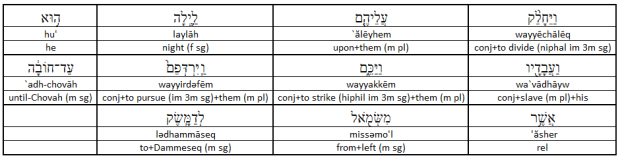
Again, adding in words to specify the pronouns.
Genesis 14:16 – He returned all of the property, women, and people, including his nephew Lot and Lot’s property.
Genesis 14:17 – The king of Sedhom went out to the valley of the plain, which is the Valley of the King, to meet Avram after he returned from attacking Kedharla’omer and his allies.

Genesis 14:18 – Malkitsedheq, king of Shalem, brought out bread and wine. He was the priest of El Elyon…
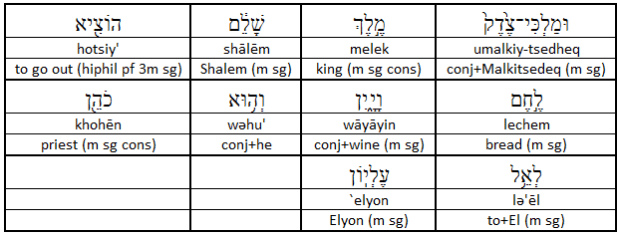
Malkitsedheq, or Melchizedek, is a strange figure. He’s the priest of El Elyon, apparently a title for El meaning “highest.” This might maintain the broader Canaanite notion of El, father of the gods and the “high god”, but his name doesn’t really appear much outside Hebrew sources. He’s the king of Shalem, or Salem, which is traditionally identified with Jerusalem. His name means “my king [is] Tsedheq.” Tsedheq is either the word “righteousness” or a god called Tsedheq. If Shalem is Jerusalem, then there might be a parallel with the later King Adhonitsedheq (“my lord [is] Tsedheq”) of Jerusalem.
Genesis 14:19 – …and he blessed Avram. “Blessed is Avram to El Elyon, possessor of the skies and the land,” he said.

Genesis 14:20 – “Blessed is El Elyon, who delivered your enemies into your hands.” He gave him a tenth of everything.
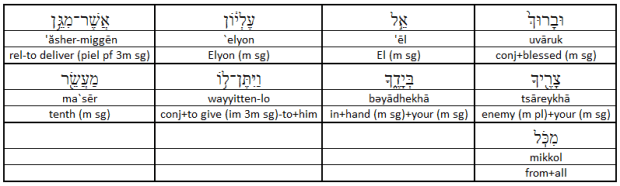
Who gave whom the tithe has never really been agreed upon.
Genesis 14:21 – “Give me the people and take the property for yourself,” the king of Sedhom said to Avram.
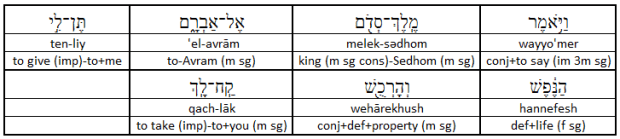
Genesis 14:22 – “I have raised my hand to Yahweh, El Elyon, possessor of the skies and the land,” Avram said to the king of Sedhom.

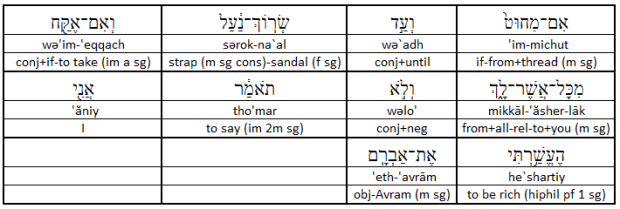
Genesis 14:23 – “I will not take even a thread or a sandal strap from anything that is yours, so that you cannot say ‘I made Avram rich.'”
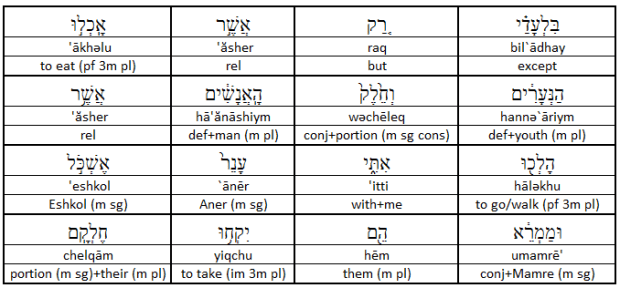
Genesis 14:24 – “I will take only that which the youths have eaten, and may Aner, Eshkol, and Mamre, the men who are with me, take their portion.”
Genesis 15:1 – After these things had happened, the word of Yahweh came to Avram in a vision, saying, “Fear not, Avram. I am your shield, and your reward will greatly increase.”
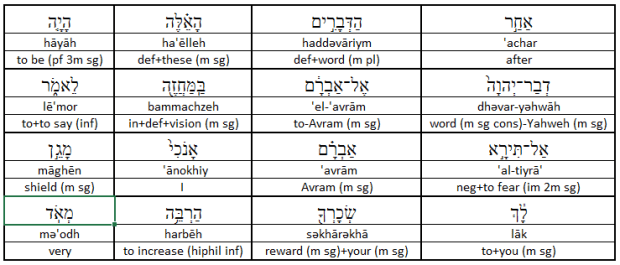
Genesis 15:2 – “My lord Yahweh,” Avram said. “What will you give me? I am childless, and my house’s heir is Eli’ezer of Dammeseq.”
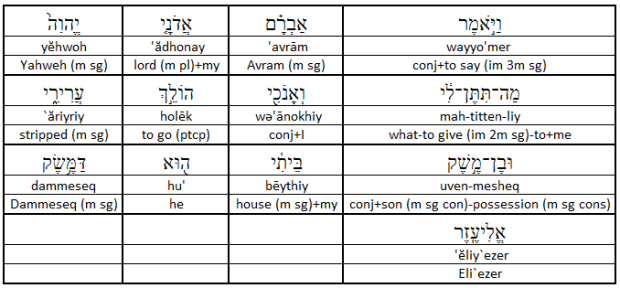
“Stripped” here is usually used in the sense of “stripped of children, childless.” Eli’ezer is currently Avram’s heir, literally the “son of the possession of my house.”
Genesis 15:3 – “You have not given me a seed, and my servant will be my heir.”

“A son of my house is inheriting me.” I’m also kind of over all of the “beholds.” That word in Hebrew is just an interjection. It’s a demonstrative used to introduce all kinds of phrases and words and situations, and it’s traditionally translated into English as “behold” or “lo.” That’s kind of an outdated translation – nobody walks around saying BEHOLD these days, so at this point in the translation I’ve decided to leave it untranslated.
Genesis 15:4 – “This man will not be your heir,” said his god Yahweh. “A child of your own will be your heir.”
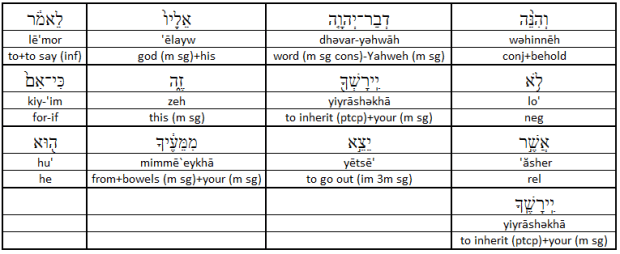
Avram’s heir will be one “going out from [his] bowels.” Hm.
Genesis 15:5 – He brought Avram outside. “Look towards the sky,” he said. “Count the stars, if you can count them. Thus will be your seed.”
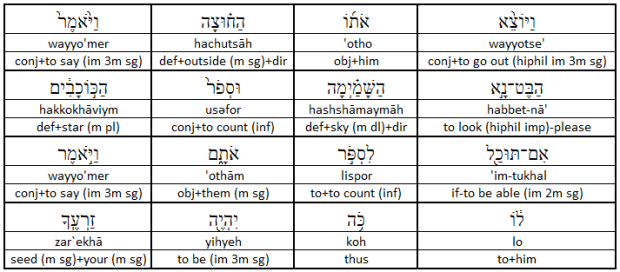
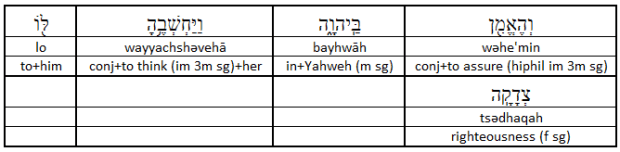
Genesis 15:6 – Avram trusted Yahweh, and credited righteousness to him.
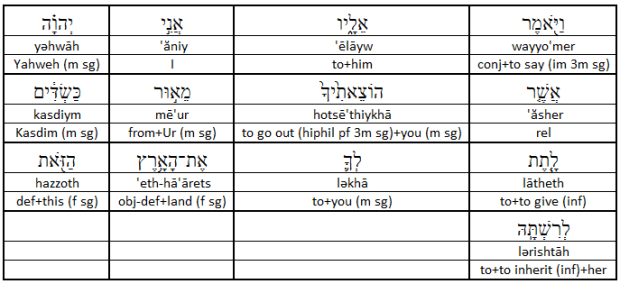
Genesis 15:7 – “I am Yahweh,” Yahweh said. “I brought you from Ur Kasdim to give you this land to inherit.”
Strangely, later in Exodus, Yahweh appears to Moses and tells him that his ancestors only knew him as El Shaddai, not Yahweh, which is clearly not true. That may have more to do with the presumed merging of El/Elohim and Yahweh in the later monolatristic/monotheistic perspective.
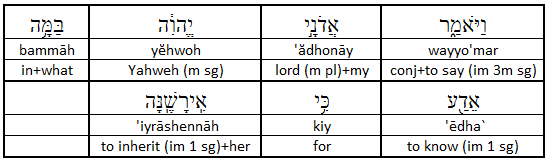
Genesis 15:8 – “My lord Yahweh,” Avram said. “How will I know that I will inherit it?”
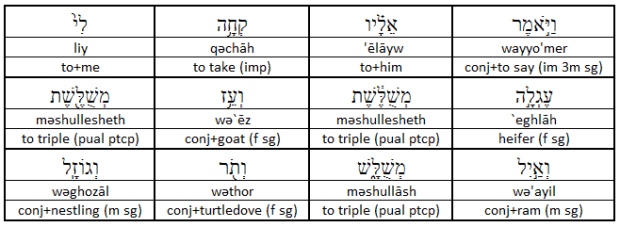
Genesis 15:9 – “Bring me a three-year old heifer, a three-year old goat, a three-year old ram, a turtledove, and a nestling.”
Genesis 15:10 – Avram brought everything. He cut them in half and set them side by side. He did not cut the birds.
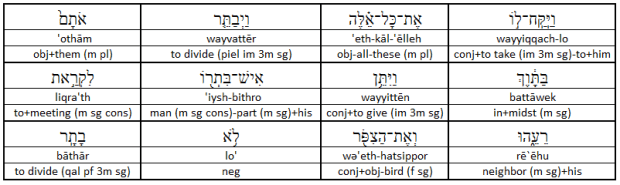
Genesis 15:11 – Birds of prey descended upon the corpses, and Avram dispersed them.
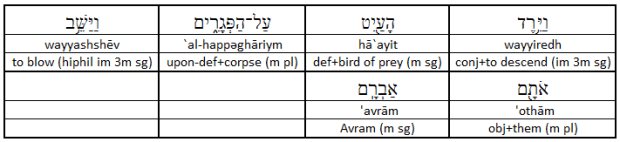
He “blew the birds away”, literally.
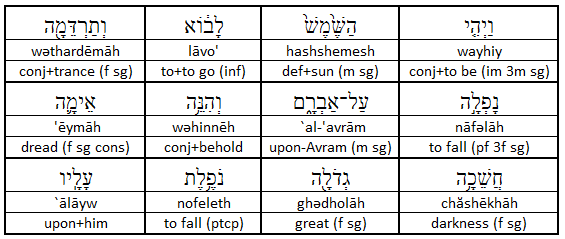
Genesis 15:12 – As the sun went down, a trance fell upon Avram, and dread and darkness fell upon him.
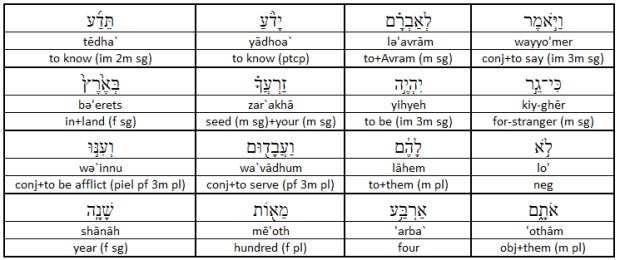
Genesis 15:13 – “Know that your seed will be strangers in a land that is not theirs,” Yahweh said to him. “For four hundred years, they will serve and be afflicted.”
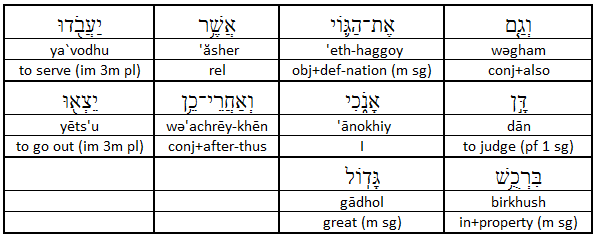
Genesis 15:14 – “I will judge the nation that they will serve, and they will leave it with great wealth.”
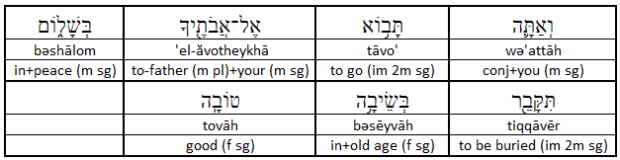
Genesis 15:15 – “You will go to your fathers in peace, and you will be buried at a good, old age.”
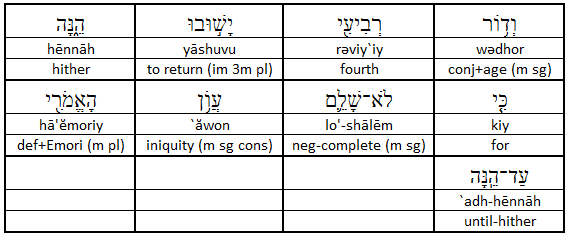
Genesis 15:16 – “They will return here in the fourth generation, for the iniquity of the Emori is not complete.”
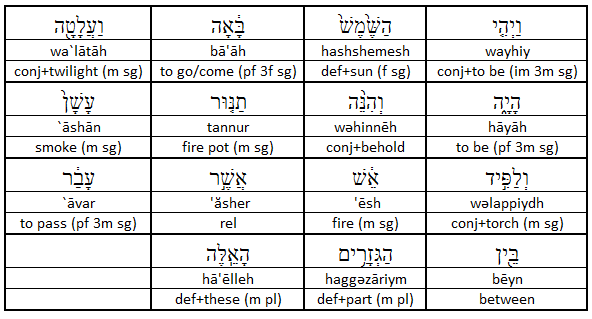
Genesis 15:17 – When the sun set and it was twilight, a smoking fire pot and a flaming torch had passed between the animal parts.
Genesis 15:18 – On that day, Yahweh made a covenant with Avram. “I give this land to your seed,” he said. “From the river of Mitsrayim to the great river Perath, the land of…”
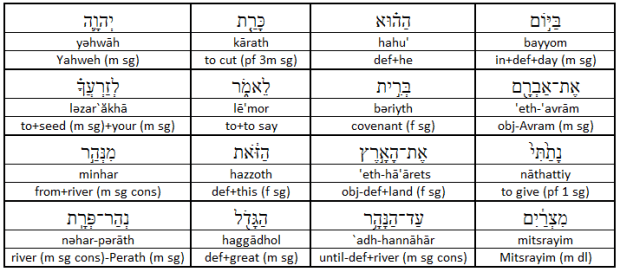
The Nile to the Euphrates. Literally, Yahweh “cut” a covenant with Avram. Had to add that last little bit to make the following list of peoples flow better.
Genesis 15:19 – “…the Qeyni, the Qenizzi, the Qadhmoni…”

Genesis 15:20 – “…the Chitti, the Perizzi, the Refa’iym…”

Genesis 15:21 – “…the Emori, the Kena’ani, the Girgashi, and the Yevusi.”

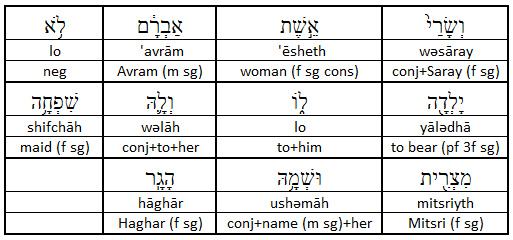
Genesis 16:1 – Avram’s wife Saray had not borne any children to him. She had a Mitsri maid named Haghar.
Genesis 16:2 – “Yahweh has restrained me from bearing children,” Saray said to Avram. “Go to my maid. Maybe I can have children through her.” Avram listened to Saray’s voice.
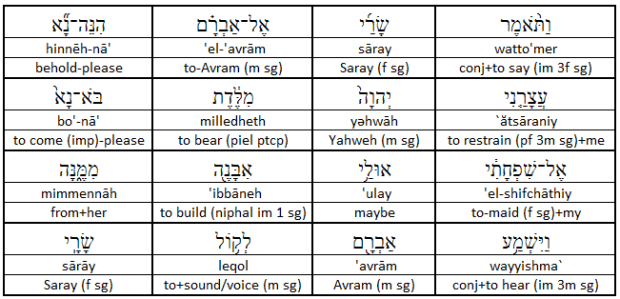
Literally “maybe I can be built from her.”
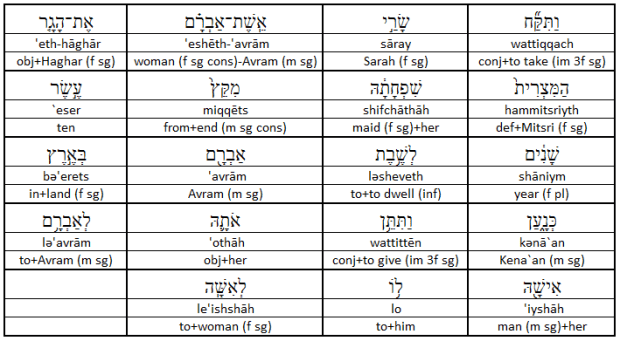
Genesis 16:3 – In the tenth year that they had dwelled in the land of Kena’an, Saray took Haghar the Mitsri and gave her to Avram to be his wife.
Genesis 16:4 – He slept with Haghar, and she conceived. When she noticed that she was pregnant, she cursed her mistress.

Genesis 16:5 – “You’re responsible for my pain,” Saray said to Avram. “I gave my maid to you, and when she saw that she was pregnant, she cursed me. May Yahweh judge between me and you.”
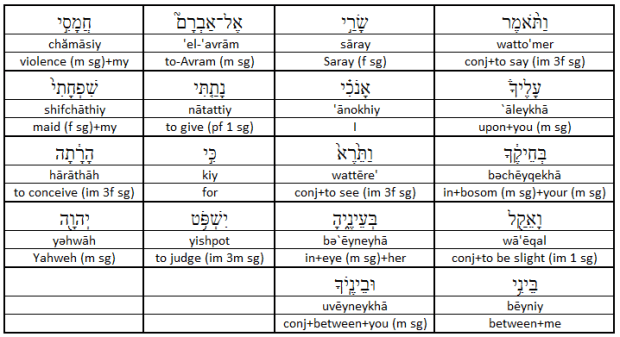
Genesis 16:6 – “Your maid is in your hands,” Avram said. “Do with her what you feel is right.” Saray oppressed her, and Haghar fled.
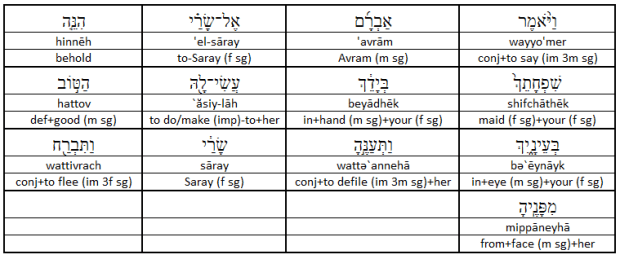
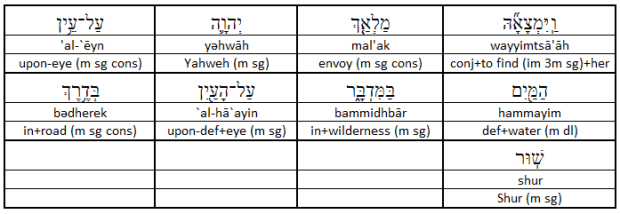
Genesis 16:7 – A messenger of Yahweh found her near a spring in the wilderness along the road to Shur.
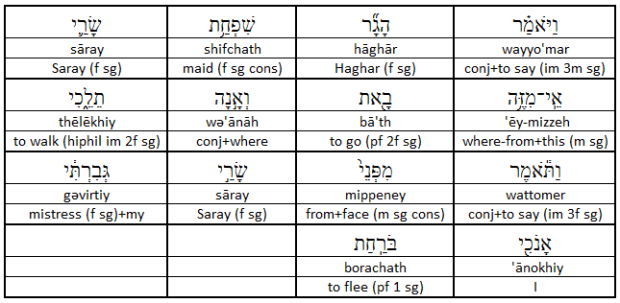
Genesis 16:8 – “Haghar, maid of Saray, where have you come from and where are you going?” he said. “I fled from my mistress Saray,” she said.
Genesis 16:9 – “Return to your mistress and submit to her hand.”
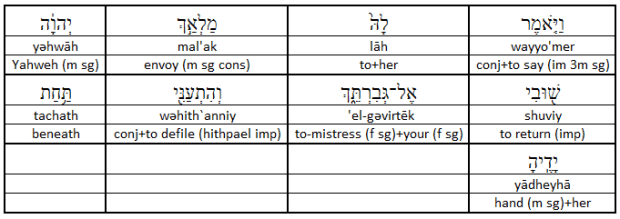
Genesis 16:10 – “I will magnify your seed, and they will be too many to count.”
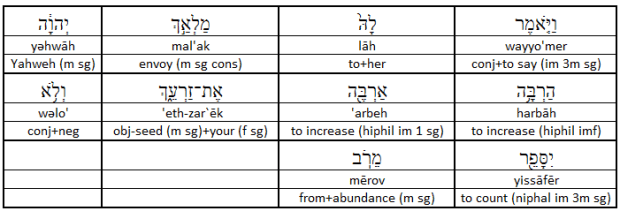
Genesis 16:11 – “You are pregnant, and you will bear a son. You will name him Yishma’el, for Yahweh has heard your misery.
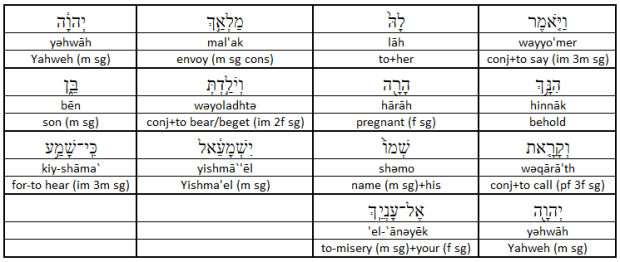
“Yishma’el” means “El has heard.”
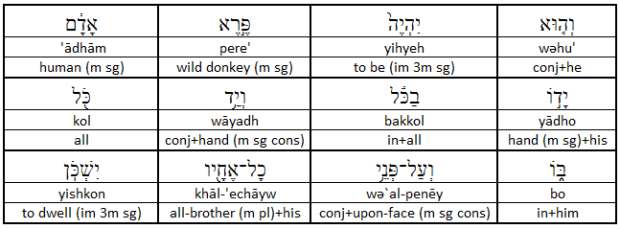
Genesis 16:12 – “He will be a wild donkey of a man. His hand will be against everyone, and everyone’s hand will be against him. He will dwell before all of his brothers.”
Genesis 16:13 – She called upon the name of Yahweh. “You are a god of sight,” she said. “Have I seen the one who sees me?”

Genesis 16:14 – For that reason, the spring between Qadhesh and Baredh is called “The Well of the Living One who Sees Me.”
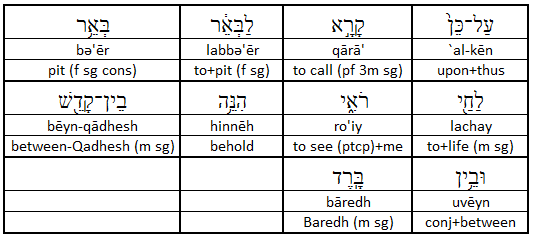
Translating as “spring” to recall the spring mentioned a few verses ago. A “bǝ’er” is a pit or a well. Sometime’s it’s qualified as a “pit of water” or a “pit of tar”, and sometimes not. I would normally translate it as just “pit” in that scenario, but since Haghar is near a spring, I’m going with “well” since we can assume it’s a pit of water.
Genesis 16:15 – Haghar bore Avram a son, and he named him Yishma’el.
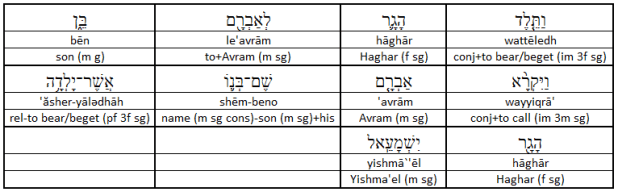
Genesis 16:16 – When Yishma’el was born, Avram was eighty-six years old.

Genesis 17:1 – When Avram was ninety-nine years old, Yahweh appeared to him. “I am the Destroyer,” he said. “Walk before me and be perfect.”
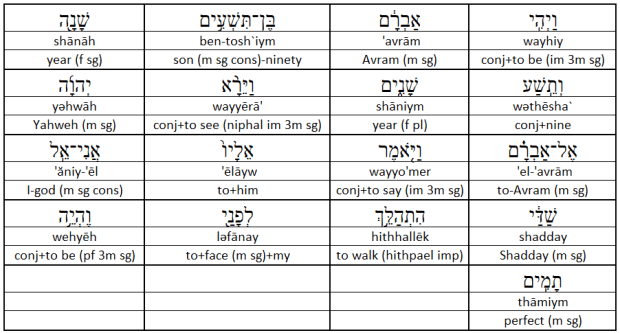
El Shadday, or El Shaddai, is usually translated as “God Almighty.” The real meaning is unknown – it might mean mountains, breasts, or destruction. The structure of El (god) + “something” is pretty common convention in the Near East for naming gods. The second element of the phrase could be a place, a proper name, or a quality.
With the ambiguity here, I’m borrowing the interpretation that “Shadday” comes from “shadad”, which means destroy/waste/spoil (this is the basis for the common English translation, God Almighty). So, El Shadday could be “God of Destruction”, and I’ve taken some liberties here by translating it simply as “the Destroyer.”
Genesis 17:2 – “I will establish my covenant between me and you, and I will magnify you exceedingly.”

Genesis 17:3 – Avram fell upon his face, and Elohim spoke to him.

Genesis 17:4 – “My covenant is with you. You will be the father of an abundance of nations.”
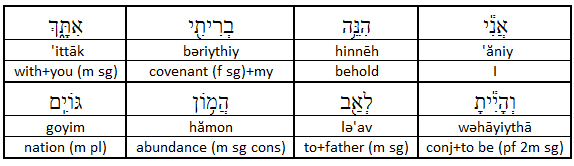
Genesis 17:5 – “You will no longer be named Avram. Your name will be Avraham, for I have made you a father of an abundance of nations.”
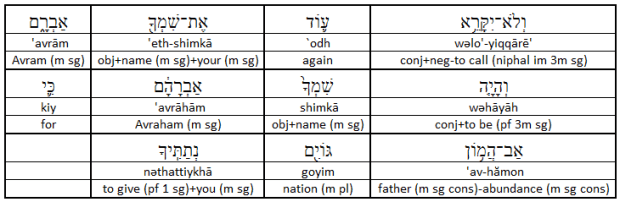
Avram’s new name, Avraham, is usually understood to be a reference to the phrase “av-hamon” (“father of abundance”).
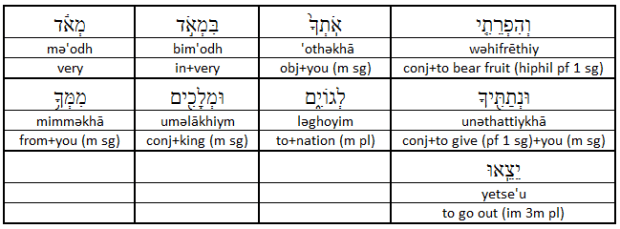
Genesis 17:6 – “I will make you very fruitful. I will make you into nations, and kings will go out from you.”
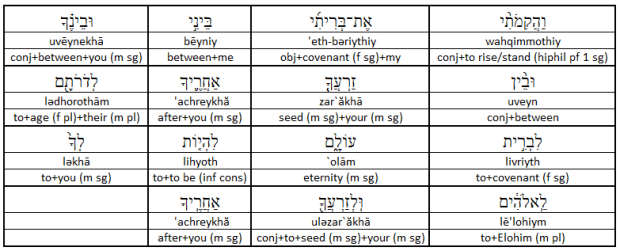
Genesis 17:7 – “I will establish my covenant between me and you and your seed after you forever in their generations, and I will be Elohim to you and your seed after you.”
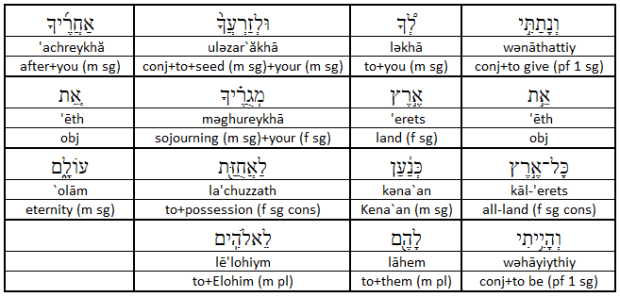
Genesis 17:8 – “I will give the land that you are staying in, all the land of Kena’an, as an eternal possession for you and your seed after you, and I will be Elohim to them.”
Genesis 17:9 – “You will preserve my covenant, you and your seed after you, through their generations.”
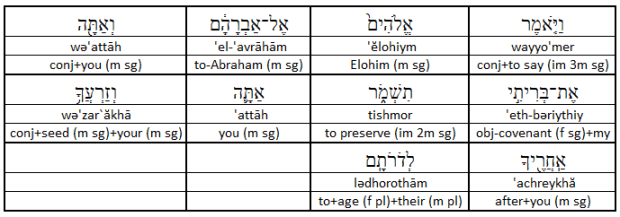
Genesis 17:10 – “This is my covenant which you will keep between me, you, and your seed after you: you will cut all the males among you.”
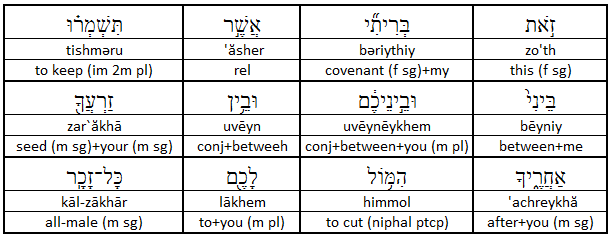
Genesis 17:11 – “You will be cut in the flesh of your foreskin, and it will be a mark of the covenant between me and you.”
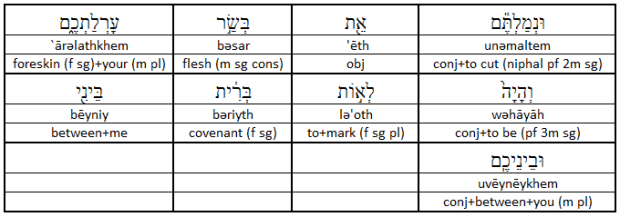
That was a lot of buildup to “cut off your foreskin.”
Genesis 17:12 – “Through your generations, all males among you will be cut on the eighth day, both those born of your house and those purchased with silver from foreigners who are not your seed.”
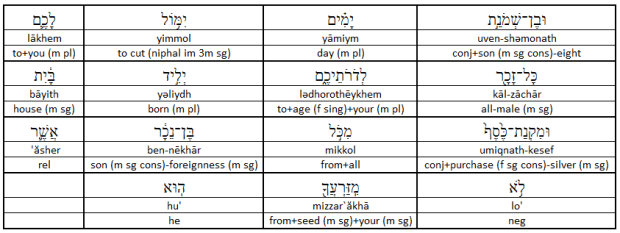
Genesis 17:13 – “Those born of your house or purchased with silver must be cut. My eternal covenant will be in their flesh.”
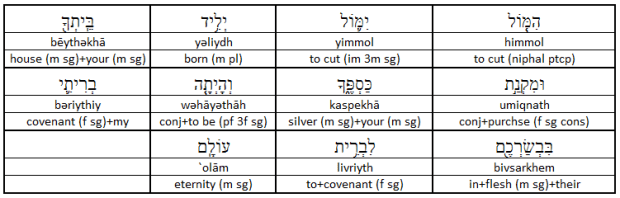
Genesis 17:14 – “Any male whose foreskin is not cut will be cut off from his people, for he has broken my covenant.”

“Arel” above means exposed and is related to the word for foreskin, so more literally “with exposed foreskin” or just “uncircumcised.”
Genesis 17:15 – “Do not call your wife Saray, for Sarah is her name.”
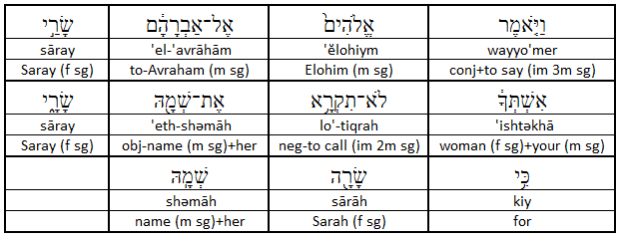
Genesis 17:16 – “I will bless her, and through her I will give you a son. I will bless her, and she will become nations. Kings of nations will come from her.”
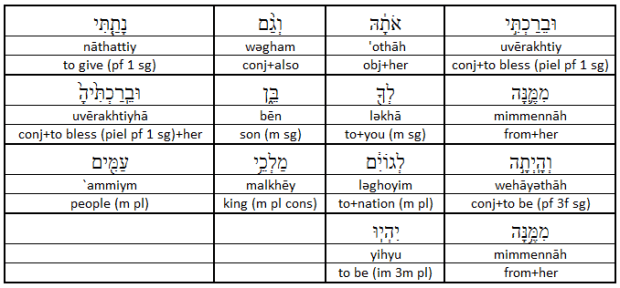
Genesis 17:17 – Avraham fell upon his face and laughed. “Will a son be born to a man who is one hundred years old?” he asked himself. “Will Sarah bear children at ninety?”
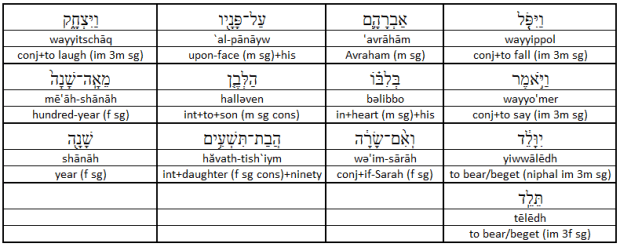
Genesis 17:18 – “If only Yishma’el could live before you,” he said to Elohim.
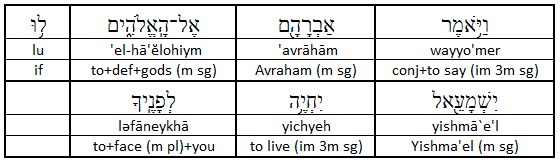
Genesis 17:19 – “Truly, your wife Sarah will bear you a son,” Elohim said. “You will name him Yitschaq, and I will establish my covenant with him, an eternal covenant with his seed after him.”
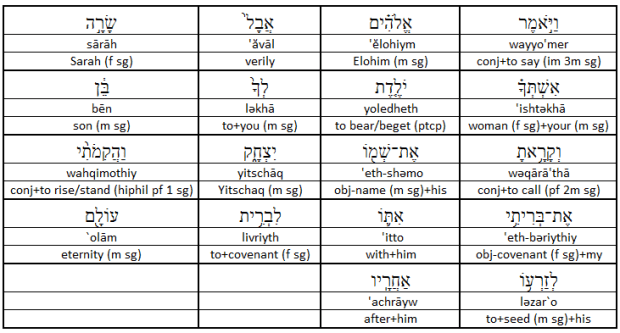
Genesis 17:20 – “As for Yishma’el, I have heard you. I have blessed him. I will make him fruitful and magnify him greatly. He will father twelve lords, and I will make him a great nation.”
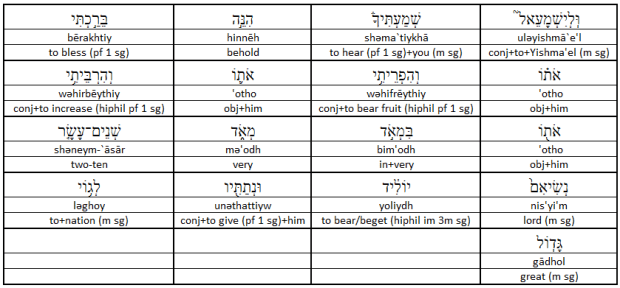
Genesis 17:21 – “But, I will establish my covenant with Yitschaq whom Sarah will bear to you one year from now.”
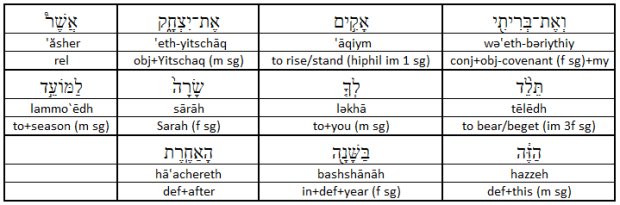
Genesis 17:22 – Elohim finished speaking to Avraham, and he ascended from him.
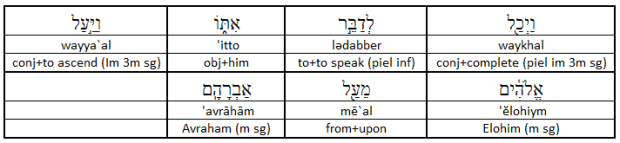
Genesis 17:23 – On that same day, Avraham took all the males of his house – his son Yishma’el, everyone born of his house, and everyone purchased with silver – and he cut the flesh of their foreskin, as Elohim had told him.
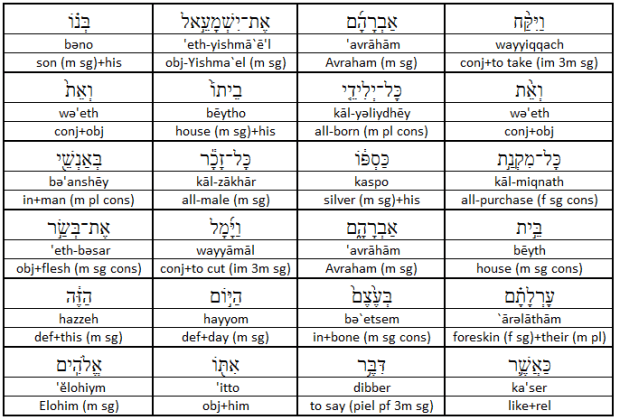
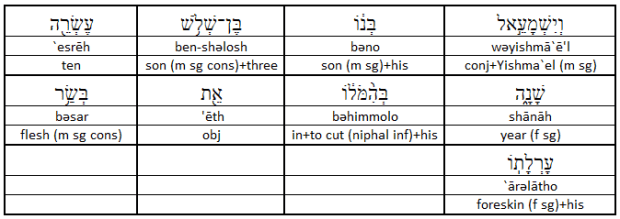
Genesis 17:24 – He was ninety-nine years old when he cut the flesh of his foreskin…

Genesis 17:25 – …and his son Yishma’el was thirteen years old.
Genesis 17:26 – On that very day, Avraham and his son Yishma’el were circumcised…
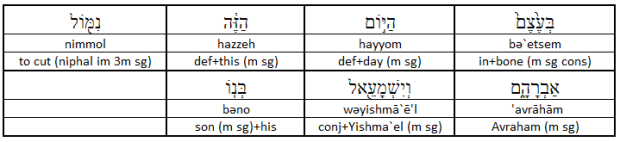
Genesis 17:27 – …along with all of the men born of his house and all of those purchased from foreigners with silver.
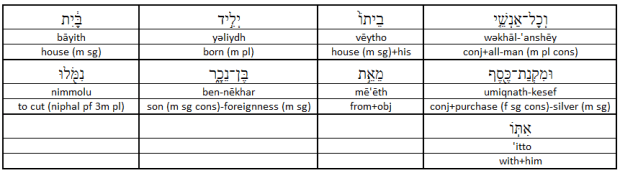
Genesis 18:1 – Yahweh appeared to Avraham at the terebinths of Mamre, while he was sitting near the entrance of his tent in the heat of the day.
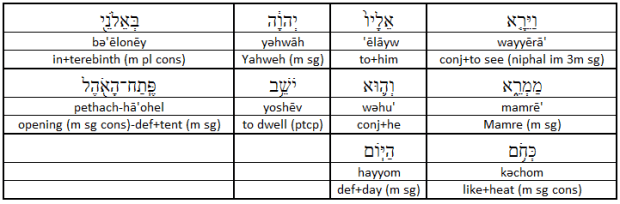
Genesis 18:2 – Avraham looked up, and he saw three men standing near him. He ran from the entrance of his tent to meet them, and he bowed to the ground.

The promise of Yitschaq in Elohist fashion was just made – now follows the Yahwist version of the story. As with the two stories of creation, Elohim is much more distant and “voice from the heavens-y”, while Yahweh actually comes face to face with his audience.
Genesis 18:3 – “My lords,” he said. “If I’ve found favor in your eyes, please don’t pass by your slave.”
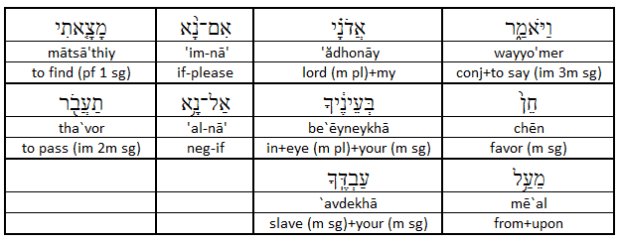
Genesis 18:4 – “Please, let a little water be brought to wash your feet, and rest under the tree.”
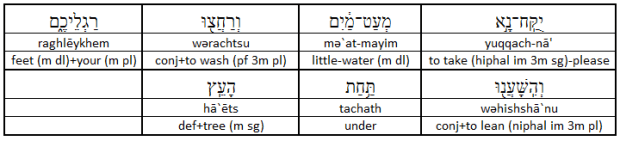
Genesis 18:5 – “I’ll get a little bread to refresh you, and then you can pass on. This is why you’ve come upon your slave.” “Do as you’ve said,” they said.
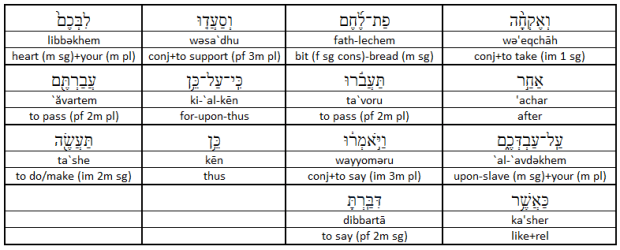
Some food “to support your heart.”
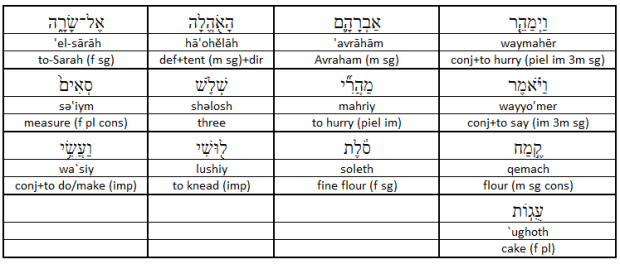
Genesis 18:6 – Avraham hurried into the tent to Sarah. “Quickly knead three measures of fine flour and make cakes,” he said.
Genesis 18:7 – He ran to the cattle and took a good, tender calf, and he gave it to a youth to prepare…
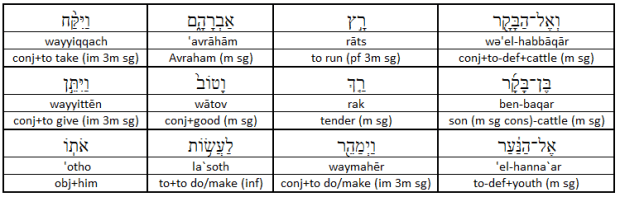
Genesis 18:8 – …then he set curds, milk, and the prepared calf before the men. While they ate, he stood near them beneath the tree.

Genesis 18:9 – “Where is your wife, Sarah?” they said. “She’s in the tent,” Avraham said.

Genesis 18:10 – “I will return to you in this season, and your wife Sarah will have a son.” Sarah heard from the entrance to the tent which was behind them.

The messengers will return “like the time of life”, or this time next year.
Genesis 18:11 – Avraham and Sarah were old, and she was past the age of childbearing.
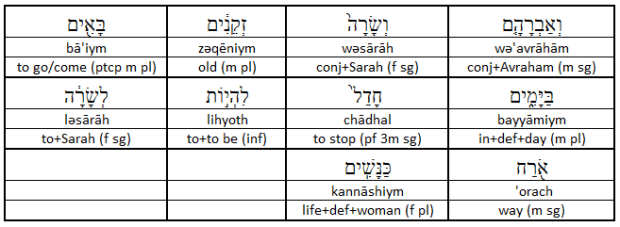
She was no longer in the “way of women.”
Genesis 18:12 – She laughed to herself. “Will I have this pleasure now that I am worn out and my lord is old?” she asked.
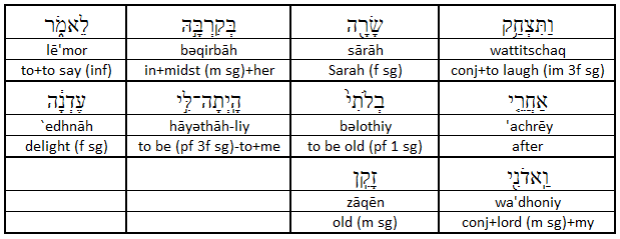
The verb Sarah uses literally means “to wear out.”
Genesis 18:13 – “Why did Sarah laugh?” Yahweh said. “Why did she ask if she would bear a child, even if she is old?”
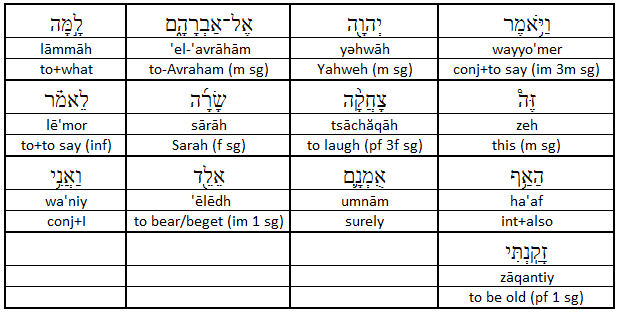
Genesis 18:14 – “Is anything too difficult for Yahweh? I will return to you at this time next year, and Sarah will have a son.”
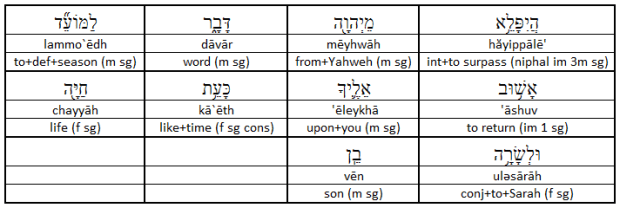
There’s davar (word/thing) again.
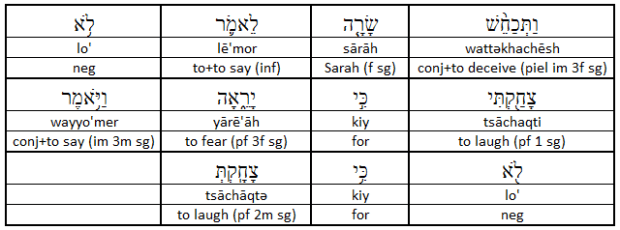
Genesis 18:15 – Sarah denied this. “I did not laugh,” she said, because she was afraid. “No,” he said. “You did laugh.”
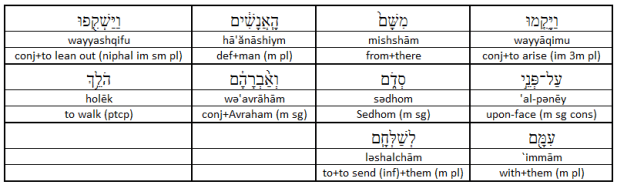
Genesis 18:16 – The men arose from there and looked to Sedhom. Avraham walked with them, to send them off.
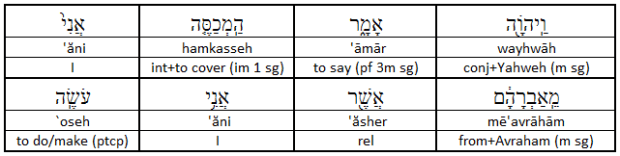
Genesis 18:17 – “Should I hide from Avraham what I am going to do?” Yahweh asked.
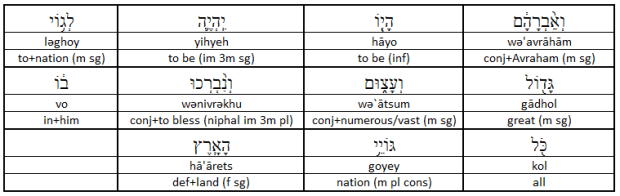
Genesis 18:18 – “Avraham will be a great, vast nation, and all the nations of the land will be blessed through him.”
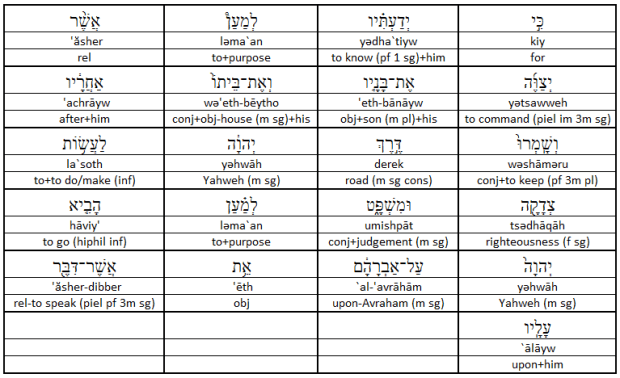
Genesis 18:19 – “I know him, that he will command his sons and his house after him to do righteousness and judgement, so that I can bring upon him the things I’ve spoken of.”
Genesis 18:20 – “The outcry of Sedhom and Amorah is great, and their sin is very heavy.”
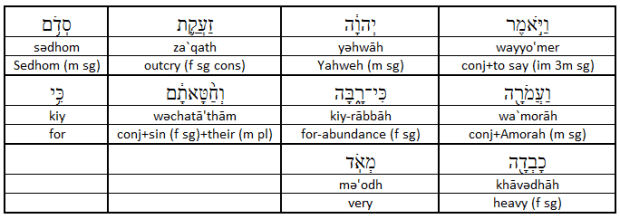
Genesis 18:21 – “I will descend and see if what they have done is as I have heard, and if not, I will know.”
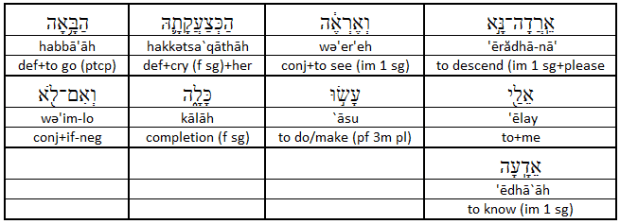
Genesis 18:22 – The men turned from there and went to Sedhom, but Avraham was standing before Yahweh.
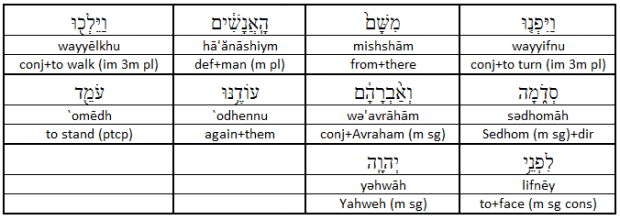
Genesis 18:23 – He approached him. “Will you sweep away the righteous with the wicked?” he asked.
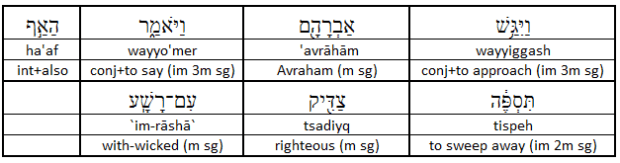
Genesis 18:24 – “Maybe there are fifty righteous ones in the midst of the city. Will you sweep them away and not spare the place for the sake of the righteous?”
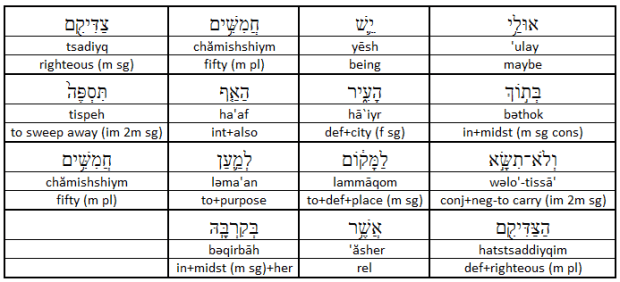
Genesis 18:25 – “Surely you wouldn’t do this, to let the righteous die with the wicked and be treated the same? Shouldn’t the judge of the all the land do what is just?”
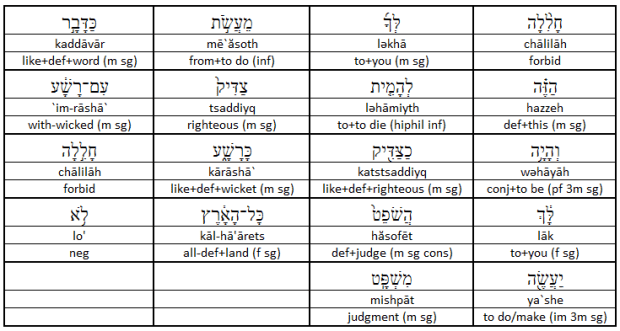
Genesis 18:26 – “If I find fifty righteous people in the midst of the city of Sedhom, I will spare the whole place on their account,” Yahweh said.
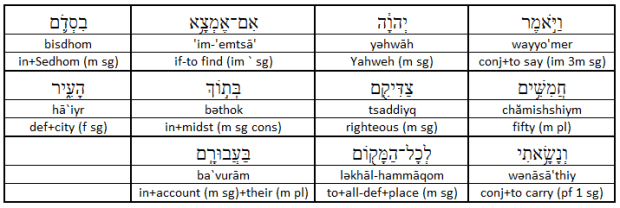
Genesis 18:27 – “I have dared to speak to my lord, though I am dust and ash,” Avraham answered.
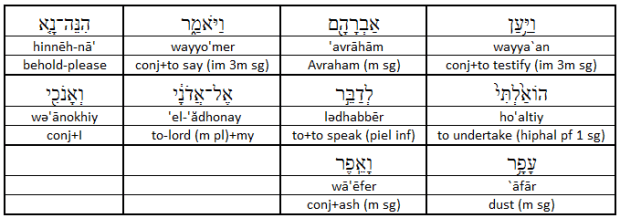
Genesis 18:28 – “What if there are forty five righteous people? Would you destroy the entire city because of those five?” “I will not destroy the city if I find forty five righteous people there.”
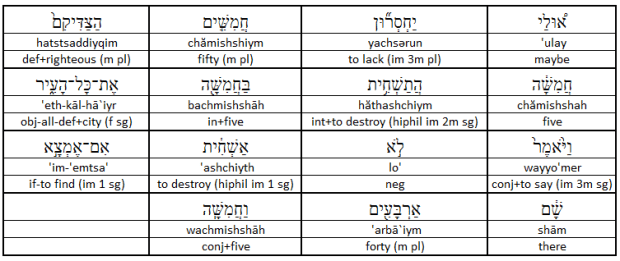
Genesis 18:29 – Again, Avraham spoke to him. “What if forty righteous people are found there?” “I will not destroy the city on account of the forty.”
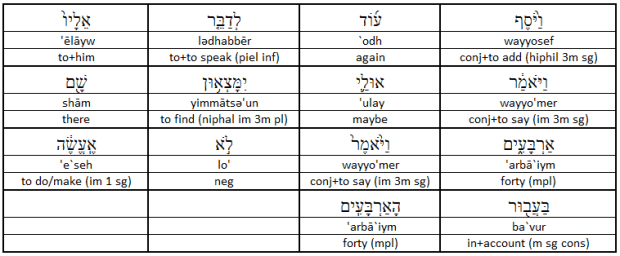
Genesis 18:30 – “May my lord not be angry, and I will speak. What if thirty righteous people are found there?” “I will not destroy the city if I find thirty righteous people there.”
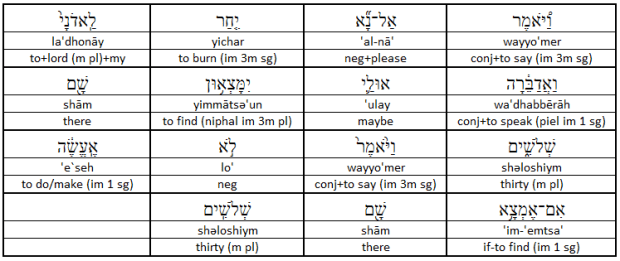
Genesis 18:31 – “I have dared to speak to my lord. What if twenty righteous people are found there?” “I will not destroy the city on account of the twenty.”
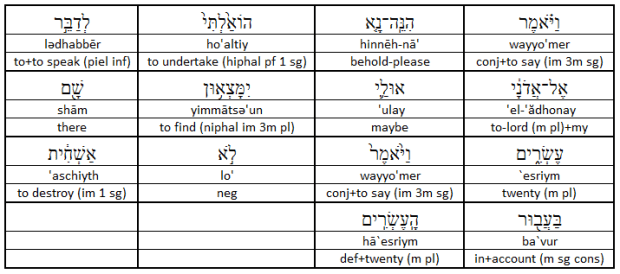
Genesis 18:32 – “May my lord not be angry, and I will speak once more. What if ten righteous people are found there?” “I will not destroy the city on account of the ten.”
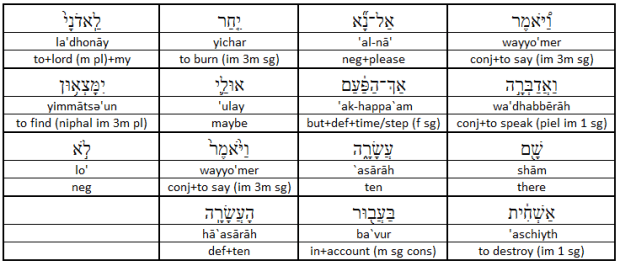
Genesis 18:33 – Yahweh left, as he had finished speaking to Avraham, and Avraham returned home.
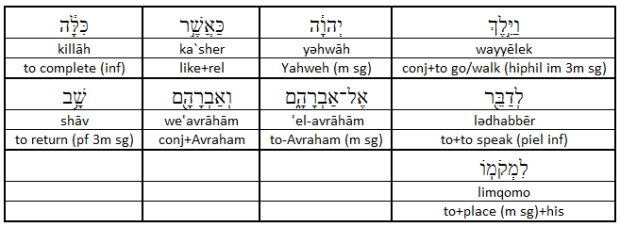
Genesis 19:1 – The two messengers went to Sedhom in the evening, and Lot was dwelling at the gates of the city. When Lot saw them, he stood to call to them, and he bowed low to the ground.
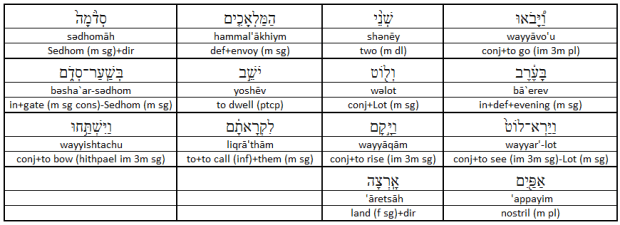
Genesis 19:2 – “Please,” he said. “My lords, turn aside to your slave’s house, lodge, and wash your feet. Then, you may rise early and return to your journey.” “No,” they said. “We will lodge in the square.”

Genesis 19:3 – Lot pressed them, and they turned aside and went into his house. He made a feast and baked matzah, and they ate.
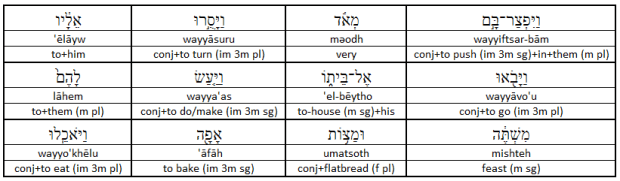
Genesis 19:4 – Before they lay down, all the men of Sedhom, young and old, surrounded the house.
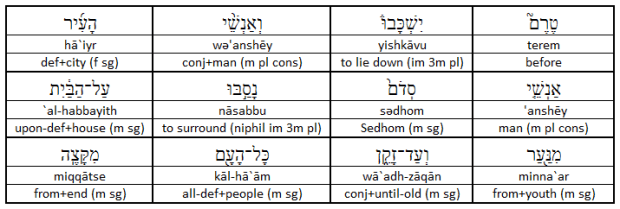
Genesis 19:5 – They called to Lot. “Where are the men who came to you tonight?” they asked. “Bring them to us, so that we can have sex with them.”
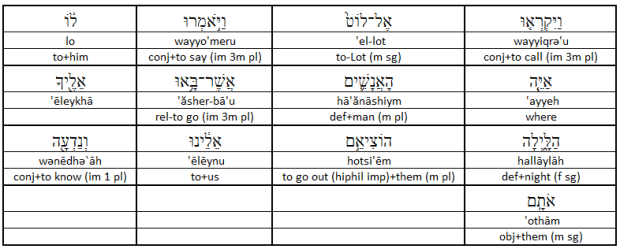
Genesis 19:6 – Lot went outside to them, and he shut the door behind him.
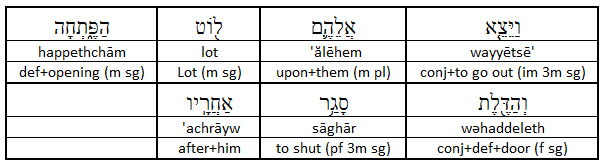
Genesis 19:7 – “Please,” he said. “My brothers, don’t do anything evil.”

Genesis 19:8 – “I have two virgin daughters. I’ll bring them out to you. Do to them what seems right to you, but don’t do a thing to these men, for they are in my care.”
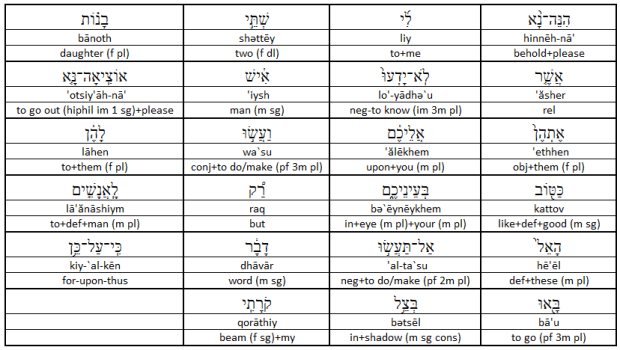
That’s straight up demented. Commentary on the importance of hospitality aside, this guy is more than willing to toss his daughters to an angry, horny mob? Yahweh should have let Lot burn along with the rest of them. I mean, there’s no allegorical hyperbole here.
Genesis 19:9 – “Stand back,” they said. “This one came as a foreigner, and now he judges us. We will do worse to you than them.” They pressed against Lot to break the door.
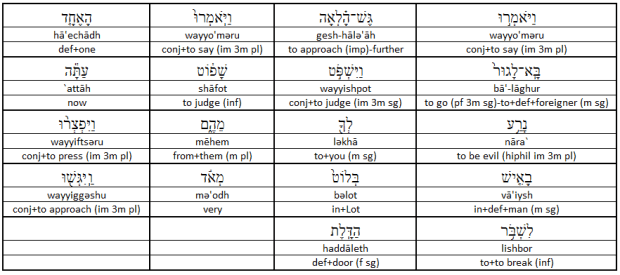
Genesis 19:10 – The two men reached out, pulled Lot into the house with them, and shut the door.

Genesis 19:11 – They blinded the men at the doorway, young and old, and the men exhausted themselves trying to find the door.
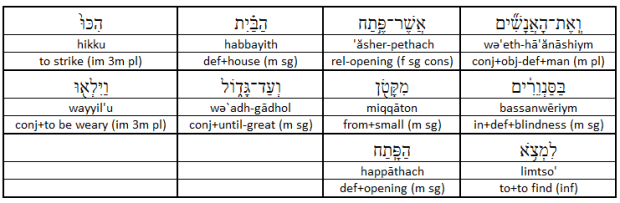
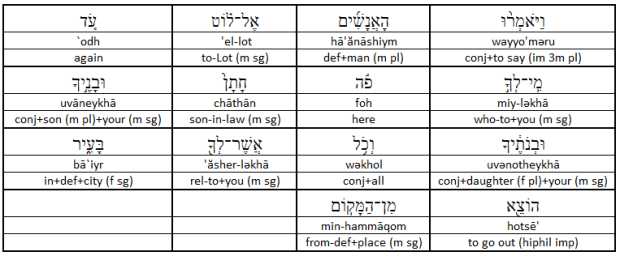
Genesis 19:12 – “Who is here with you?” the two men asked Lot.
“Bring your sons-in-law, sons, daughters, and anyone with you in the city out of this place. “
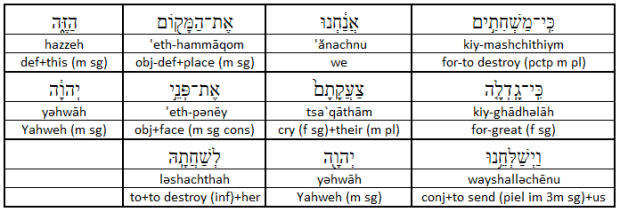
Genesis 19:13 – “We are going to destroy this place, for its outcry is great before Yahweh, and he has sent us to destroy it.”
Genesis 19:14 – Lot went out and spoke to his sons-in-law, the ones married to his daughters. “Rise,” he said. “Get away from this place, for Yahweh is going to destroy the city.” They thought he was joking.

Genesis 19:15 – As dawn rose, the messengers pressed Lot. “Rise,” they said. “Take your wife and your two daughters who are here, lest you are swept away with the city’s iniquity.”
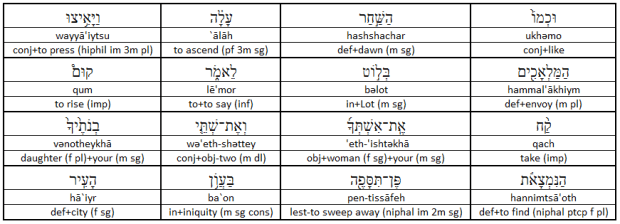
According to some interpretations (the ones that I like and have chosen to follow here), Lot had four daughters, not the usually assumed two.
It goes like this – Lot promises his two virgin daughters, in his house, to the horde of horny men outside (father of the year, huh). He then goes out to his sons-in-law, who were married to his two other daughters. They, however, think Lot is joking – his words are “like laughing in the eyes of his sons-in-law.” They, therefore, stick around and get destroyed with the city. In 19:15, Lot (back in his house) is told to take his two daughters who are with him in the house (the virgins), and they escape. Literally, it’s “your two daughters who are found” – in other words, your daughters here, vs any other daughters elsewhere.
Two married daughters, who stick around, and two unmarried daughters, who leave with him.
Genesis 19:16 – He lingered, and the men grabbed his hand, his wife’s hand, and his two daughters’ hands, for he had Yahweh’s compassion, and they led them outside the city.
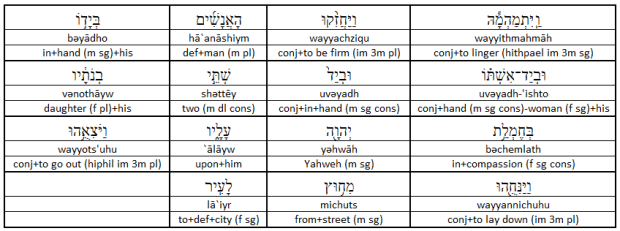
Genesis 19:17 – “Run for your life,” one of them said when they were outside the city. “Don’t look back, and don’t stop anywhere in the plain. Escape to the mountains, lest you be swept away.”

Genesis 19:18 – “Please, my lords,” Lot said.
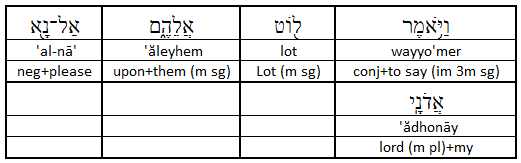
Genesis 19:19 – “Your slave has found favor in your eyes, and in saving my life you have been exceedingly kind to me, but I am unable to escape to the mountains. Evil will cling to me, and I will die.”
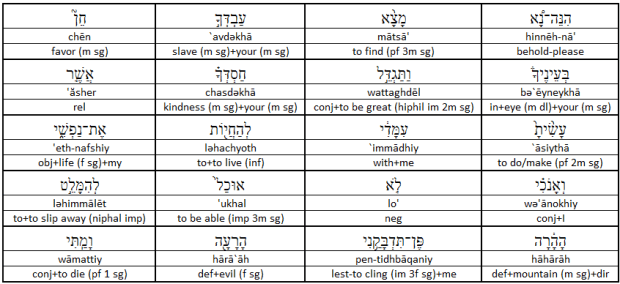
Genesis 19:20 – “This city is near enough to escape to, and it’s small, isn’t it? Please, let me escape there and my life will be saved.”
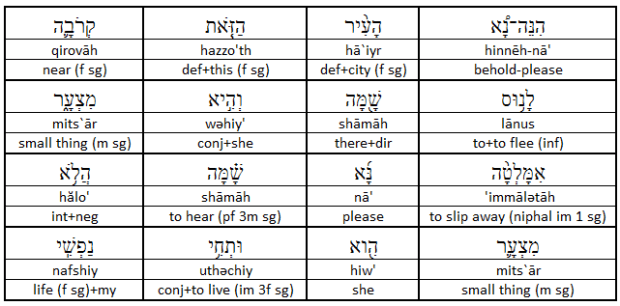
Genesis 19:21 – “I accept this,” he said. “I will not overturn this city you speak of.”
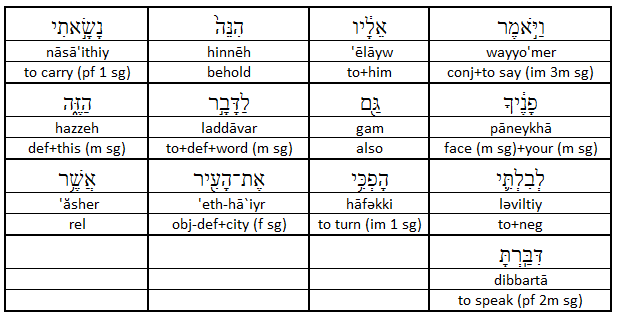
Genesis 19:22 – “Hurry and escape there, for until you do, I cannot do anything.” This is why the city is called Tso’ar.
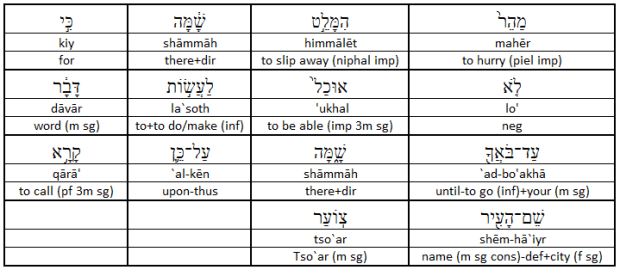
Tso’ar doesn’t get its name until this moment – in prior verses, its name is used anachronistically, and it is mentioned that the original name of the city was Bela. Tso’ar means “small”, related to Lot’s speech earlier when he refers to the city as small/mits’ar.
Genesis 19:23 – The sun had risen over the land when Lot came to Tso’ar.
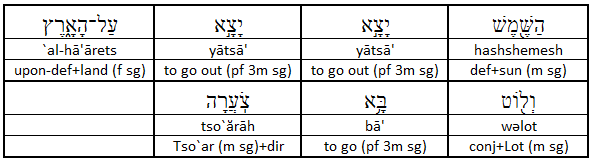
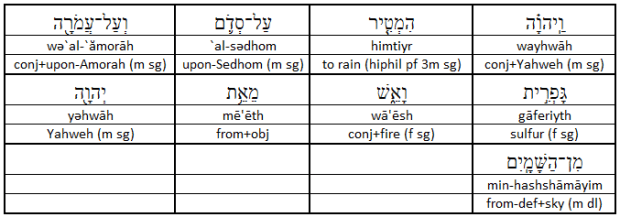
Genesis 19:24 – Yahweh rained sulfur and fire from the sky upon Sedhom and Amorah.
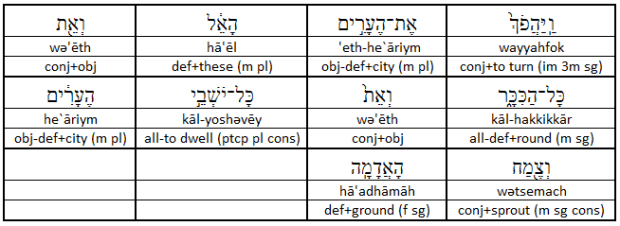
Genesis 19:25 – He overthrew the cities, the entire plain, all who dwelled in the cities, and all that sprouted from the ground.
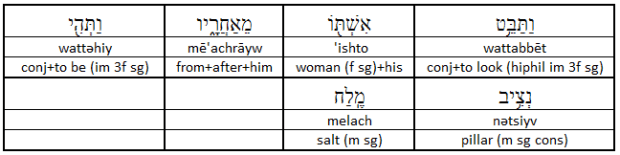
Genesis 19:26 – His wife looked back, and she became a pillar of salt.
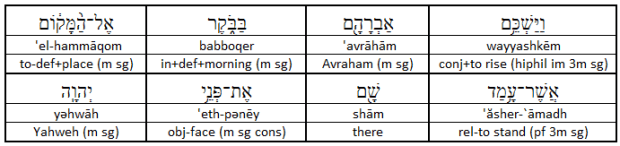
Genesis 19:27 – Avraham rose in the morning and went to the place where he had stood before Yahweh.
Genesis 19:28 – He looked toward Sedhom, Amorah, and all the land of the plain, and he saw fumes rising from the land like a kiln.
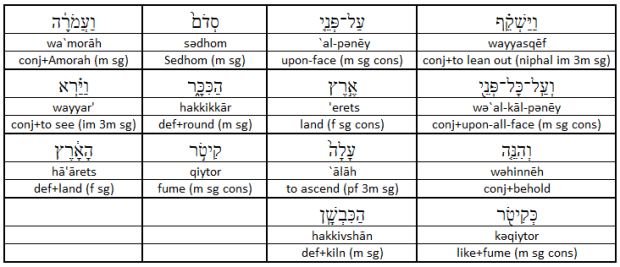
Genesis 19:29 – When Elohim destroyed the cities of the plain, he remembered Avraham, and he sent Lot from the midst of the destruction that overthrew the cities where he lived.
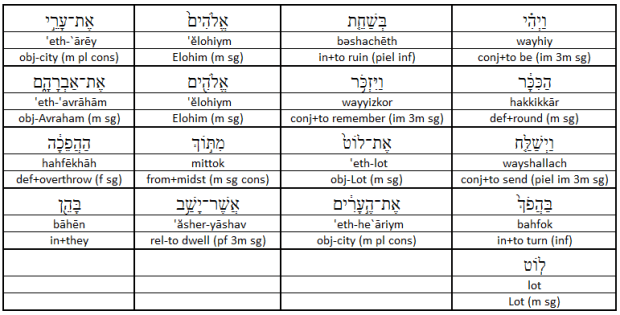
Genesis 19:30 – Lot left Tso’ar and dwelled in a cave in the mountains with his two daughters, for he was afraid to dwell in Tso’ar.
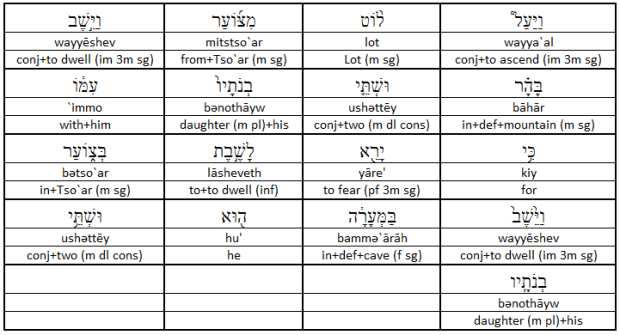
Mountains or Tso’ar, Lot, make up your mind.
Genesis 19:31 – “Our father is old,” the firstborn said to the younger. “There is no man in the land who can marry us, as is the custom everywhere.”
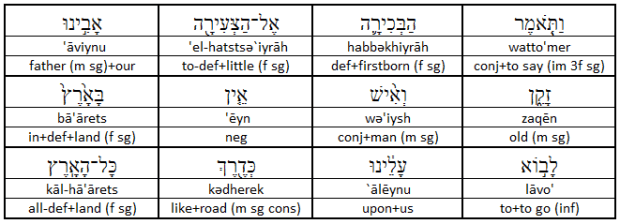
Kind of a strange phrasing, but they’re basically saying that there aren’t any men to marry them now (I feel like there are bigger concerns when you’re living in a cave, your mother is a pillar of salt, and everyone and everything you know is dead and destroyed, but whatever). “There isn’t a man in the land to go upon us, as is the road/way of all the land.”
Genesis 19:32 – “Come, let’s give our father wine, and then we can sleep with him and preserve our seed through our father.”
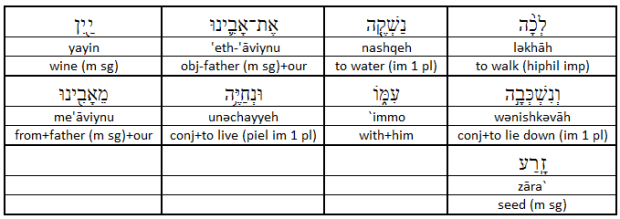
This freaking family. They were the ones worth saving?
Genesis 19:33 – That night, they gave their father wine. The firstborn went and slept with her father, and he didn’t know when she lay and when she rose.
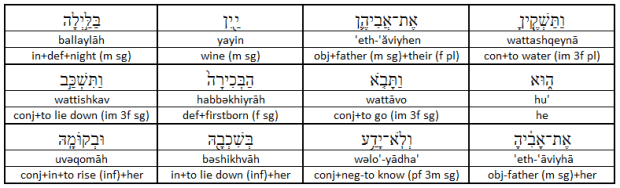
Genesis 19:34 – “I slept with my father last night,” the firstborn said to the younger in the morning. “Tonight we’ll give him more wine. Go, sleep with him, and we will preserve our seed through our father.”

Genesis 19:35 – That night, they gave wine to their father again. The younger one went and slept with him, and he didn’t know when she lay and when she rose.
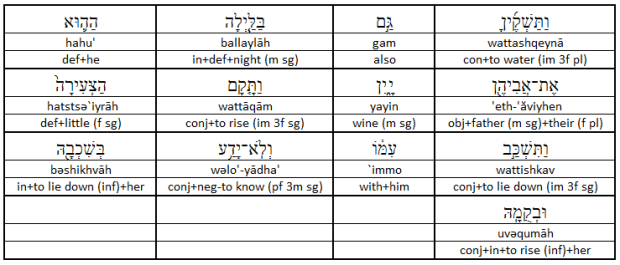
Genesis 19:36 – The two daughters of Lot conceived by their father.

Genesis 19:37 – The firstborn bore a son, and she named him Mo’av. He is the father of Mo’av today.
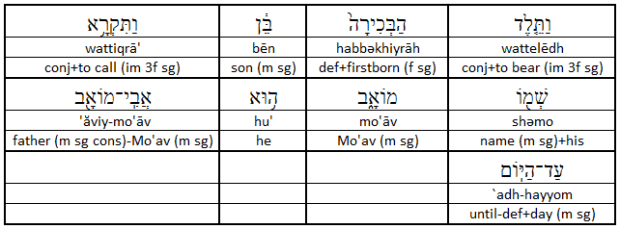
Genesis 19:38 – The younger also bore a son, and she named him Ben-Ammiy. He is the father of Ammon today.
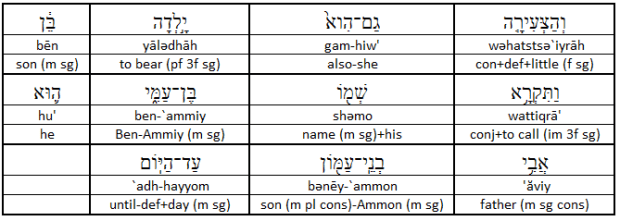
Two nations are said to descend from Lot – Mo’av, through Mo’av, and Ammon, through Ben-Ammiy. Their placement in the family tree so close to Avraham reflects the degree of similarity they share with Israel/Judah. The Moabites and Ammonites were neighbors and rivals to Israel and Judah, and I’ve heard it suggested before that this story was designed to disparage their origins.
Genesis 20:1 – Avraham journeyed from there and went toward the land of the Neghev. He dwelled between Qadhesh and Shuv, and then he stayed in Gerar.
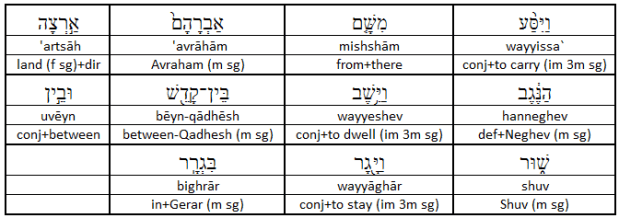
Genesis 20:2 – “She is my sister,” Avraham said concerning Sarah, his wife. Avimelek, king of Gerar, sent for her and took her.

This sounds familiar – it’s essentially a (slightly lazier) retelling of the previous debacle in Egypt.
Genesis 20:3 – Elohim came to Avimelek in a dream one night. “You will die, because of the woman you took,” he said. “A lord already rules over her.”
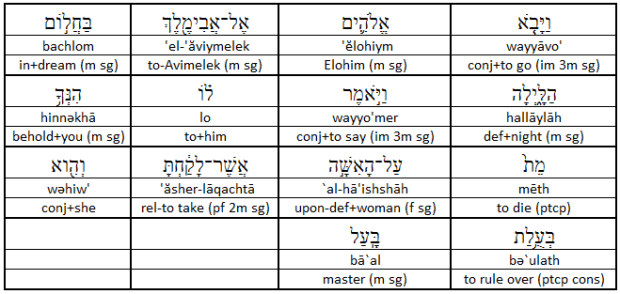
Essentially, Elohim is saying that Sarah is a married woman. The word typically used for husband, ba’al, means “lord/master”, and the word often translated here as “married” comes from the same root, meaning dominion. Alternatively, as you may have noticed, the word typically used for “wife” is just the same word as “woman.” A wife is a “woman”, a husband is a “lord.” The Hebrews were not trailblazers of egalitarianism.
Genesis 20:4 – Avimelek had not approached her. “My lord,” he said. “Would you destroy a righteous nation?”
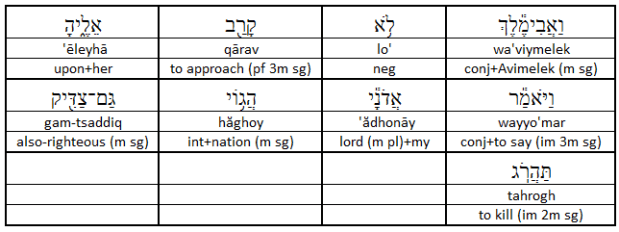
Genesis 20:5 – “Didn’t he tell me that she is his sister? And didn’t she say that he is her brother? I’ve done this with an innocent heart and pure hands.”
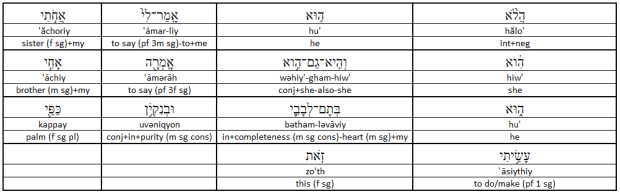
Genesis 20:6 – “I know that you did this with an innocent heart,” Elohim said. “I withheld you from sinning against me. That’s why I didn’t let you touch her.”
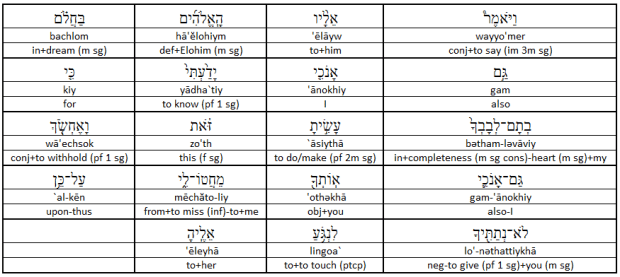
Genesis 20:7 – “Now, return the man’s wife, for he is a prophet. He will intervene for you, and you will life. If you do not return her, know that you and all your people will surely die.”
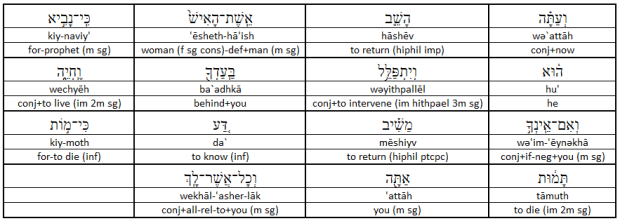
Genesis 20:8 – Avimelek rose in the morning. He called all his slaves and repeated all of these words, and they were terrified.

Genesis 20:9 – Avimelek called Avraham. “What did you do to us?” he asked. “What sin have I committed against you, that you would bring such a great offense on me and my kingdom? You have done things to me which should not be done.”
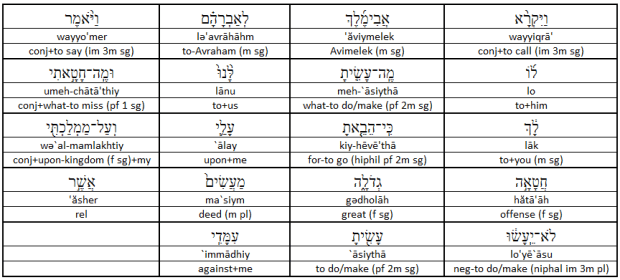
Genesis 20:10 – “What did you see that made you do this?”
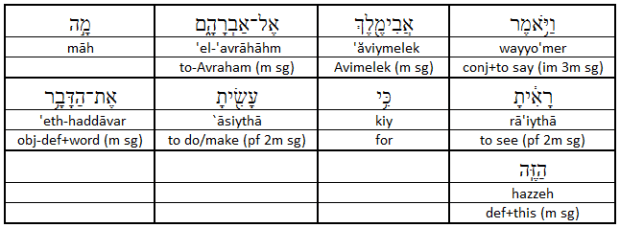
Genesis 20:11 – “I said, ‘there is no fear of Elohim in this place,'” Avraham said. “They will kill me because of my wife.”
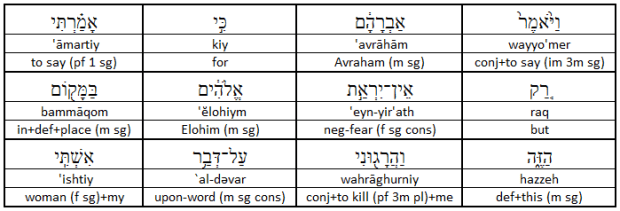
Genesis 20:12 – “And truly, she is my sister, the daughter of my father, but not the daughter of my mother, so I married her.”
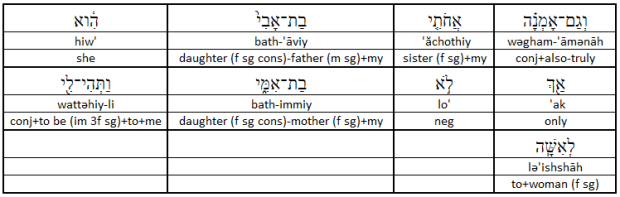
Genesis 20:13 – “When the gods made me wander away from the house of my father, I said to her, ‘This is your kindness you can do for me: everywhere we go, say that I am your brother.'”
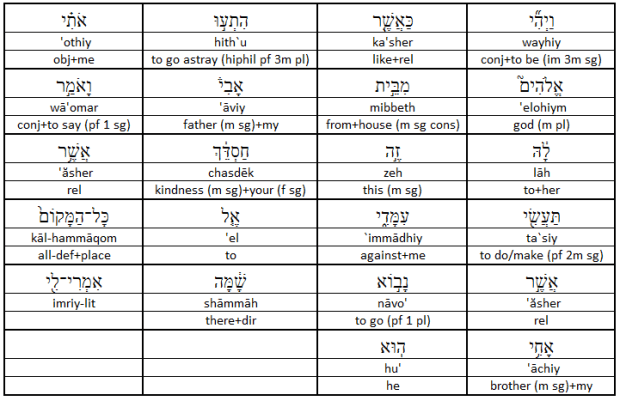
Normally, Elohim (a plural noun) is understood as a singular because its verbs are in the singular. Here, however, the associated verb “hith’u” is plural. It means “to go astray” in the hiphil form, which changes the meaning to “cause to go astray.” So, “the gods caused me to go astray.”
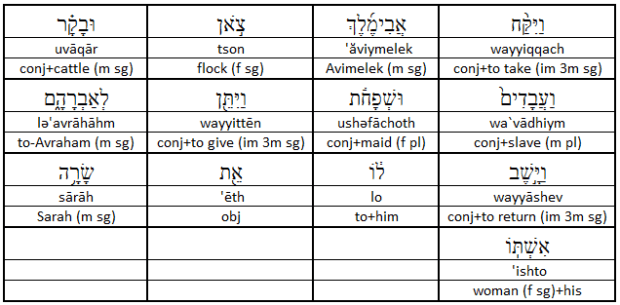
Genesis 20:14 – Avimelek took sheeps, cattle, slaves, and maids, and he gave them to Avraham, and he returned Sarah, his wife, to him.
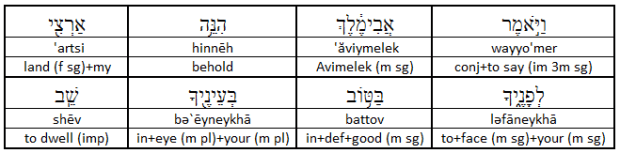
Genesis 20:15 – “My land is before you,” Avimelek said. “Dwell wherever you see fit.”
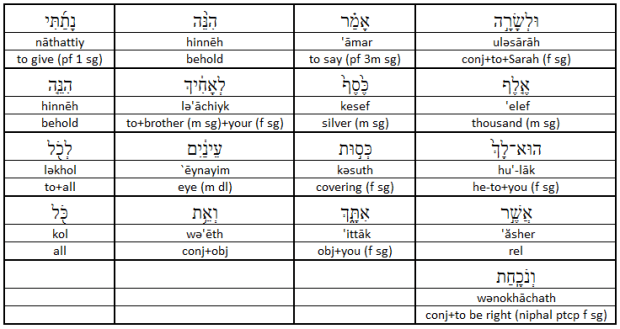
Genesis 20:16 – “I’ve given one thousand pieces of silver to your brother,” he said to Sarah. “It is a covering of the eyes, before everybody here.” She was vindicated.
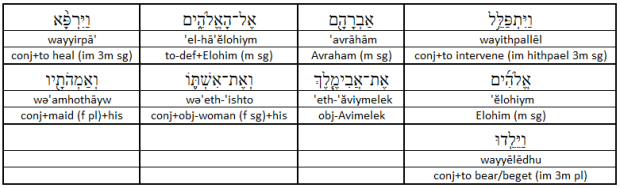
Genesis 20:17 – Avraham prayed to Elohim, and Elohim healed Avimelek, his wife, and his maids, and they bore children…
Genesis 20:18 – …for Yahweh had closed up all of the wombs of Avimelek’s house because of Sarah, Avraham’s wife.
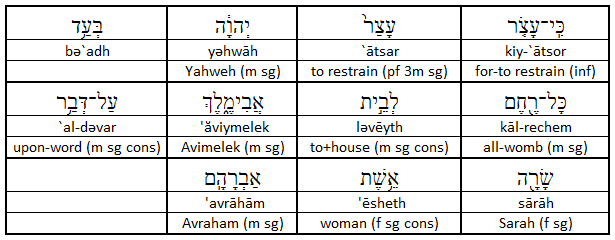
Genesis 21:1 – Yahweh visited Sarah, as he had said, and did to her as he had spoken.
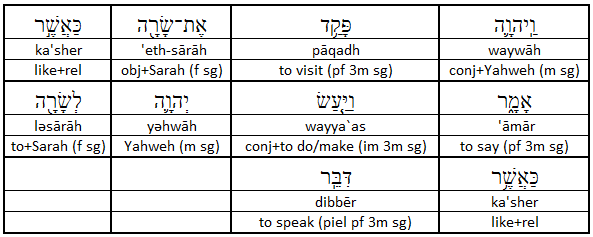
Genesis 21:2 – She conceived, and she bore a son to Avraham in his old age, at the time Elohim had mentioned.

Genesis 21:3 – Avraham named his son whom Sarah had borne Yitschaq.

Genesis 21:4 – On the eighth day, he cut his son Yitschaq, as Elohim had commanded him.

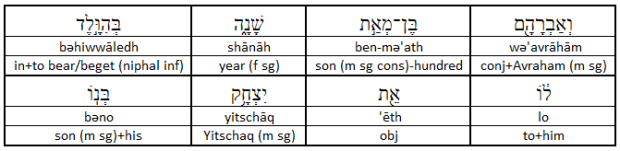
Genesis 21:5 – He was 100 years old when his son was born.
Genesis 21:6 – “Elohim has given me laughter,” Sarah said. “Everyone who hears this will laugh with me.”
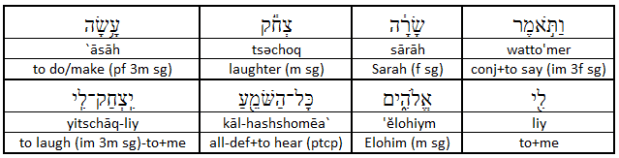
“Yitschaq” is the third person imperfect masculine singular of “to laugh.”
Genesis 21:7 – “Who would have said to Avraham that Sarah would nurse children? Yet, I have borne him a son in his old age.”
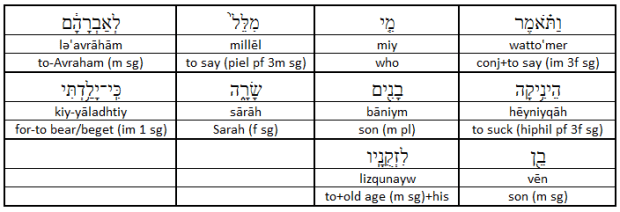
Genesis 21:8 – The child grew and was weaned, and Avraham made a great feast on the day that Yitschaq was weaned.
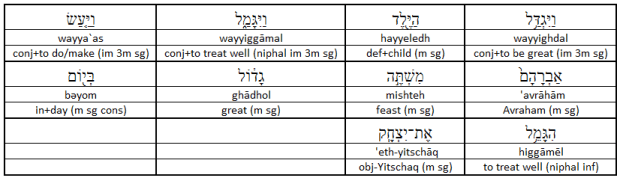
The verb translated “to treat well” has the sense of something doing something else well, and from that, ripening/growing/reward.
Genesis 21:9 – Sarah saw the son of Haghar the Mitsri, whom she had borne to Avraham, laughing.

Presumably, Yishma’el is mocking Yitschaq.
Genesis 21:10 – “Drive out this maid and her son,” she said to Avraham. “The son of this maid will not inherit alongside my son, Yitschaq.”

Genesis 21:11 – This greatly afflicted Avraham, for the sake of his son.
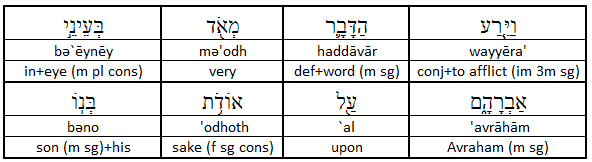
Genesis 21:12 – “Don’t be upset because of the youth or your maid,” Elohim said to Avraham. “Listen to everything Sarah tells you, for it is through Yitschaq that your seed will be named.”
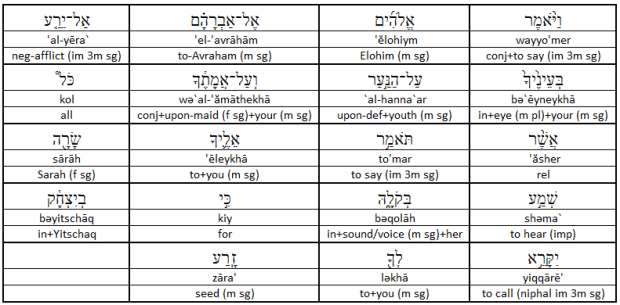
Genesis 21:13 – “I will make your maid’s son a nation as well, for he is your seed.”

Genesis 21:14 – Avraham rose in the morning. He took bread and a skin of water, and he gave them to Haghar, and he put the child on her shoulder. He sent her away to wander in the wilderness of the Pit of the Oath.
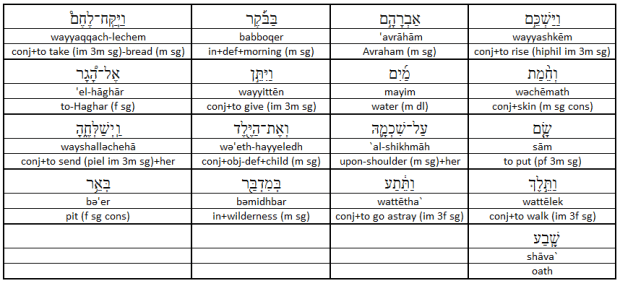
“Be’er Shava” (usually Beersheba in English) has an unclear meaning – the second component could mean either “oath” or “seven.” The act of swearing, in Hebrew, means to “sevens oneself.”
Weirdly, Yishma’el should be at least 14 – when he was born, Avraham was 86, and when Yitschaq was born, he was 100. Here, Avraham puts Yishma’el on his mother’s shoulder, implying that he’s far younger.
Genesis 21:15 – When the water from the skin was gone, Hagher threw the child beneath a shrub.

Genesis 21:16 – She walked off and sat a bowshot away. “I won’t watch the child die,” she said, and she raised her voice and wept.
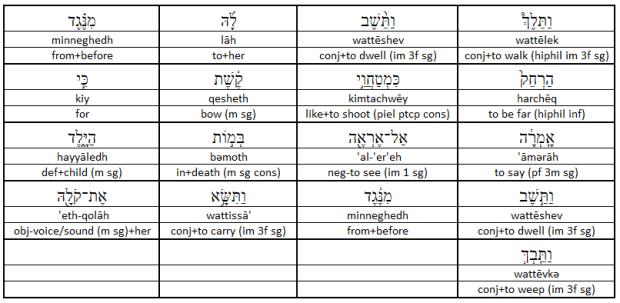
Genesis 21:17 – Elohim heard the youth’s voice, and the messenger of Elohim called to Haghar from the skies. “What’s wrong, Haghar?” he asked. “Don’t fear, for Elohim has heard the youth’s voice.”
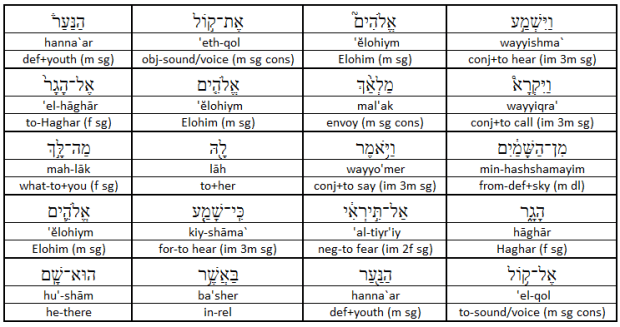
Genesis 21:18 – “Rise. Carry the youth. Hold him in your hand, for I will make him a great nation.”
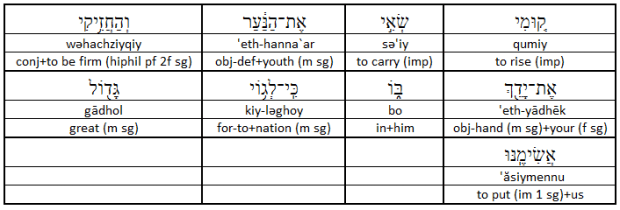
Genesis 21:19 – Elohim opened her eyes, and she saw a well. She went and filled the skin with water, and gave a drink to the youth.
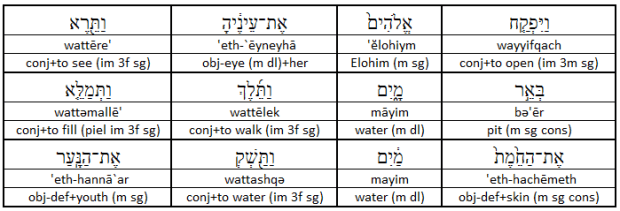
Genesis 21:20 – Elohim was with him. He grew and dwelled in the wilderness, and became a great archer.

Genesis 21:21 – He dwelled in the wilderness of Pa’ran, and his mother gave him a wife from the land of Mitsrayim.
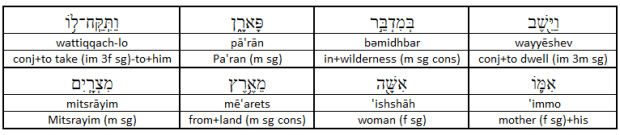
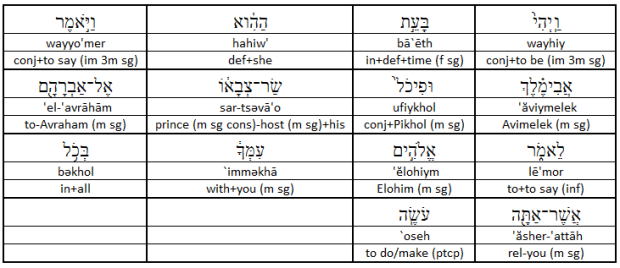
Genesis 21:22 – “Elohim is with you in all that you do,” said Avimelek and Pikhol, the prince of his hosts, to Avraham at that time.
Genesis 21:23 – “Now, swear to me here by Elohim that you won’t cheat me or my offspring. Show the same kindness to me and to the land that you’re staying in that I have shown to you.”
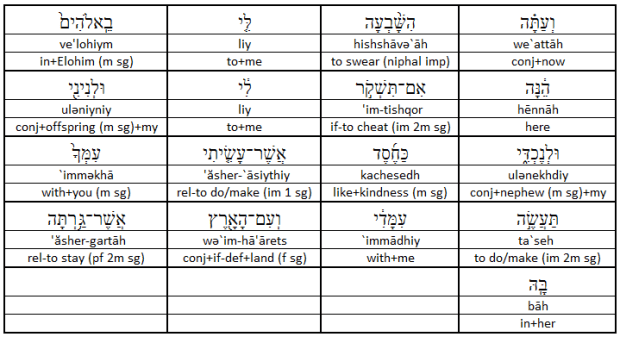
Genesis 21:24 – “I swear,” said Avraham.

Genesis 21:25 – Avraham complained to Avimelek because his slaves had seized a well.

Genesis 21:26 – “I don’t know who did this,” Avimelek said. “You did not tell me, and I didn’t hear about it until today.”
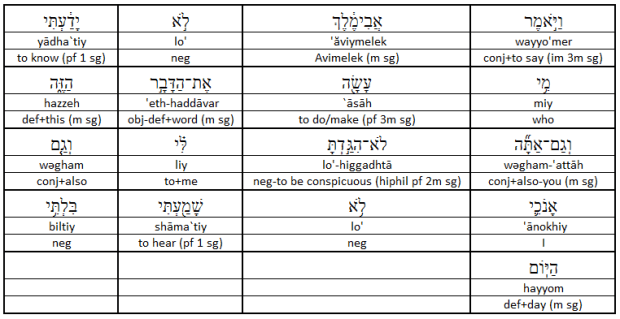
Genesis 21:27 – Avraham took sheep and cattle and gave them to Avimelek, and they made a covenant.

Genesis 21:28 – Avraham set seven lambs from the flock by themselves.
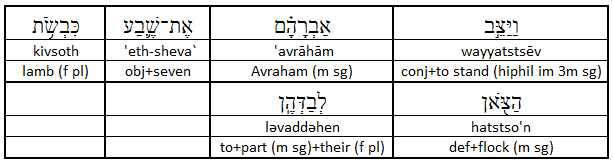
Genesis 21:29 – “What are these seven lambs that are set by themselves?” asked Avimelek.
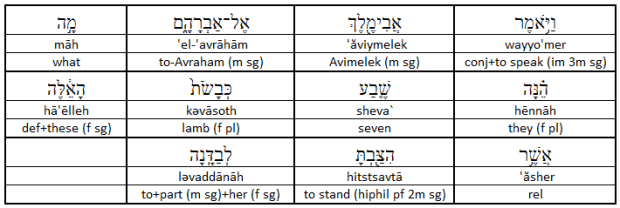
Genesis 21:30 – “Take these seven lambs from me as a testimony that I dug this well.”
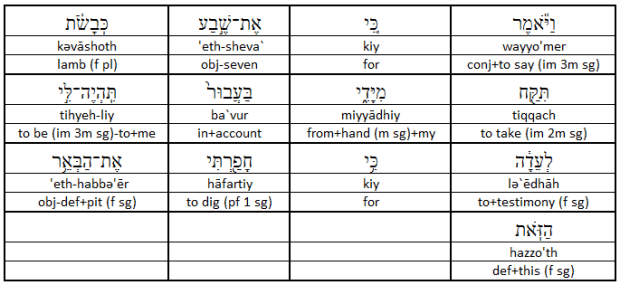
Genesis 21:31 – For this reason, that place is called the Pit of the Oath, for the two of them swore an oath there.
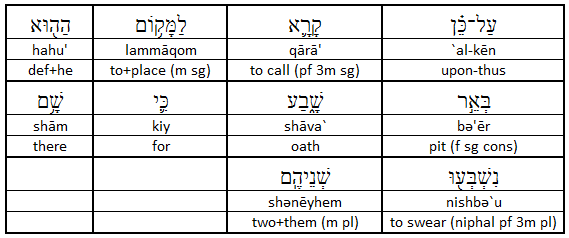
Genesis 21:32 – They made a covenant at the Pit of the Oath. Avimelek and Pikhol, prince of his hosts, rose and returned to the land of the Pelishtim.
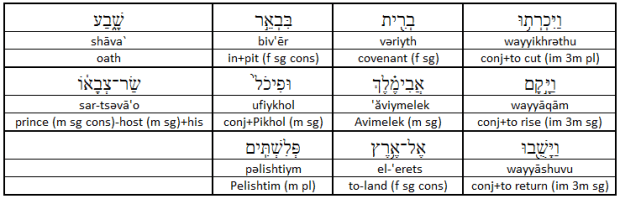
Pelishtim, or Philistines – same root as Palestine.
Genesis 21:33 – Avraham planted a tamarisk at the Pit of the Oath, and he called upon the name of Yahweh El Olam.

El Olam – god of eternity, the eternal god, or the eternal El.
Genesis 21:34 – Avraham stayed in the land of the Pelishtim for many days.
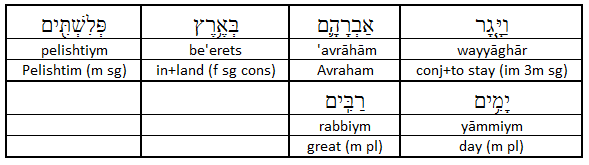
Genesis 22:1 – After these things had happened, Elohim tested Avraham. “Avraham,” he said. “I am here,” Avraham said.
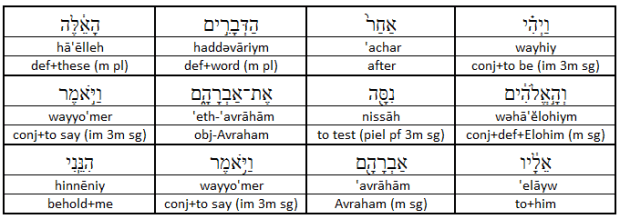
Genesis 22:2 – “Take your only son Yitschaq, whom you love, and travel to the land of Moriyyah. There, raise him up as a sacrifice upon the one of the mountains that I will show you.”
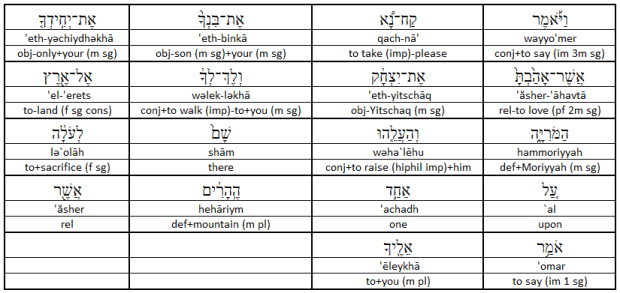
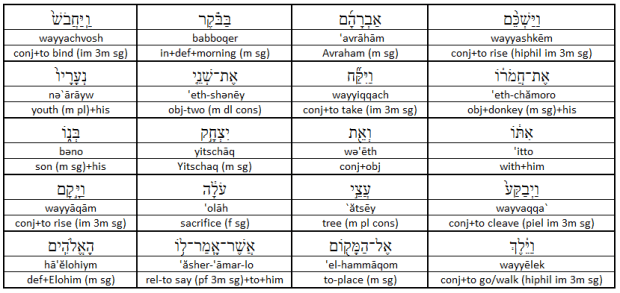
Genesis 22:3 – In the morning, Avraham got up early and saddled his donkey, and he took two youths and his son Yitschaq with him. He cut wood for the sacrifice, and then he rose and went to the place that Elohim had told him about.
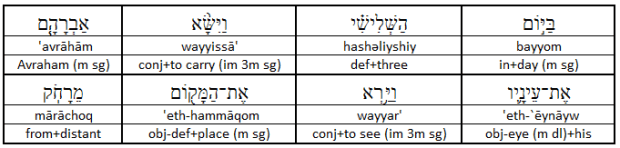
Genesis 22:4 – On the third day, Avraham looked up and saw the place from a distance.
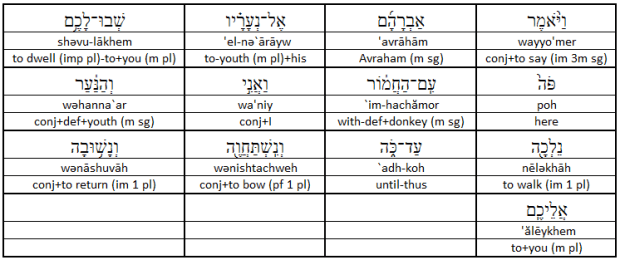
Genesis 22:5 – “Wait here with the donkey,” Avraham said to the youths. “The youth and I will go up there, prostrate ourselves, and return to you.”
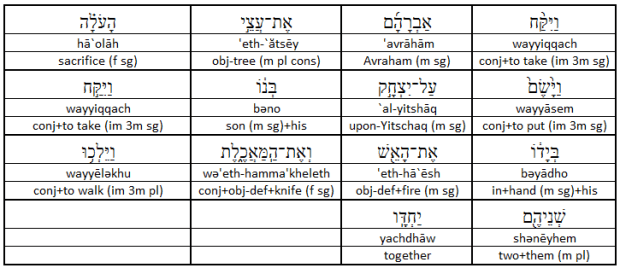
Genesis 22:6 – Avraham took the wood for the sacrifice, and he put it on his son Yitschaq. He took the fire and the knife, and the two of them left together.
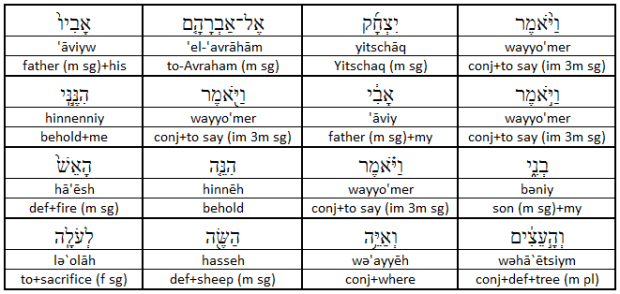
Genesis 22:7 – “Father,” Yitschaq said to Avraham. “I’m here, my son,” Avraham said. “I see the fire and the wood, but where is the sheep for the sacrifice?”
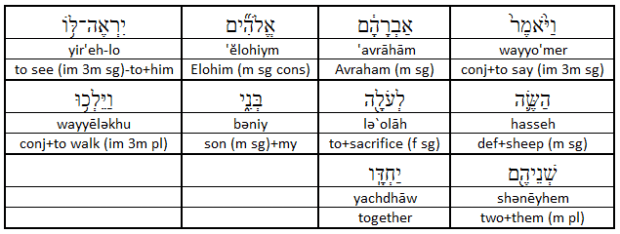
Genesis 22:8 – “Elohim will provide the sheep for the sacrifice, my son.” The two of them walked together.
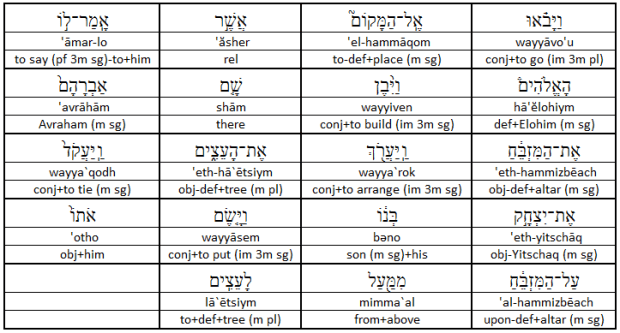
Genesis 22:9 – They came to the place Elohim had told him about, and Avraham built an altar there. He arranged the wood, and he tied up Yitschaq his son. He then put him on the altar, on top of the wood.
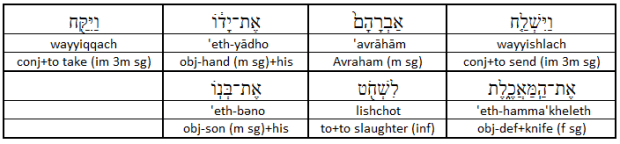
Genesis 22:10 – Avraham reached out his hand and took the knife to slaughter his son.
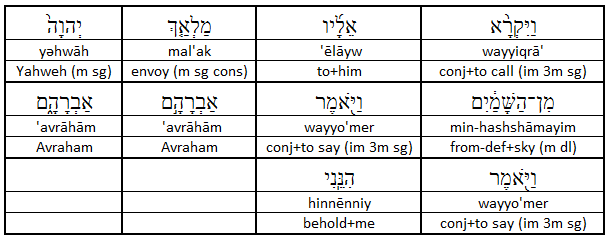
Genesis 22:11 – The messenger of Yahweh called to him from the skies. “Avraham, Avraham,” he said. “I’m here,” Avraham said.
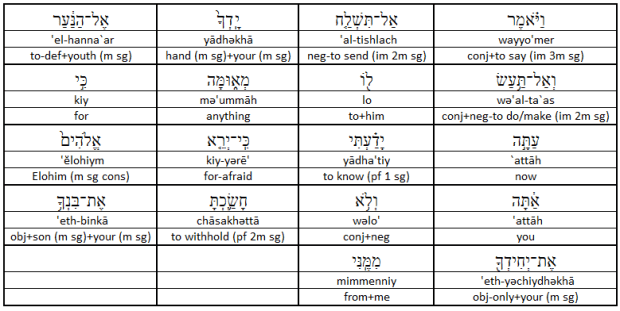
Genesis 22:12 – “Don’t put your hand on the youth. Don’t do anything to him, for now I know you fear Elohim. You did not withhold your only son from me.”
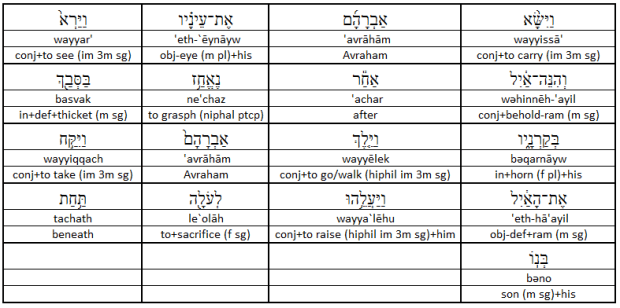
Genesis 22:13 – Avraham looked up and saw a ram with its horns caught in a thicket. He went and took it, and he sacrificed it in place of his son.
Genesis 22:14 – Avraham named that place Yahweh Provides. Today, it is said on Yahweh’s mountain, he will provide.
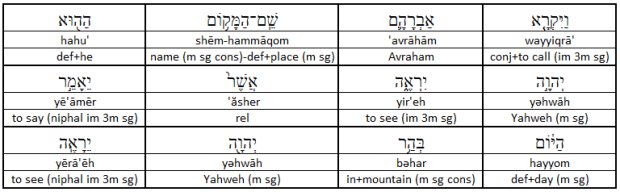
Genesis 22:15 – The messenger of Yahweh called to Avraham from the skies for a second time.
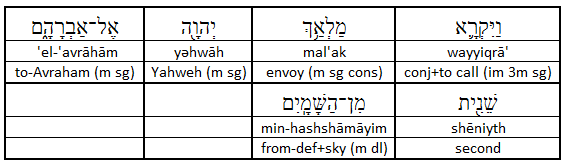
Genesis 22:16 – “I swear by myself that this is the declaration of Yahweh,” he said. “Because you did this and did not withhold your only son from me…”
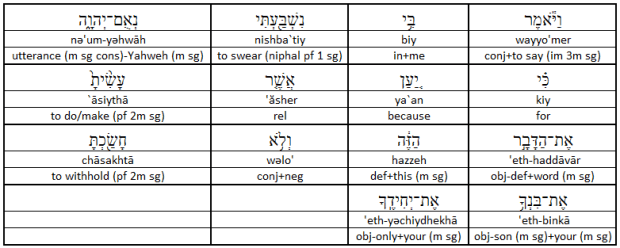
Genesis 22:17 – “…I will surely bless you and increase your seed like the stars of the skies and the sand upon the seashore. Your seed will possess the gate of his enemies.”
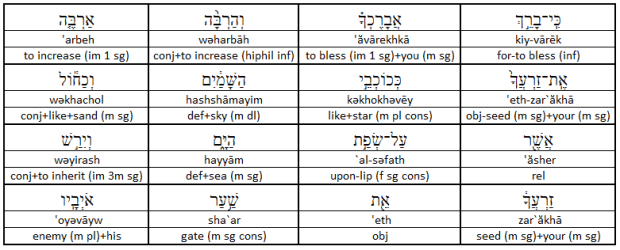
Genesis 22:18 – “Through your seed, all the nations across the land will be blessed, because you listened to my voice.”
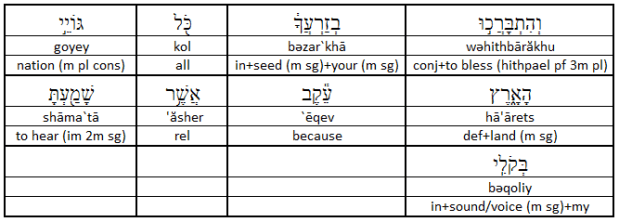
Genesis 22:19 – Avraham returned to the youths. They rose and left together for the Pit of the Oath, and they dwelled there.
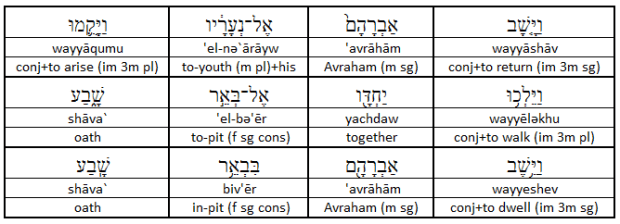
Genesis 22:20 – After these things had happened, it was told to Avraham that Milkah had also borne sons to his brother Nachor:
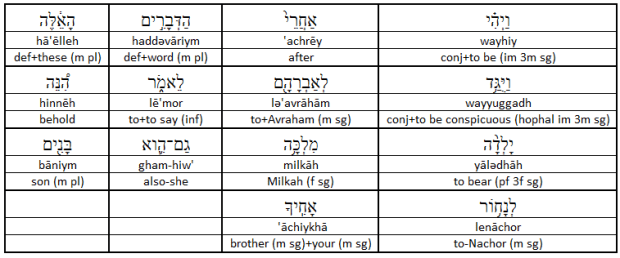
Genesis 22:21 – Uts, his firstborn, Buz, his brother, Qemuel, the father of Aram…
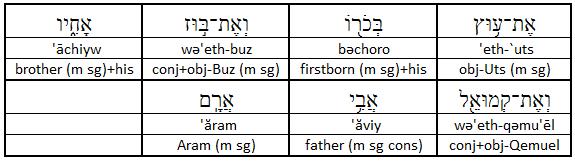
Genesis 22:22 – …Kesedh, Chazo, Pildash, Yidhlaf, and Bethu’el.
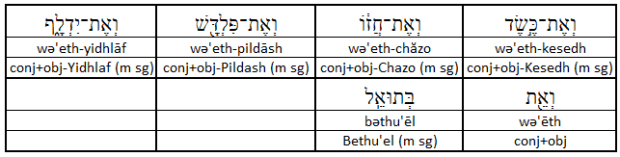
Genesis 22:23 – Bethu’el fathered Rivqah. Milkah bore these eight to Nachor, Avraham’s brother.

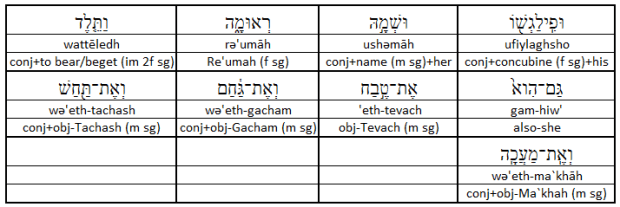
Genesis 22:24 – His concubine Re’umah bore Tevach, Gacham, Tachash, and Ma’khah.
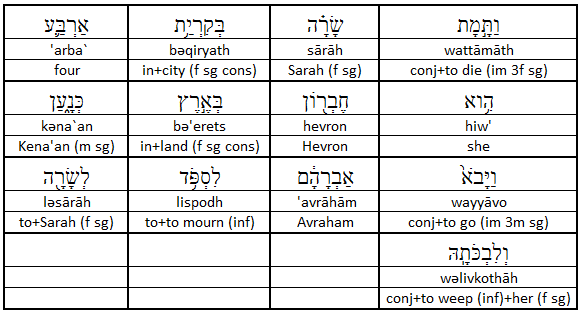
Genesis 23:1 – Sarah lived 127 years.

Genesis 23:2 – She died in the City of the Four, which is Chevron, in the land of Kena’an, and Avraham mourned and wept for Sarah.
Genesis 23:3 – Avraham rose up from his dead, and he spoke to the sons of Cheth.
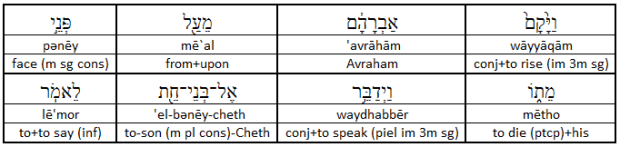
The sons of Cheth, or the Hittites.
Genesis 23:4 – “I am a stranger and foreigner among you,” he said. “Give me a burial site, and I will bury my dead out of my sight.”

Genesis 23:5 – The sons of Cheth answered him.
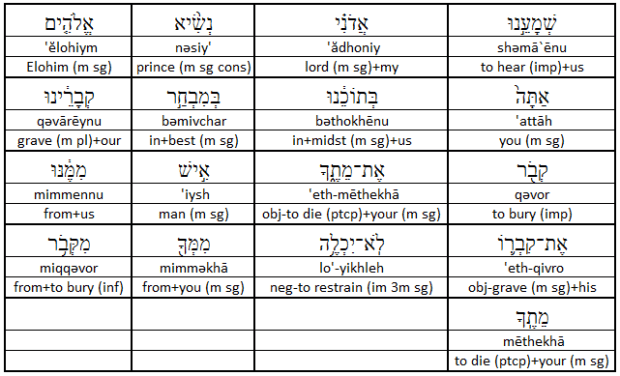
Genesis 23:6 – “Listen to us, my lord,” they said. “You are a prince of Elohim among us. Bury your dead in our best grave. None of us will withhold his grave from you to bury your dead.”
Genesis 23:7 – Avraham rose, and he bowed to the people of the land, to the sons of Cheth.

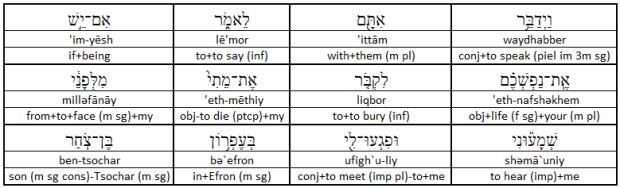
Genesis 23:8 – “If it’s your will that I bury my dead, then listen to me and meet with Efron, son of Tsochar, for me,” he said.
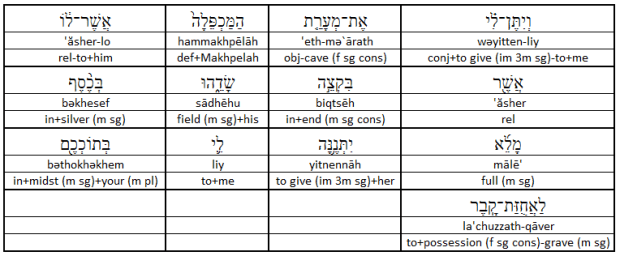
Genesis 23:9 – “Give me the cave of Makhpelah. He owns it, and it’s at the end of his field. I’ll pay the full price before you for the burial site.”
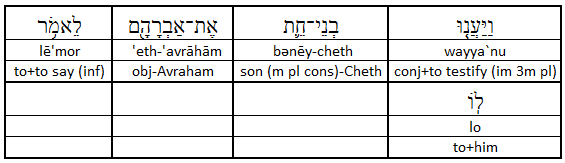
Genesis 23:10 -Efron the Chittiy was sitting among the sons of Cheth. He answered Avraham before all the sons of Cheth at the gate of his city.
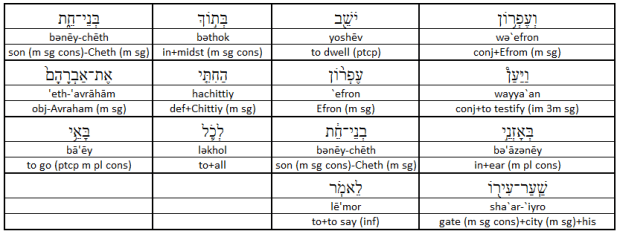
Genesis 23:11 – “No, my lord,” he said. “Listen to me. I’ll give you the field and the cave, here in the sight of the sons of my people. Bury your dead.”
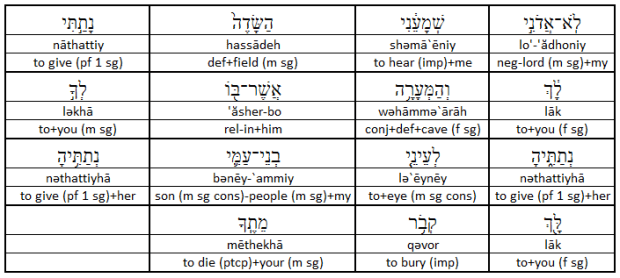
Genesis 23:12 – Avraham bowed before the people of the land.

Genesis 23:13 – “Listen to me,” he said. “I’ll give you silver for the field. Take it from me, and I’ll bury my dead there.”
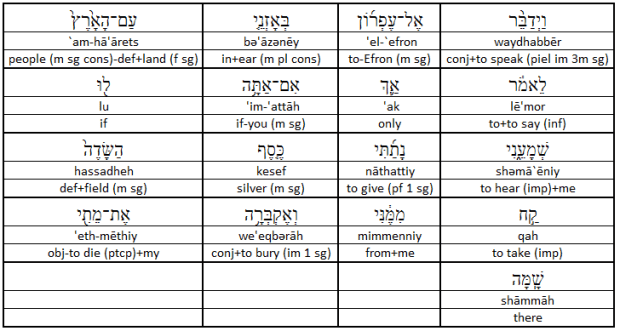
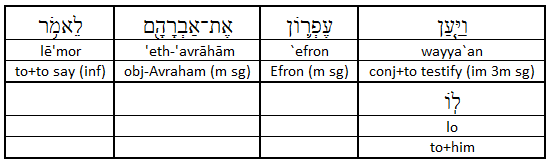
Genesis 23:14 – Efron answered Avraham.
Genesis 23:15 – “My lord, listen to me. The land is worth 400 sheqels of silver. What is that between us? Bury your dead.”
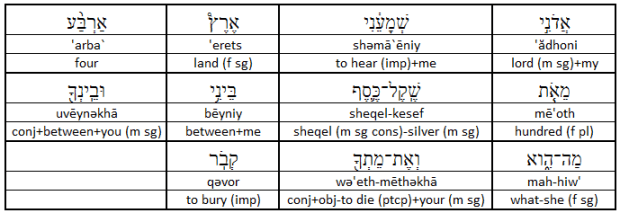
Genesis 23:16 – Avraham heard Efron, and he weighed out the silver that had been spoken of in the hearing of the sons of Cheth – 400 sheqels of silver, according to the merchants.
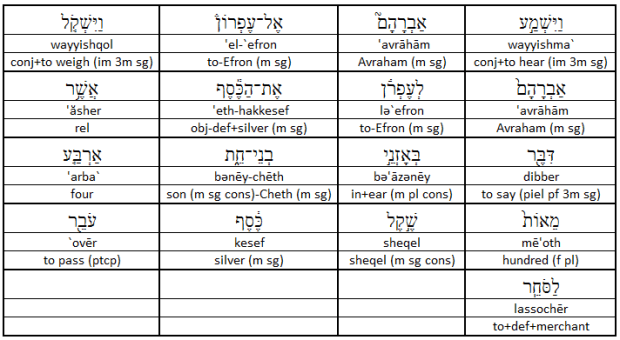
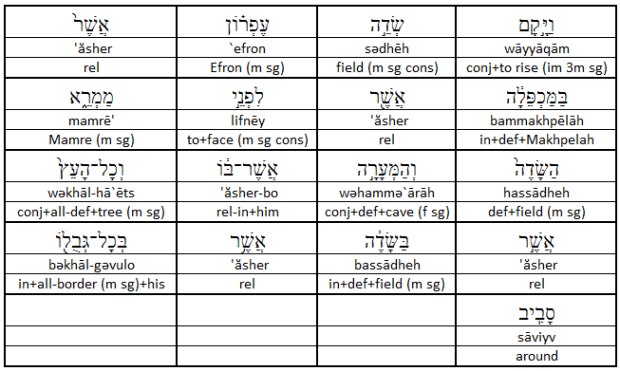
Genesis 23:17 – Efron’s field in Makhpelah, facing Mamre – the field, the cave within it, and all the trees within the borders of the field – was handed over…
“Rise” here is the same word that is sometimes used for “establish”, with the meaning “stand/rise/set up/etc.”
Genesis 23:18 – …to Avraham, in the sight of all the sons of Cheth who were at the city’s gate.
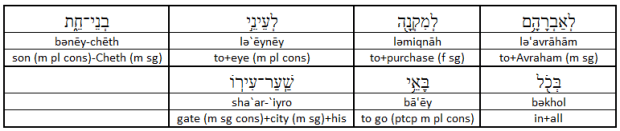
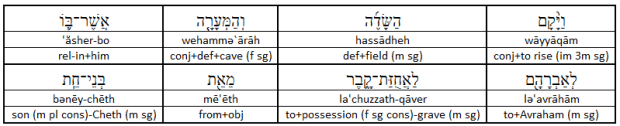
Genesis 23:19 – After, Avraham buried his wife Sarah in the cave of the field of Makhpelah, facing Mamre, which is Hevron, in the land of Kena’an.
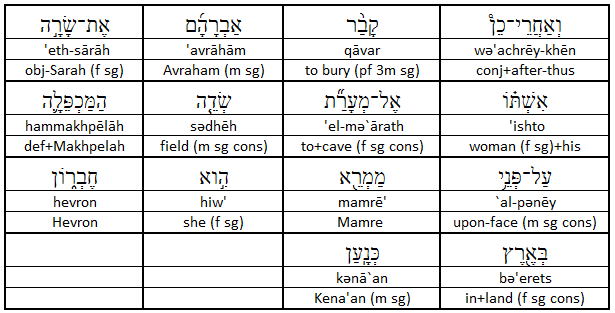
Genesis 23:20 – The field and the cave within it were handed over to Avraham as a burial site from the sons of Cheth.
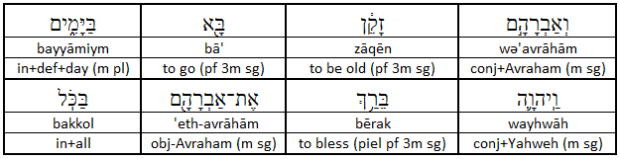
Genesis 24:1 – Avraham was old, and Yahweh blessed Avraham in every way.
Genesis 24:2 – “Put your hand under my thigh,” Avraham said to the eldest slave of his house, who ruled over all his property.
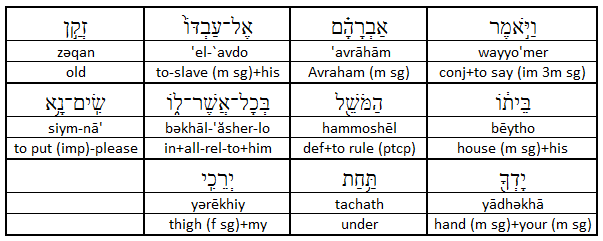
I’ve read some interpretations that suggest that Avraham is euphemistically asking his slave to swear on his testicles – his progeny, his seed, his lineage, all that. “Testicle” does mean “witness” (same root as “testify”), but it might also have that meaning simply as a witness of virility, not as a relation to any oath-related practices.
The word translated as thigh can mean “thigh” or “loins.” In other interpretations, he’s asking him to hold his penis, swearing by his circumcision and the covenant he has with Yahweh. Some Jewish commentators, like Rashi, have historically used this reading of the verse.
Genesis 24:3 – “Swear to me by Yahweh, god of the skies and the land, that you will not take a wife for my son from the daughters of the Kena’ani with whom I am living.”
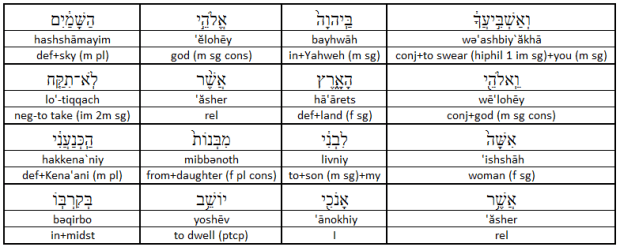
Genesis 24:4 – “Go to the land of my birth and take a wife for my son Yitschaq.”
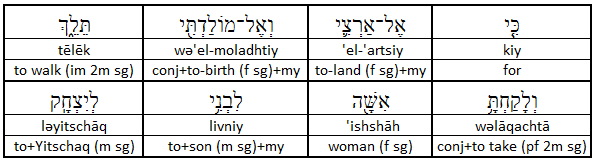
Genesis 24:5 – “What if no woman is willing to follow me back to this land?” the slave asked. “Shall I return your son to the land from which you came?”
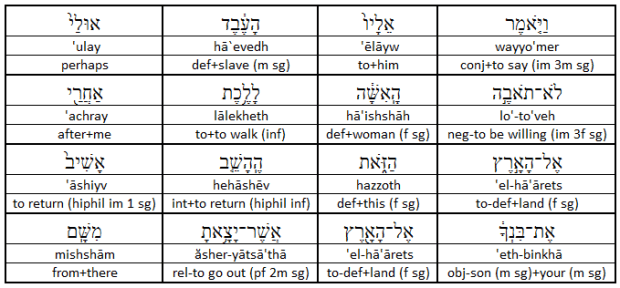
Genesis 24:6 – “Do not return my son there,” Avraham said to him.
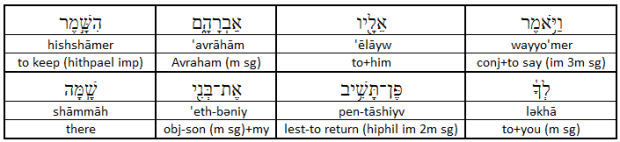
Genesis 24:7 – “Yahweh, god of the skies, who took me from my father’s house and from the land of my birth, who spoke to me, who swore to me, said, ‘I will give this land to your seed.’ He will send his messenger before you, and you will bring a woman to my son from there.”
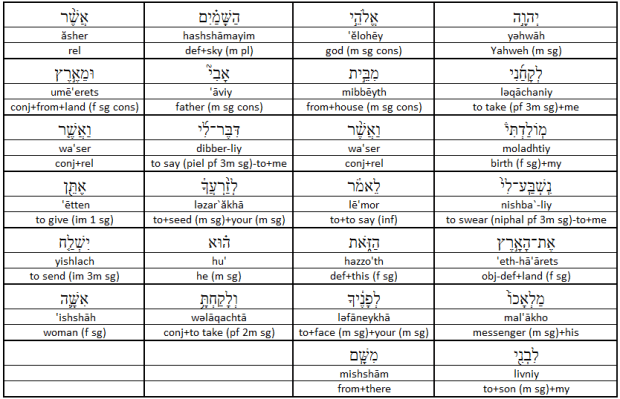
Genesis 24:8 – “If she is unwilling to follow you back, then you are released from this oath, but you will not return my son there.”
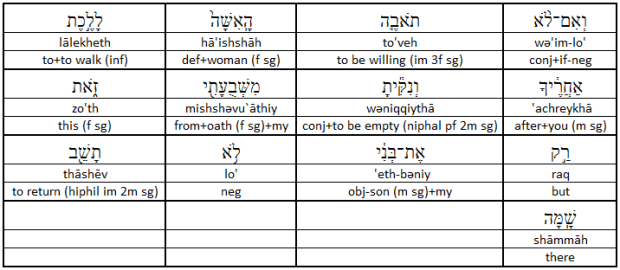
Genesis 24:9 – His slave put his hand under the thigh of his lord Avraham, and he swore these things to him.
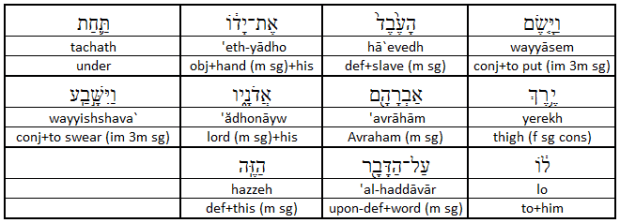
Genesis 24:10 – The slave took ten of his lord’s camels, loaded with all kinds of good things from his lord. He left for Aram of the Rivers, for the city of Nachor.
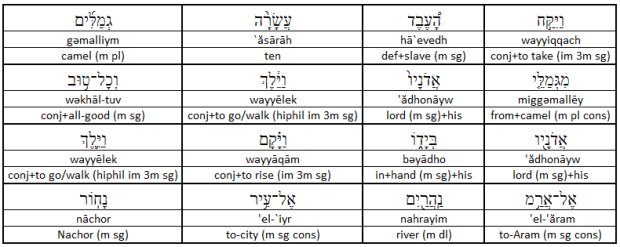
Genesis 24:11 – He made the camels kneel outside the city at evening, near a well. It was the time when women would go to draw water.
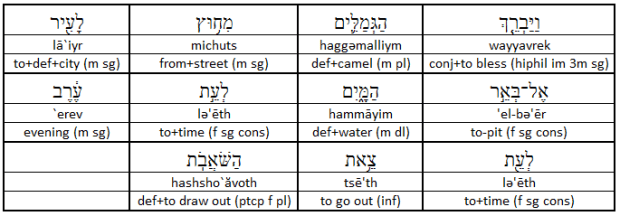
This is kind of an interesting way to say it – “bless” literally means “kneel”, and here it’s in the hiphil (causative) with the slave as the subject. He’s causing the camels to bless/kneel.
Genesis 24:12 – “Yahweh,” he said. “God of my lord, Avraham. Give me success today, and show kindness to my lord, Avraham.”
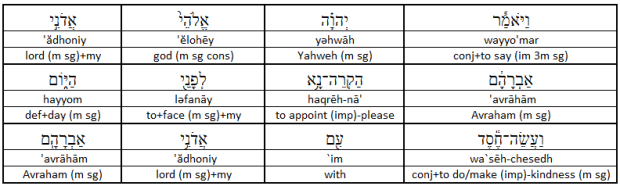
Genesis 24:13 – “I am standing at the well, and the daughters of the men of the city are coming out to draw water.”

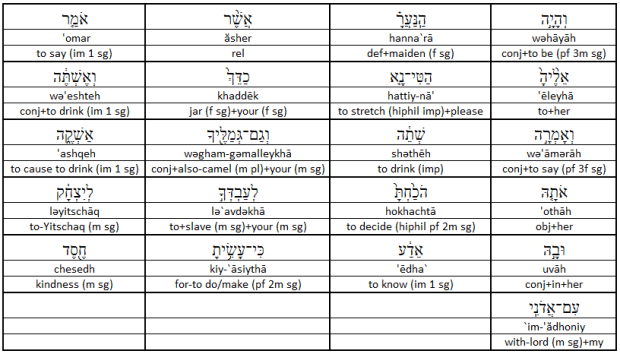
Genesis 24:14 – “May it be the maiden to whom I say ‘please, hand me your jar so that I may drink.’ May she say, ‘drink, and I’ll also give a drink to your camels.’ May she be the one whom you chose for your slave Yitschaq. In this, I will know you’ve done kindness to my lord.”
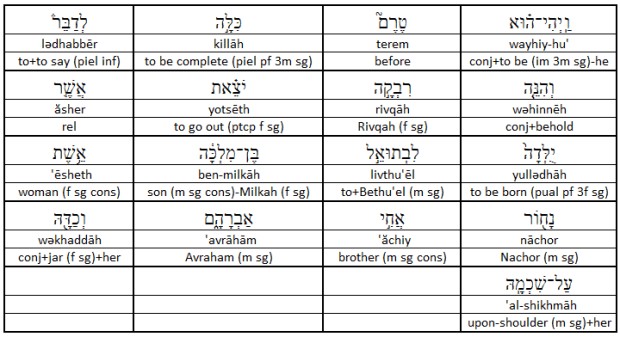
Genesis 24:15 – Before he had finished saying this, Rivqah came out with her jar on her shoulder. She was born to Bethu’el son of Milkah, wife of Nachor, the brother of Avraham.
Genesis 24:16 – She was very beautiful and a virgin. No man had slept with her. She went down to the well, filled her jar, and came back up.
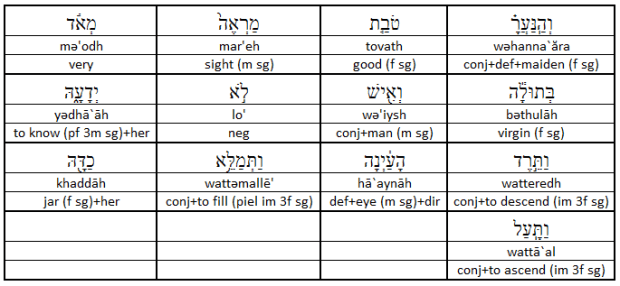
Genesis 24:17 – The slave ran to meet her. “Please,” he said. “May I have a little water from your jar?”
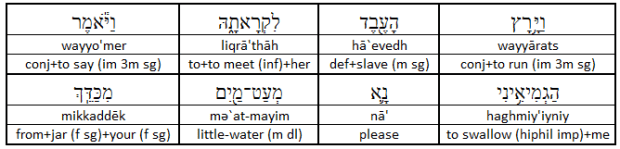
Genesis 24:18 – “Drink, my lord,” she said, and she quickly handed her jar to him to give him a drink.
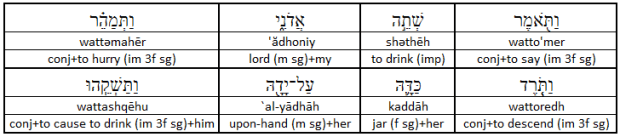
Genesis 24:19 – “I’ll also draw water for your camels, until they’ve had enough to drink,” she said, after she had given him a drink.
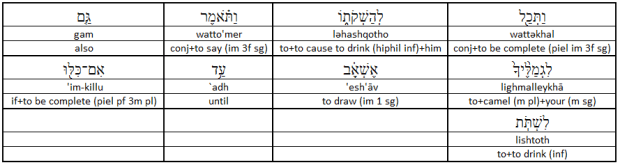
Genesis 24:20 – She quickly emptied her jar into trough, and again ran to the well to draw water for his camels.
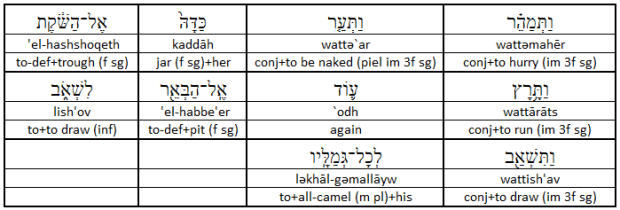
Genesis 24:21 – The man watched her silently to see if Yahweh had made his journey successful or not.
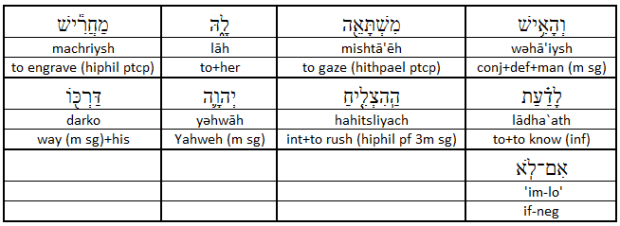
Another kind of fun one – “to engrave” in the hiphil, so “cause to engrave” has the meaning of “to be silent.” “Rush” can also mean “prosper.”
Genesis 24:22 – When the camels had finished drinking, the man took out a gold ring, weighing half a sheqel, and two bracelets weighing ten sheqels.
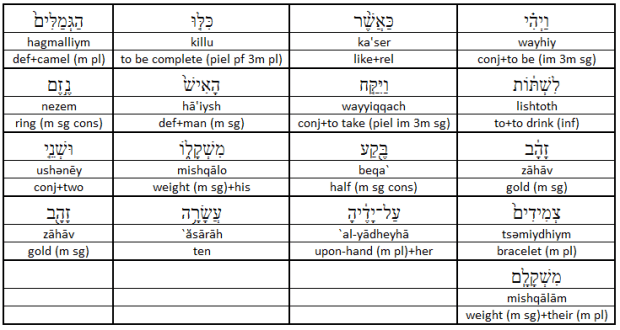
Genesis 24:23 – “Whose daughter are you?” he asked. “Please, tell me. Is there room at your father’s house for us to lodge?”

Genesis 24:24 – “I am the daughter of Bethu’el’,” she said. “Whom Milkah bore to Nachor.”
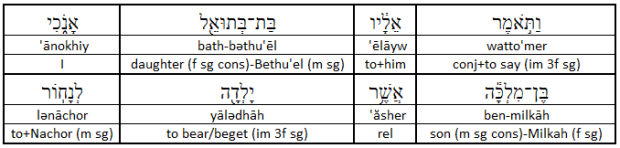
Genesis 24:25 – “We have plenty of straw and fodder with us, and a place to lodge.”
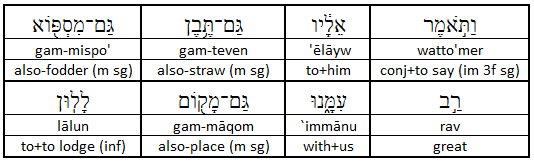
Genesis 24:26 – The man bowed and worshipped Yahweh.

Genesis 24:27 – “Blessed is Yahweh, god of my lord, Avraham,” he said. “He did not forsake his kindness and his truth from my lord. Yahweh has led me down the path to the house of my lord’s brother.”

Genesis 24:28 – The maiden ran to tell these words to her mother’s house.
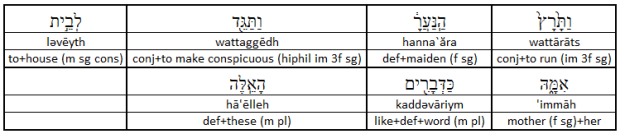
Genesis 24:29 – Rivqah had a brother named Lavan. He ran out to the man by the well…
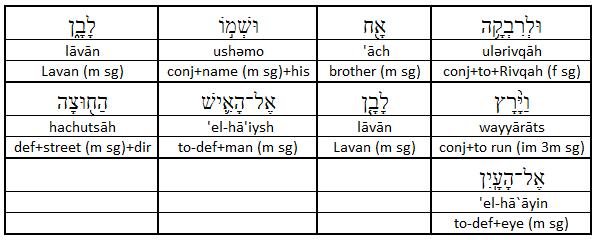
Genesis 24:30 – …as soon has he had seen the ring and the bracelets on his sister’s hands and heard what she had to say. He found the man standing with his camels by the well.
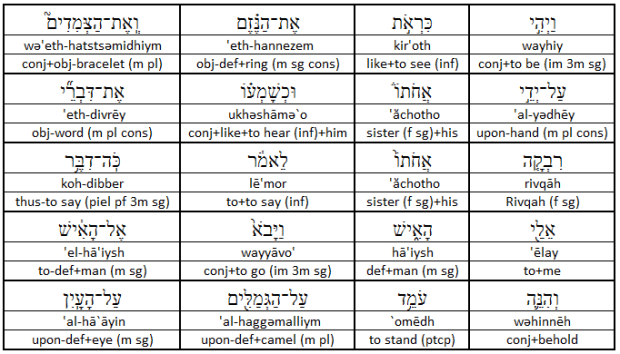
Genesis 24:31 – “Come, blessed of Yahweh,” he said. “Why are you standing outside? I have prepared the house and a place for the camels.”
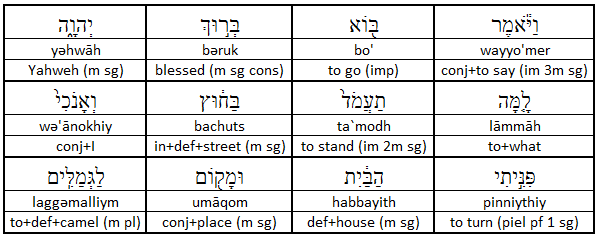
Genesis 24:32 – The man went toward the house and unloaded the camels. He gave them straw and fodder, and also water to wash his feet and the feet of the men who were with him.
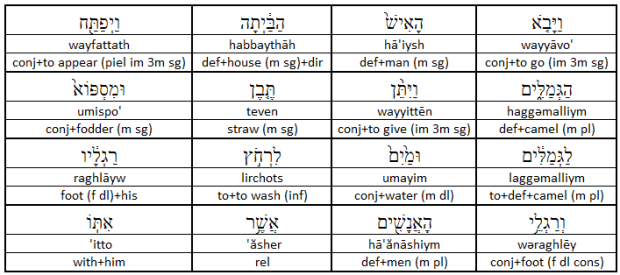
Genesis 24:33 – Food was put before him to eat. “I will not eat until I say what I have come to say,” the slave said. “Speak,” Lavan said.
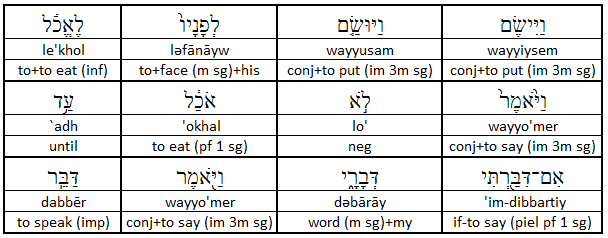
Genesis 24:34 – “I am Avraham’s slave,” he said.

Genesis 24:35 – “Yahweh has greatly blessed my lord, and he has become great. He has given him sheep, cattle, silver, gold, slaves, maids, camels, and donkeys.”
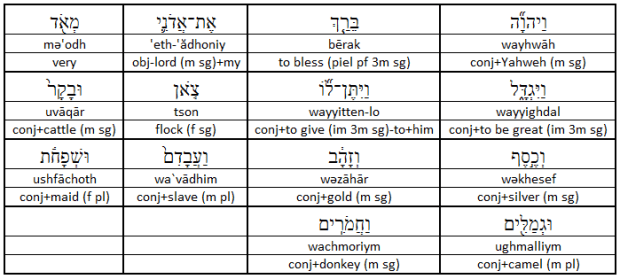
Genesis 24:36 – “My lord’s wife Sarah bore him a son in her old age, and he has given him everything he owns.”
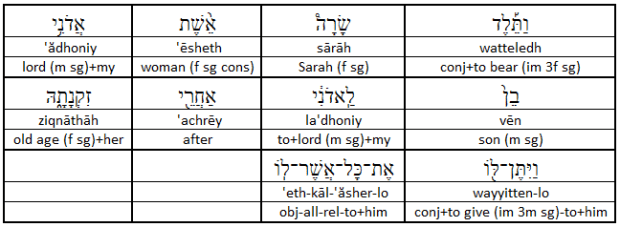
Genesis 24:37 – “My lord made me swear to him, saying, ‘don’t take a wife for my son from the daughters of the Kena’ani, in whose land I am dwelling.'”
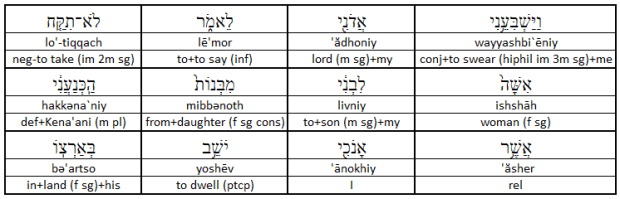
Genesis 24:38 – “Instead, go to my father’s house, to my tribe, and take a wife for my son.”
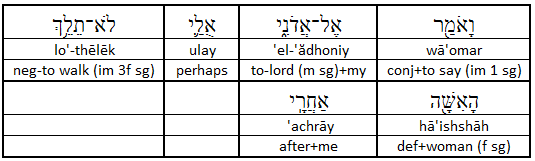
Genesis 24:39 – “I said to my lord, ‘perhaps no woman will follow me back.'”
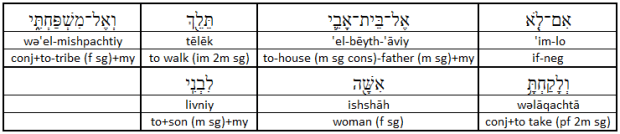
Genesis 24:40 – “He told me, ‘Yahweh, before whom I walk, will send his messenger with you to make your journey successful, and you will take a wife for my son from my tribe and from my father’s house.'”
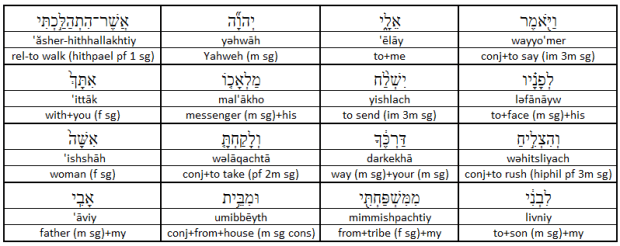
Genesis 24:41 – “‘Then, you will be released from my oath, for you will have gone to my tribe. If they do not give a woman to you, then you will be released from my oath.'”
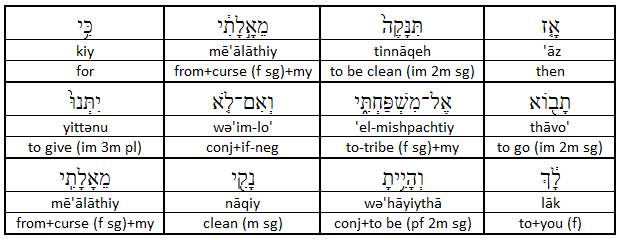
Genesis 24:42 – “Today, I went to the well, and I said, ‘Yahweh, god of my lord Avraham, please make this journey I am making successful.'”
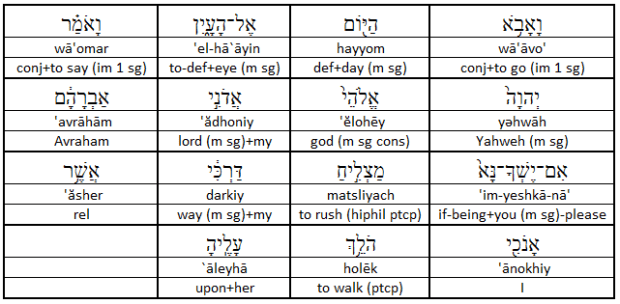
Genesis 24:43 – “‘I am standing by the well. May a girl go out to draw water, and if I say to her, ‘please, let me drink a little water from your jar…””
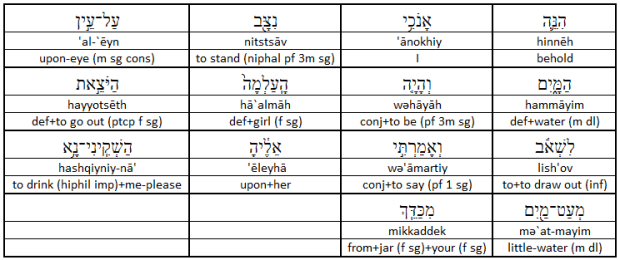
Genesis 24:44 – “‘…and she says to me, ‘you may drink, and I’ll also draw water for your camels,’ then may she be the woman whom Yahweh has chosen for my lord’s son.'”
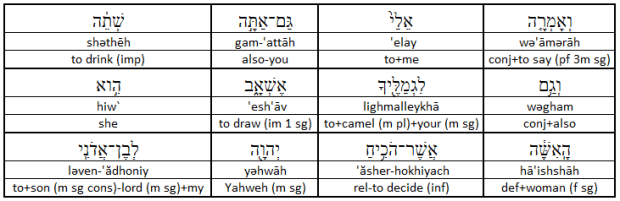
Genesis 24:45 – “Before I finished speaking to myself, Rivqah came out with her jar on her shoulder, and she went down to the well. She drew water, and I said to her, ‘Please, may I have a drink?'”

Genesis 24:46 – “She quickly handed me her jar, and said, ‘Drink, and I’ll give your camels water, too.’ I drank, and she gave water to my camels.”
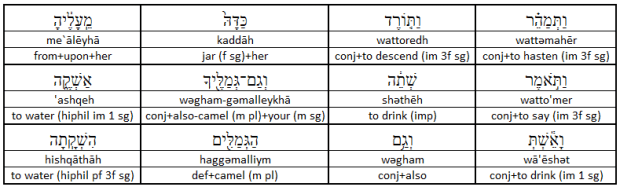
Genesis 24:47 – “‘Whose daughter are you?’ I asked. ‘Bethu’el son of Nachor, whom Milkah bore to him,’ she said. I put the ring in her nose and the bracelets on her hands.”
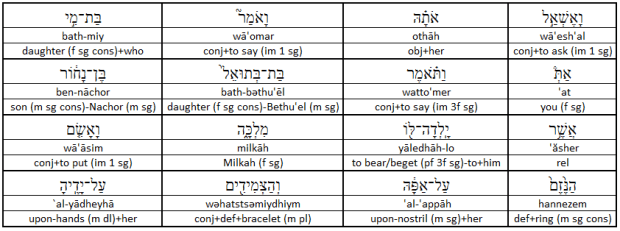
Genesis 24:48 – “I bowed and worshipped Yahweh, and I blessed Yahweh, god of my lord, Avraham, who led me on a true path to take the daughter of my lord’s brother to his son.”
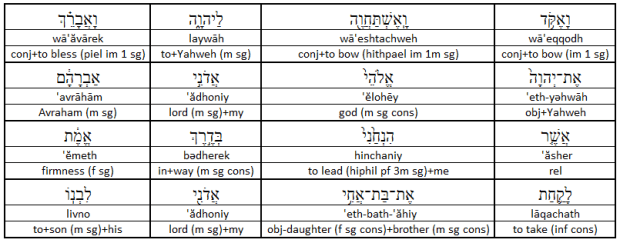
Genesis 24:49 – “Now, if you will deal kindly and truthfully with my lord, tell me, and if not, tell me, and I will turn to the right or the left.”
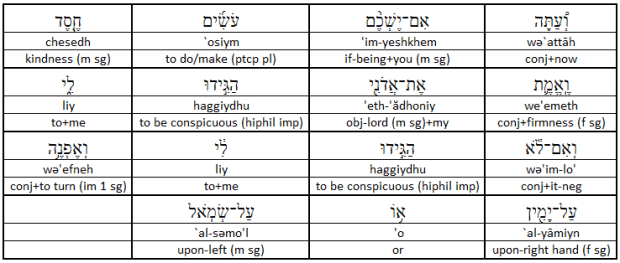
Genesis 24:50 – “This word comes from Yahweh,” said Lavan and Bethu’el. “We cannot tell you right or wrong.”
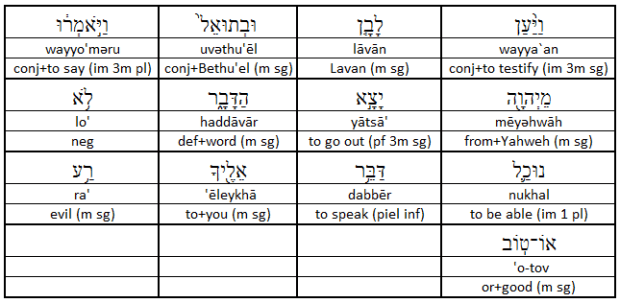
Genesis 24:51 – “Here is Rivqah. Take her and go, and may she be your lord’s son’s wife, as Yahweh said.”
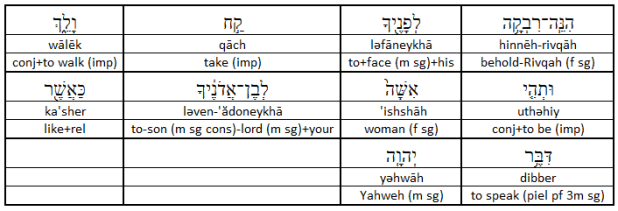
Genesis 24:52 – When Avraham’s slave heard their words, he bowed low to Yahweh.

Genesis 24:53 – He brought out silver and gold jewelry and clothing, and he gave them to Rivqah. He also gave valuables to her brother and mother.
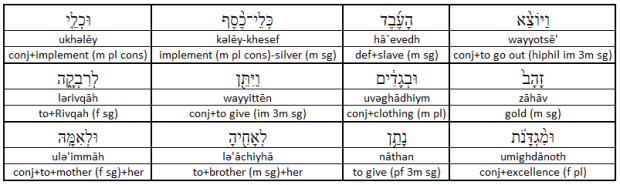
Genesis 24:54 – He and the men with him ate and drank, and they lodged for the night. In the morning, they rose. “Send me to my lord,” he said.
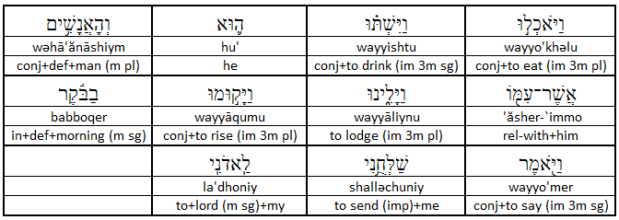
Genesis 24:55 – “Let the maiden dwell with us for ten days or so,” said her brother and mother. “After that, she can go.”
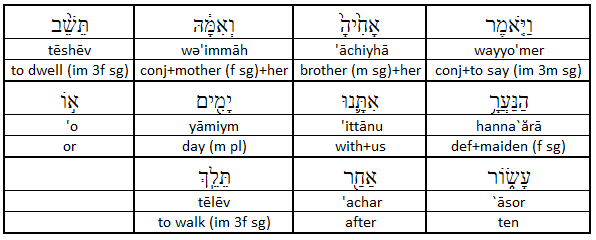
Genesis 24:56 – “Don’t detain me,” he said to them. “Yahweh has made my journey successful. Send me to my lord.”
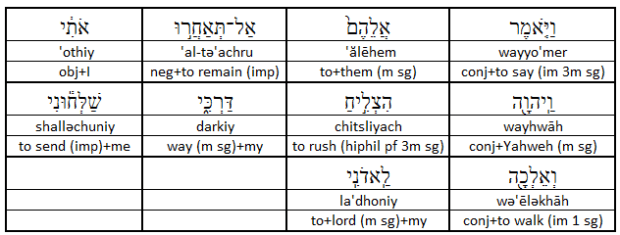
Genesis 24:57 – “Let’s call the maiden and ask what she thinks,” they said.
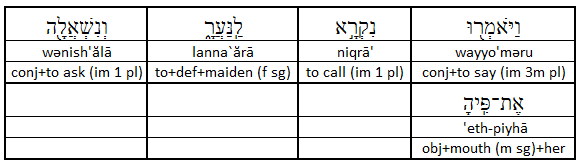
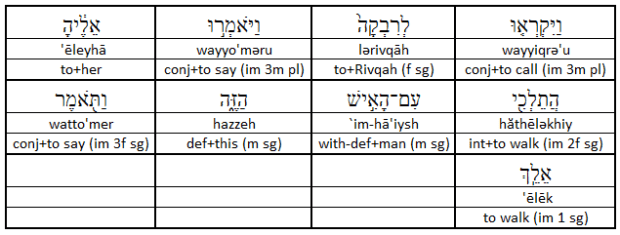
Genesis 24:58 – They called Rivqah. “Will you go with this man?” they asked. “I will,” she said.
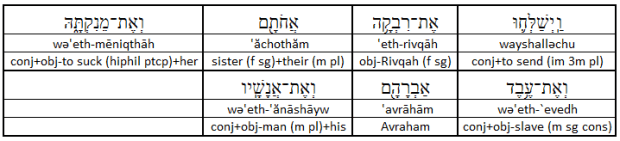
Genesis 24:59 – They sent Rivqah, her nurse, Avraham’s slave, and his men on their way.
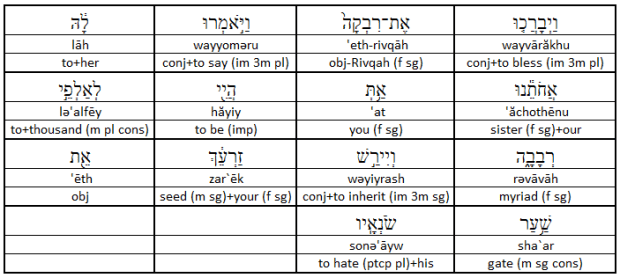
Genesis 24:60 – They blessed Rivqah. “Our sister,” they said. “May you become tens of thousands, and may your seed inherit the gates of those they hate.”
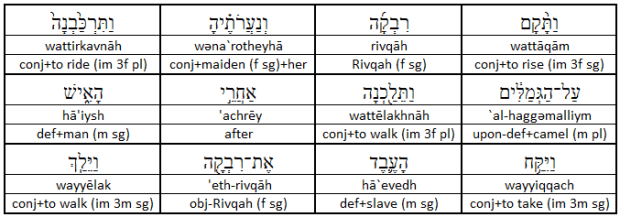
Genesis 24:61 – Rivqah and her maids rose and rode upon the camels, and they followed the man, and the slave took Rivqah and left.
Genesis 24:62 – Yitschaq came from the Well of the Living One who Sees Me. He was dwelling in the land of the Neghev.
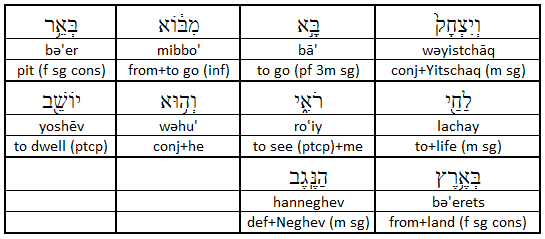
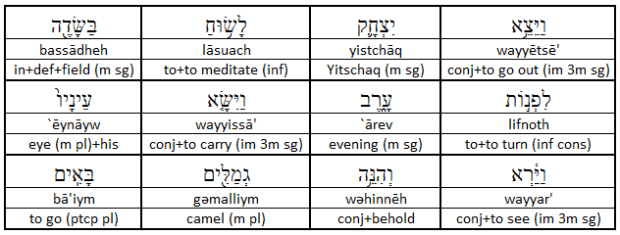
Genesis 24:63 – He went out to meditate in the field as it became evening. He looked up and saw camels coming.
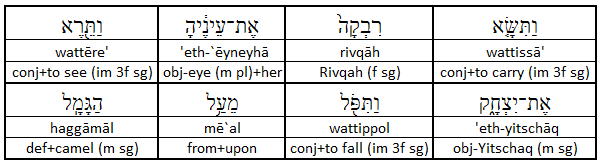
Genesis 24:64 – Rivqah looked up and saw Yitschaq, and she fell from her camel.
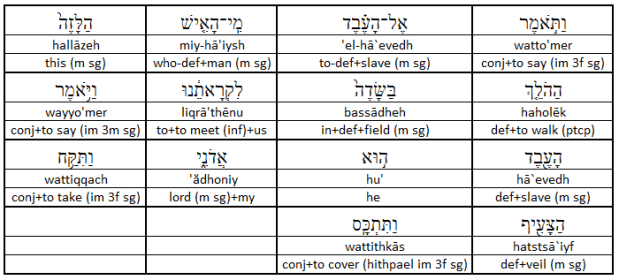
Genesis 24:65 – “Who is this man walking in the field to meet us?” she asked the slave. “He is my lord,” the slave said. She took her veil and covered herself.
Genesis 24:66 – The slave recounted to Yitschaq everything that he had done.
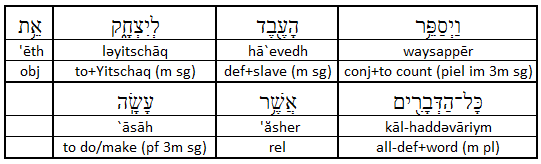
Genesis 24:67 – Yitschaq brought her to the tent of his mother, Sarah. He took Rivqah as his wife, and he loved her, and he was comforted for the loss of his mother.
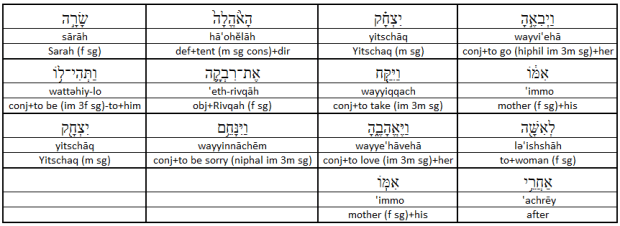
Moral of the story: incest is better than race mixing?
Seriously, check out the family tree.

Genesis 25:1 – Avraham took another wife, whose name was Qeturah.
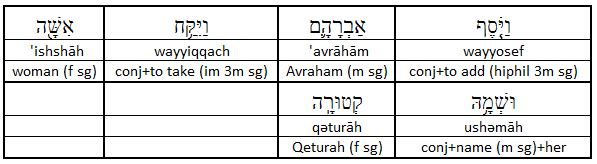
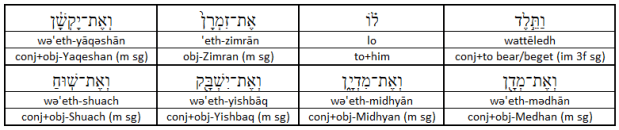
Genesis 25:2 – She bore to him Zimran, Yaqeshan, Medhan, Midhyan, Yishbaq, and Shuach.
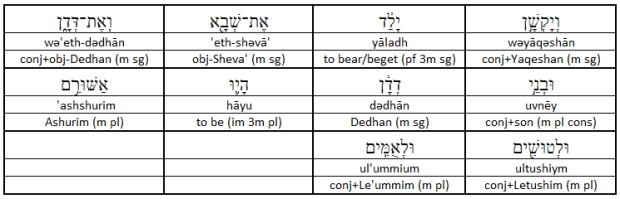
Genesis 25:3 – Yaqeshan fathered Sheva and Dedhan, and the sons of Dedhan were Ashurim, Letushim, and Le’ummim.
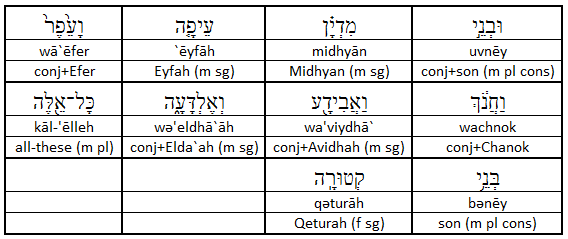
Genesis 25:4 – The sons of Midhyan were Eyfah, Efer, Chanok, Avidhah, and Elda’ah. All of these were the sons of Qeturah.
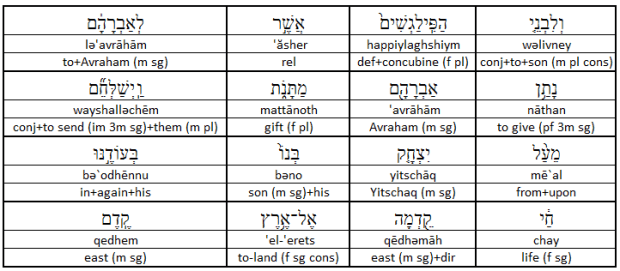
Genesis 25:5 – Avraham gave all of his possessions to Yitschaq.

Genesis 25:6 – While he was still alive, he gave gifts to the sons of his concubines. He sent them away from Yitschaq, his son, to a land in the east.
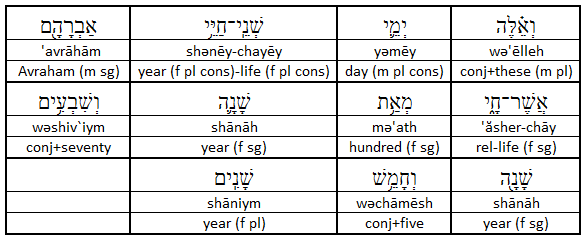
Genesis 25:7 – Avraham lived 175 years.
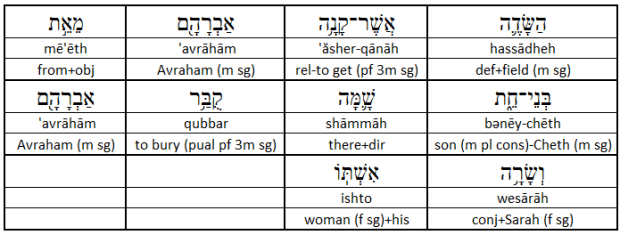
Genesis 25:8 – He breathed out and died at good age, old and satisfied, and he was gathered to his people.
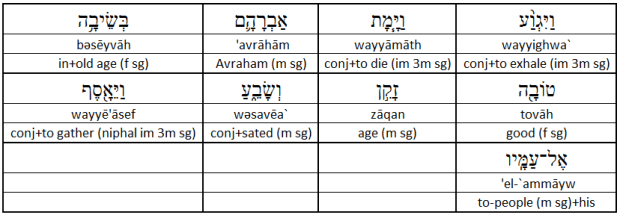
Genesis 25:9 – His sons, Yitschaq and Yishma’el, buried him in the cave of Makhpelah, in the field of Efron son of Tsochar the Chittiy, facing Mamre…
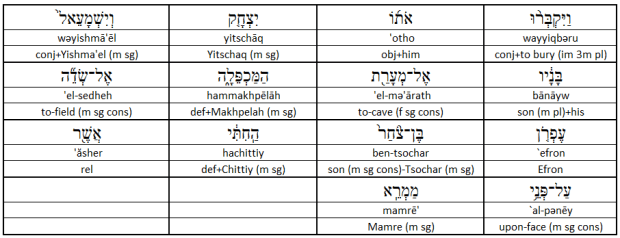
Genesis 25:10 – …which he had gotten from the sons of Cheth. There, Avraham was buried with his wife, Sarah.
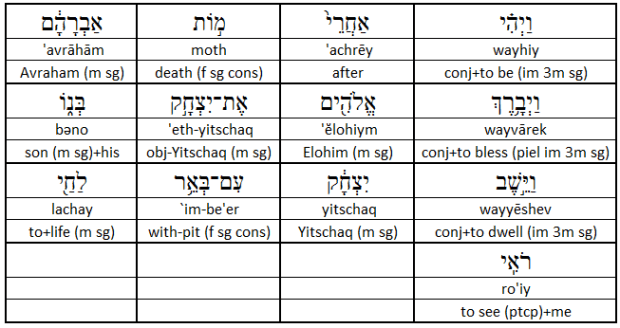
Genesis 25:11 – After Avraham’s death, Elohim blessed his son, Yitschaq. Yitschaq dwelled at the Well of the Living One who Sees Me.
Full Text
These are the generations of Terach.
Terach fathered Avram, Nachor, and Haran, and Haran fathered Lot. Haran died in the presence of his father Terach in Ur Kasdim, the land of his birth. Avram and Nachor took wives. Avram’s wife was named Saray, and Nachor’s wife was named Milkah. She was the daughter of Haran, who fathered Milkah and Yiskah. Saray was barren, and she had no children.
Terach took his son Avram, his grandson Lot son of Haran, and his daughter-in-law Saray, and they left Ur Kasdim for the land of Kena’an, and they dwelled at Charan. Terach was 205 years old when he died in Charan.
“Leave your land and your kindred,” Yahweh said to Avram. “Go from your father’s house to the land that I will show you. I will make you a great nation. I will bless you, and I will magnify your name. You will be a blessing. I will bless those who bless you and curse those who curse you. Through you, all of the tribes of the earth will be blessed.”
Avram left, as Yahweh told him, and Lot went with him. He was seventy-five years old when he left Charan. Avram took his wife Saray and his nephew Lot, and all the property and people they had gathered in Charan, and they left for the land of Kena’an.
Avram passed through the land until he came to Shekhem and the terebinths of Moreh. The Kena’ani were in the land at that time. Yahweh appeared to Avram.
“I will give this land to your seed,” he said.
Avram built an altar to Yahweh who had appeared to him.
He moved from there towards the mountains to the east of the House of El, and he set up his tent with the House of El on the west and Ay from the east. He built an altar to Yahweh there, and he called on the name of Yahweh. Avram then journeyed towards the Neghev.
There was a heavy famine in the land, and Avram went down to Mitsrayim to stay there.
“I know that you are a beautiful woman,” he said to his wife Saray as they approached Mitsrayim. “When the Mitsrim see you, they will say, ‘This is his wife’, and they will kill me but let you live. Say that you are my sister. For your sake, they will be good to me and let me live.”
When Avram went into Mitsrayim, the Mitsrim saw that his wife was very beautiful. The princes of Par’oh saw her, and they praised her to him, and they took her to his house. They were good to Avram for her sake, and they gave him sheep, cattle, donkeys, slaves, maids, and camels.
Yahweh struck Par’oh and his house with a great plague on behalf of Avram’s wife Saray. Par’oh called for Avram.
“What have you done to me?” he asked. “Why didn’t you tell me that she’s your wife? Why did you say that she’s your sister? I took her as my wife. Now, take your wife and go.”
Par’oh commanded his men, and they sent Avram away with his wife and all of his possessions. He went up from Mitsrayim to the Neghev with his wife, all of his possessions, and Lot. He was very rich in cattle, silver, and gold.
He journeyed from the Neghev towards the House of El, coming to the place where his tent had been before, between the House of El and Ay, to the place where he had made the altar, and he called upon the name of Yahweh.
Lot was traveling with Avram, and he also had sheep, cattle, and tents. The land couldn’t support them living together, for their possessions were great, and they were unable to dwell together. There was strife between Avram’s shepherds and Lot’s shepherds, and the Kena’ani and the Perizzi were also dwelling in the land.
“There shouldn’t be strife between me and you and between my shepherds and yours,” Avram said to Lot. “We are brothers. Isn’t all of the land before you? Separate from me. If you go to the left, I will go to the right. If you go to the right, I will go to the left.”
Lot looked up, and he saw that the whole plain of Yarden towards Tso’ar was watered like the garden of Yahweh and the land of Mitsrayim, before Yahweh destroyed Sedhom and Amorah. He chose the plain of Yarden, and he traveled eastward, separating from his brother. Avram dwelled in the land of Kena’an, and Lot dwelled in the cities of the plain, and he camped near Sedhom. The men of Sedhom were evil, and they were great sinners before Yahweh.
“Look up,” Yahweh said to Avram after Lot had separated from him. “Look out from the place where you are, to the north, to the south, to the east, and to the west. I will give all the land you are seeing to you and your seed forever. I will make your seed like the dust of the land. If anyone can count the dust, then they could also count your seed. Rise. Walk the length and width of the land, for I am giving it to you.”
Avram packed his tent, and he went to dwell at the terebinths of Mamre in Chevron, and he built an altar to Yahweh there.
At that time, Amrafel king of Shin’ar, Aryok king of Ellasar, Kedharla’omer king of Eylam, and Tidh’al king of Goyim made war against Bera king of Sedhom, Birsha king of Amorah, Shin’av king of Adhmah, Shem’ever king of Tsevoyim, and the king of Bela, which is Tso’ar. They all united in the valley of Siddim, at the Sea of Salt. They had served Kedharla’omer for twelve years, and in the thirteenth year they rebelled.
In the fourteenth year, Kedharla’omer and the kings who were with him attacked the Refa’im in Astarte of the Horns, the Zuzim in Ham, the Emim in the Plain of the Two Cities, and the Choriy at their Mount Se’ir, as far as the terebinth of Par’an in the wilderness.
They returned, and they went to the Eye of Judgment, which is Qadhesh, and they attacked the entire field of the Amaleqi, and also the Emori who were dwelling in the Valley of the Palms.
The kings of Sedhom, Amorah, Adhman, Tsevoyim, and Bela, which is Tso’ar, went out and made war in the valley of Siddim against Kedharla’omer king of Elam, Tidh’al king of Goyim, Amrafel king of Shin’ar, and Aryok king of Ellasar – four kings against five.
There were tar pits in the valley of Siddim, and the kings of Sedhom and Amorah fled. They fell there, and those who remained fled to the mountains. Kedhorla’omer and his allies took all the property and food of Sedhom and Amorah, and then they left. They also took Avram’s nephew Lot and all of his possessions, because he was living in Sedhom.
A refugee came and told Avram the Ivri, who was dwelling at the terebinths of Mamre the Emori, the brother of Eshkol and Aner, his allies. Avram heard that his nephew had been taken captive, and he brought 318 trained men from his house and pursued the captors as far as Dan. Avram divided his slaves against their enemies at night, and they attacked them and pursued them to Chovah, north of Dammeseq. He returned all of the property, women, and people, including his nephew Lot and Lot’s property.
The king of Sedhom went out to the valley of the plain, which is the Valley of the King, to meet Avram after he returned from attacking Kedharla’omer and his allies. Malkitsedheq, king of Shalem, brought out bread and wine. He was the priest of El Elyon, and he blessed Avram.
“Blessed is Avram to El Elyon, possessor of the skies and the land,” he said. “Blessed is El Elyon, who delivered your enemies into your hands.”
He gave him a tenth of everything.
“Give me the people and take the property for yourself,” the king of Sedhom said to Avram.
“I have raised my hand to Yahweh, El Elyon, possessor of the skies and the land,” Avram said to the king of Sedhom. “I will not take even a thread or a sandal strap from anything that is yours, so that you cannot say ‘I made Avram rich.’ I will take only that which the youths have eaten, and may Aner, Eshkol, and Mamre, the men who are with me, take their portion.”
After these things had happened, the word of Yahweh came to Avram in a vision, saying, “Fear not, Avram. I am your shield, and your reward will greatly increase.”
“My lord Yahweh,” Avram said. “What will you give me? I am childless, and my house’s heir is Eli’ezer of Dammeseq. You have not given me a seed, and my servant will be my heir.”
“This man will not be your heir,” said his god Yahweh. “A child of your own will be your heir.”
He brought Avram outside.
“Look towards the sky,” he said. “Count the stars, if you can count them. Thus will be your seed.”
Avram trusted Yahweh, and credited righteousness to him.
“I am Yahweh,” Yahweh said. “I brought you from Ur Kasdim to give you this land to inherit.”
“My lord Yahweh,” Avram said. “How will I know that I will inherit it?”
“Bring me a three-year old heifer, a three-year old goat, a three-year old ram, a turtledove, and a nestling.”
Avram brought everything. He cut them in half and set them side by side. He did not cut the birds. Birds of prey descended upon the corpses, and Avram dispersed them. As the sun went down, a trance fell upon Avram, and dread and darkness fell upon him.
“Know that your seed will be strangers in a land that is not theirs,” Yahweh said to him. “For four hundred years, they will serve and be afflicted. I will judge the nation that they will serve, and they will leave it with great wealth. You will go to your fathers in peace, and you will be buried at a good, old age. They will return here in the fourth generation, for the iniquity of the Emori is not complete.”
When the sun set and it was twilight, a smoking fire pot and a flaming torch had passed between the animal parts. On that day, Yahweh made a covenant with Avram.
“I give this land to your seed,” he said. “From the river of Mitsrayim to the great river Perath, the land of the Qeyni, the Qenizzi, the Qadhmoni, the Chitti, the Perizzi, the Refa’iym, the Emori, the Kena’ani, the Girgashi, and the Yevusi.”
Avram’s wife Saray had not borne any children to him. She had a Mitsri maid named Haghar.
“Yahweh has restrained me from bearing children,” Saray said to Avram. “Go to my maid. Maybe I can have children through her.”
Avram listened to Saray’s voice. In the tenth year that they had dwelled in the land of Kena’an, Saray took Haghar the Mitsri and gave her to Avram to be his wife. He slept with Haghar, and she conceived. When she noticed that she was pregnant, she cursed her mistress.
“You’re responsible for my pain,” Saray said to Avram. “I gave my maid to you, and when she saw that she was pregnant, she cursed me. May Yahweh judge between me and you.”
“Your maid is in your hands,” Avram said. “Do with her what you feel is right.”
Saray oppressed her, and Haghar fled. A messenger of Yahweh found her near a spring in the wilderness along the road to Shur.
“Haghar, maid of Saray, where have you come from and where are you going?” he said.
“I fled from my mistress, Saray,” she said.
“Return to your mistress and submit to her hand. I will magnify your seed, and they will be too many to count. You are pregnant, and you will bear a son. You will name him Yishma’el, for Yahweh has heard your misery. He will be a wild donkey of a man. His hand will be against everyone, and everyone’s hand will be against him. He will dwell before all of his brothers.”
She called upon the name of Yahweh.
“You are a god of sight,” she said. “Have I seen the one who sees me?”
For that reason, the spring between Qadhesh and Baredh is called “The Well of the Living One who Sees Me.”
Haghar bore Avram a son, and he named him Yishma’el. When Yishma’el was born, Avram was eighty-six years old.
When Avram was ninety-nine years old, Yahweh appeared to him.
“I am the the Destroyer,” he said. “Walk before me and be perfect. I will establish my covenant between me and you, and I will magnify you exceedingly.”
Avram fell upon his face, and Elohim spoke to him.
“My covenant is with you. You will be the father of an abundance of nations. You will no longer be named Avram. Your name will be Avraham, for I have made you a father of an abundance of nations. I will make you very fruitful. I will make you into nations, and kings will go out from you. I will establish my covenant between me and you and your seed after you forever in their generations, and I will be Elohim to you and your seed after you.
“I will give the land that you are staying in, all the land of Kena’an, as an eternal possession for you and your seed after you, and I will be Elohim to them. You will preserve my covenant, you and your seed after you, through their generations.
“This is my covenant which you will keep between me, you, and your seed after you: you will cut all the males among you. You will be cut in the flesh of your foreskin, and it will be a mark of the covenant between me and you. Through your generations, all males among you will be cut on the eighth day, both those born of your house and those purchased with silver from foreigners who are not your seed. Those born of your house or purchased with silver must be cut. My eternal covenant will be in their flesh. Any male whose foreskin is not cut will be cut off from his people, for he has broken my covenant.
“Do not call your wife Saray, for Sarah is her name. I will bless her, and through her I will give you a son. I will bless her, and she will become nations. Kings of nations will come from her.”
Avraham fell upon his face and laughed.
“Will a son be born to a man who is one hundred years old?” he asked himself. “Will Sarah bear children at ninety? If only Yishma’el could live before you.”
“Truly, your wife Sarah will bear you a son,” Elohim said. “You will name him Yitschaq, and I will establish my covenant with him, an eternal covenant with his seed after him. As for Yishma’el, I have heard you. I have blessed him. I will make him fruitful and magnify him greatly. He will father twelve lords, and I will make him a great nation. But, I will establish my covenant with Yitschaq whom Sarah will bear to you one year from now.”
Elohim finished speaking to Avraham, and he ascended from him. On that same day, Avraham took all the males of his house – his son Yishma’el, everyone born of his house, and everyone purchased with silver – and he cut the flesh of their foreskin, as Elohim had told him. He was ninety-nine years old when he cut the flesh of his foreskin, and his son Yishma’el was thirteen years old. On that very day, Avraham and his son Yishma’el were circumcised, along with all of the men born of his house and all of those purchased from foreigners with silver.
Yahweh appeared to Avraham at the terebinths of Mamre, while he was sitting near the entrance of his tent in the heat of the day. Avraham looked up, and he saw three men standing near him. He ran from the entrance of his tent to meet them, and he bowed to the ground.
“My lords,” he said. “If I’ve found favor in your eyes, please don’t pass by your slave. Please, let a little water be brought to wash your feet, and rest under the tree. I’ll get a little bread to refresh you, and then you can pass on. This is why you’ve come upon your slave.”
“Do as you’ve said,” they said.
Avraham hurried into the tent to Sarah.
“Quickly knead three measures of fine flour and make cakes,” he said.
He ran to the cattle and took a good, tender calf, and he gave it to a youth to prepare, then he set curds, milk, and the prepared calf before the men. While they ate, he stood near them beneath the tree.
“Where is your wife, Sarah?” they said.
“She’s in the tent,” Avraham said.
“I will return to you in this season, and your wife Sarah will have a son.”
Sarah heard from the entrance to the tent which was behind them. Avraham and Sarah were old, and she was past the age of childbearing. She laughed to herself.
“Will I have this pleasure now that I am worn out and my lord is old?” she asked.
“Why did Sarah laugh?” Yahweh said. “Why did she ask if she would bear a child, even if she is old?”
“Is anything too difficult for Yahweh? I will return to you at this time next year, and Sarah will have a son.”
Sarah denied this.
“I did not laugh,” she said, because she was afraid.
“No,” he said. “You did laugh.”
The men arose from there and looked to Sedhom. Avraham walked with them, to send them off.
“Should I hide from Avraham what I am going to do?” Yahweh asked. “Avraham will be a great, vast nation, and all the nations of the land will be blessed through him. I know him, that he will command his sons and his house after him to do righteousness and judgement, so that I can bring upon him the things I’ve spoken of.
“The outcry of Sedhom and Amorah is great, and their sin is very heavy. I will descend and see if what they have done is as I have heard, and if not, I will know.”
The men turned from there and went to Sedhom, but Avraham was standing before Yahweh. He approached him.
“Will you sweep away the righteous with the wicked?” he asked. “Maybe there are fifty righteous ones in the midst of the city. Will you sweep them away and not spare the place for the sake of the righteous? Surely you wouldn’t do this, to let the righteous die with the wicked and be treated the same? Shouldn’t the judge of the all the land do what is just?”
“If I find fifty righteous people in the midst of the city of Sedhom, I will spare the whole place on their account,” Yahweh said.
“I have dared to speak to my lord, though I am dust and ash,” Avraham answered. “What if there are forty-five righteous people? Would you destroy the entire city because of those five?”
“I will not destroy the city if I find forty-five righteous people there.”
Again, Avraham spoke to him.
“What if forty righteous people are found there?”
“I will not destroy the city on account of the forty.”
“May my lord not be angry, and I will speak. What if thirty righteous people are found there?”
“I will not destroy the city if I find thirty righteous people there.”
“I have dared to speak to my lord. What if twenty righteous people are found there?”
“I will not destroy the city on account of the twenty.”
“May my lord not be angry, and I will speak once more. What if ten righteous people are found there?”
“I will not destroy the city on account of the ten.”
Yahweh left, as he had finished speaking to Avraham, and Avraham returned home.
The two messengers went to Sedhom in the evening, and Lot was dwelling at the gates of the city. When Lot saw them, he stood to call to them, and he bowed low to the ground.
“Please,” he said. “My lords, turn aside to your slave’s house, lodge, and wash your feet. Then, you may rise early and return to your journey.”
“No,” they said. “We will lodge in the square.”
Lot pressed them, and they turned aside and went into his house. He made a feast and baked matzah, and they ate. Before they lay down, all the men of Sedhom, young and old, surrounded the house. They called to Lot.
“Where are the men who came to you tonight?” they asked. “Bring them to us, so that we can have sex with them.”
Lot went outside to them, and he shut the door behind him.
“Please,” he said. “My brothers, don’t do anything evil. I have two virgin daughters. I’ll bring them out to you. Do to them what seems right to you, but don’t do a thing to these men, for they are in my care.”
“Stand back,” they said. “This one came as a foreigner, and now he judges us. We will do worse to you than them.”
They pressed against Lot to break the door. The two men reached out, pulled Lot into the house with them, and shut the door. They blinded the men at the doorway, young and old, and the men exhausted themselves trying to find the door.
“Who is here with you?” the two men asked Lot. “Bring your sons-in-law, sons, daughters, and anyone with you in the city out of this place. We are going to destroy this place, for its outcry is great before Yahweh, and he has sent us to destroy it.”
Lot went out and spoke to his sons-in-law, the ones married to his daughters.
“Rise,” he said. “Get away from this place, for Yahweh is going to destroy the city.”
They thought he was joking.
As dawn rose, the messengers pressed Lot.
“Rise,” they said. “Take your wife and your two daughters who are here, lest you are swept away with the city’s iniquity.”
He lingered, and the men grabbed his hand, his wife’s hand, and his two daughters’ hands, for he had Yahweh’s compassion, and they led them outside the city.
“Run for your life,” one of them said when they were outside the city. “Don’t look back, and don’t stop anywhere in the plain. Escape to the mountains, lest you be swept away.”
“Please, my lords,” Lot said. “Your slave has found favor in your eyes, and in saving my life you have been exceedingly kind to me, but I am unable to escape to the mountains. Evil will cling to me, and I will die. This city is near enough to escape to, and it’s small, isn’t it? Please, let me escape there and my life will be saved.”
“I accept this,” he said. “I will not overturn this city you speak of. Hurry and escape there, for until you do, I cannot do anything.”
This is why the city is called Tso’ar.
The sun had risen over the land when Lot came to Tso’ar. Yahweh rained sulfur and fire from the sky upon Sedhom and Amorah. He overthrew the cities, the entire plain, all who dwelled in the cities, and all that sprouted from the ground. His wife looked back, and she became a pillar of salt.
Avraham rose in the morning and went to the place where he had stood before Yahweh. He looked toward Sedhom, Amorah, and all the land of the plain, and he saw fumes rising from the land like a kiln. When Elohim destroyed the cities of the plain, he remembered Avraham, and he sent Lot from the midst of the destruction that overthrew the cities where he lived.
Lot left Tso’ar and dwelled in a cave in the mountains with his two daughters, for he was afraid to dwell in Tso’ar.
“Our father is old,” the firstborn said to the younger. “There is no man in the land who can marry us, as is the custom everywhere. Come, let’s give our father wine, and then we can sleep with him and preserve our seed through our father.”
That night, they gave their father wine. The firstborn went and slept with her father, and he didn’t know when she lay and when she rose.
“I slept with my father last night,” the firstborn said to the younger in the morning. “Tonight, we’ll give him more wine. Go, sleep with him, and we will preserve our seed through our father.”
That night, they gave wine to their father again. The younger one went and slept with him, and he didn’t know when she lay and when she rose. The two daughters of Lot conceived by their father.
The firstborn bore a son, and she named him Mo’av. He is the father of Mo’av today. The younger also bore a son, and she named him Ben-Ammiy. He is the father of Ammon today.
Avraham journeyed from there and went toward the land of the Neghev. He dwelled between Qadhesh and Shuv, and then he stayed in Gerar.
“She is my sister,” Avraham said concerning Sarah, his wife.
Avimelek, king of Gerar, sent for her and took her. Elohim came to Avimelek in a dream one night.
“You will die because of the woman you took,” he said. “A lord already rules over her.”
Avimelek had not approached her.
“My lord,” he said. “Would you destroy a righteous nation? Didn’t he tell me that she is his sister? And didn’t she say that he is her brother? I’ve done this with an innocent heart and pure hands.”
“I know that you did this with an innocent heart,” Elohim said. “I withheld you from sinning against me. That’s why I didn’t let you touch her. Now, return the man’s wife, for he is a prophet. He will intervene for you, and you will life. If you do not return her, know that you and all your people will surely die.”
Avimelek rose in the morning. He called all his slaves and repeated all of these words, and they were terrified. Avimelek called Avraham.
“What did you do to us?” he asked. “What sin have I committed against you, that you would bring such a great offense on me and my kingdom? You have done things to me which should not be done. What did you see that made you do this?”
“I said, ‘there is no fear of Elohim in this place,'” Avraham said. “They will kill me because of my wife. And truly, she is my sister, the daughter of my father, but not the daughter of my mother, so I married her. When the gods made me wander away from the house of my father, I said to her, ‘This is the your kindness you can do for me: everywhere we go, say that I am your brother.'”
Avimelek took sheeps, cattle, slaves, and maids, and he gave them to Avraham, and he returned Sarah, his wife, to him.
“My land is before you,” Avimelek said. “Dwell wherever you see fit.”
“I’ve given one thousand pieces of silver to your brother,” he said to Sarah. “It is a covering of the eyes, before everybody here.”
She was vindicated. Avraham prayed to Elohim, and Elohim healed Avimelek, his wife, and his maids, and they bore children, for Yahweh had closed up all of the wombs of Avimelek’s house because of Sarah, Avraham’s wife.
Yahweh visited Sarah, as he had said, and did to her as he had spoken. She conceived, and she bore a son to Avraham in his old age, at the time Elohim had mentioned. Avraham named his son whom Sarah had borne Yitschaq. On the eighth day, he cut his son Yitschaq, as Elohim had commanded him. He was 100 years old when his son was born.
“Elohim has given me laughter,” Sarah said. “Everyone who hears this will laugh with me. Who would have said to Avraham that Sarah would nurse children? Yet, I have borne him a son in his old age.”
The child grew and was weaned, and Avraham made a great feast on the day that Yitschaq was weaned. Sarah saw the son of Haghar the Mitsri, whom she had borne to Avraham, laughing.
“Drive out this maid and her son,” she said to Avraham. “The son of this maid will not inherit alongside my son, Yitschaq.”
This greatly afflicted Avraham, for the sake of his son.
“Don’t be upset because of the youth or your maid,” Elohim said to Avraham. “Listen to everything Sarah tells you, for it is through Yitschaq that your seed will be named. I will make your maid’s son a nation as well, for he is your seed.”
Avraham rose in the morning. He took bread and a skin of water, and he gave them to Haghar, and he put the child on her shoulder. He sent her away to wander in the wilderness of the Pit of the Oath. When the water from the skin was gone, Hagher threw the child beneath a shrub. She walked off and sat a bowshot away.
“I won’t watch the child die,” she said, and she raised her voice and wept.
Elohim heard the youth’s voice, and the messenger of Elohim called to Haghar from the skies.
“What’s wrong, Haghar?” he asked. “Don’t fear, for Elohim has heard the youth’s voice.Rise. Carry the youth. Hold him in your hand, for I will make him a great nation.”
Elohim opened her eyes, and she saw a well. She went and filled the skin with water, and gave a drink to the youth. Elohim was with him. He grew and dwelled in the wilderness, and became a great archer. He dwelled in the wilderness of Pa’ran, and his mother gave him a wife from the land of Mitsrayim.
“Elohim is with you in all that you do,” said Avimelek and Pikhol, the prince of his hosts, to Avraham at that time. “Now, swear to me here by Elohim that you won’t cheat me or my offspring. Show the same kindness to me and to the land that you’re staying in that I have shown to you.”
“I swear,” said Avraham.
Avraham complained to Avimelek because his slaves had seized a well.
“I don’t know who did this,” Avimelek said. “You did not tell me, and I didn’t hear about it until today.”
Avraham took sheep and cattle and gave them to Avimelek, and they made a covenant. Avraham set seven lambs from the flock by themselves.
“What are these seven lambs that are set by themselves?” asked Avimelek.
“Take these seven lambs from me as a testimony that I dug this well.”
For this reason, that place is called the Pit of the Oath, for the two of them swore an oath there. They made a covenant at the Pit of the Oath. Avimelek and Pikhol, prince of his hosts, rose and returned to the land of the Pelishtim. Avraham planted a tamarisk at the Pit of the Oath, and he called upon the name of Yahweh El Olam. Avraham stayed in the land of the Pelishtim for many days.
After these things had happened, Elohim tested Avraham.
“Avraham,” he said.
“I am here,” Avraham said.
“Take your only son Yitschaq, whom you love, and travel to the land of Moriyyah. There, raise him up as a sacrifice upon the one of the mountains that I will show you.”
In the morning, Avraham got up early and saddled his donkey, and he took two youths and his son Yitschaq with him. He cut wood for the sacrifice, and then he rose and went to the place that Elohim had told him about. On the third day, Avraham looked up and saw the place from a distance.
“Wait here with the donkey,” Avraham said to the youths. “The youth and I will go up there, prostrate ourselves, and return to you.”
Avraham took the wood for the sacrifice, and he put it on his son Yitschaq. He took the fire and the knife, and the two of them left together.
“Father,” Yitschaq said to Avraham.
“I’m here, my son,” Avraham said.
“I see the fire and the wood, but where is the sheep for the sacrifice?”
“Elohim will provide the sheep for the sacrifice, my son.”
The two of them walked together. They came to the place Elohim had told him about, and Avraham built an altar there. He arranged the wood, and he tied up Yitschaq his son. He then put him on the altar, on top of the wood. Avraham reached out his hand and took the knife to slaughter his son. The messenger of Yahweh called to him from the skies.
“Avraham, Avraham,” he said.
“I’m here,” Avraham said.
“Don’t put your hand on the youth. Don’t do anything to him, for now I know you fear Elohim. You did not withhold your only son from me.”
Avraham looked up and saw a ram with its horns caught in a thicket. He went and took it, and he sacrificed it in place of his son. Avraham named that place Yahweh Provides. Today, it is said on Yahweh’s mountain, he will provide.
The messenger of Yahweh called to Avraham from the skies for a second time.
“I swear by myself that this is the declaration of Yahweh,” he said. “Because you did this and did not withhold your only son from me, I will surely bless you and increase your seed like the stars of the skies and the sand upon the seashore. Your seed will possess the gate of his enemies. Through your seed, all the nations across the land will be blessed, because you listened to my voice.”
Avraham returned to the youths. They rose and left together for the Pit of the Oath, and they dwelled there.
After these things had happened, it was told to Avraham that Milkah had also borne sons to his brother Nachor: Uts, his firstborn, Buz, his brother, Qemuel, the father of Aram, Kesedh, Chazo, Pildash, Yidhlaf, and Bethu’el. Bethu’el fathered Rivqah. Milkah bore these eight to Nachor, Avraham’s brother. His concubine Re’umah bore Tevach, Gacham, Tachash, and Ma’khah.
Sarah lived 127 years. She died in the City of the Four, which is Chevron, in the land of Kena’an, and Avraham mourned and wept for Sarah. Avraham rose up from his dead, and he spoke to the sons of Cheth.
“I am a stranger and foreigner among you,” he said. “Give me a burial site, and I will bury my dead out of my sight.”
The sons of Cheth answered him.
“Listen to us, my lord,” they said. “You are a prince of Elohim among us. Bury your dead in our best grave. None of us will withhold his grave from you to bury your dead.”
Avraham rose, and he bowed to the people of the land, to the sons of Cheth.
“If it’s your will that I bury my dead, then listen to me and meet with Efron, son of Tsochar, for me,” he said. “Give me the cave of Makhpelah. He owns it, and it’s at the end of his field. I’ll pay the full price before you for the burial site.”
Efron the Chittiy was sitting among the sons of Cheth. He answered Avraham before all the sons of Cheth at the gate of his city.
“No, my lord,” he said. “Listen to me. I’ll give you the field and the cave, here in the sight of the sons of my people. Bury your dead.”
Avraham bowed before the people of the land.
“Listen to me,” he said. “I’ll give you silver for the field. Take it from me, and I’ll bury my dead there.”
Efron answered Avraham.
“My lord, listen to me. The land is worth 400 sheqels of silver. What is that between us? Bury your dead.”
Avraham heard Efron, and he weighed out the silver that had been spoken of in the hearing of the sons of Cheth – 400 sheqels of silver, according to the merchants. Efron’s field in Makhpelah, facing Mamre – the field, the cave within it, and all the trees within the borders of the field – was handed over to Avraham, in the sight of all the sons of Cheth who were at the city’s gate.
After, Avraham buried his wife Sarah in the cave of the field of Makhpelah, facing Mamre, which is Hevron, in the land of Kena’an. The field and the cave within it were handed over to Avraham as a burial site from the sons of Cheth.
Avraham was old, and Yahweh blessed Avraham in every way.
“Put your hand under my thigh,” Avraham said to the eldest slave of his house, who ruled over all his property. “Swear to me by Yahweh, god of the skies and the land, that you will not take a wife for my son from the daughters of the Kena’ani with whom I am living. Go to the land of my birth and take a wife for my son Yitschaq.”
“What if no woman is willing to follow me back to this land?” the slave asked. “Shall I return your son to the land from which you came?”
“Do not return my son there,” Avraham said to him.
“Yahweh, god of the skies, who took me from my father’s house and from the land of my birth, who spoke to me, who swore to me, said, ‘I will give this land to your seed.’ He will send his messenger before you, and you will bring a woman to my son from there. If she is unwilling to follow you back, then you are released from this oath, but you will not return my son there.”
His slave put his hand under the thigh of his lord Avraham, and he swore these things to him. The slave took ten of his lord’s camels, loaded with all kinds of good things from his lord. He left for Aram of the Rivers, for the city of Nachor.
He made the camels kneel outside the city at evening, near a well. It was the time when women would go to draw water.
“Yahweh,” he said. “God of my lord, Avraham. Give me success today, and show kindness to my lord, Avraham. I am standing at the well, and the daughters of the men of the city are coming out to draw water. May it be the maiden to whom I say ‘please, hand me your jar so that I may drink.’ May she say, ‘drink, and I’ll also give a drink to your camels.’ May she be the one whom you chose for your slave Yitschaq. In this, I will know you’ve done kindness to my lord.”
Before he had finished saying this, Rivqah came out with her jar on her shoulder. She was born to Bethu’el son of Milkah, wife of Nachor, the brother of Avraham. She was very beautiful and a virgin. No man had slept with her. She went down to the well, filled her jar, and came back up.
The slave ran to meet her.
“Please,” he said. “May I have a little water from your jar?”
“Drink, my lord,” she said, and she quickly handed her jar to him to give him a drink.
“I’ll also draw water for your camels, until they’ve had enough to drink,” she said, after she had given him a drink. She quickly emptied her jar into trough, and again ran to the well to draw water for his camels.
The man watched her silently to see if Yahweh had made his journey successful or not. When the camels had finished drinking, the man took out a gold ring, weighing half a sheqel, and two bracelets weighing ten sheqels.
“Whose daughter are you?” he asked. “Please, tell me. Is there room at your father’s house for us to lodge?”
“I am the daughter of Bethu’el’,” she said. “Whom Milkah bore to Nachor. We have plenty of straw and fodder with us, and a place to lodge.”
The man bowed and worshipped Yahweh.
“Blessed is Yahweh, god of my lord, Avraham,” he said. “He did not forsake his kindness and his truth from my lord. Yahweh has led me down the path to the house of my lord’s brother.”
The maiden ran to tell these words to her mother’s house. Rivqah had a brother named Lavan. He ran out to the man by the well as soon has he had seen the ring and the bracelets on his sister’s hands and heard what she had to say. He found the man standing with his camels by the well.
“Come, blessed of Yahweh,” he said. “Why are you standing outside? I have prepared the house and a place for the camels.”
The man went toward the house and unloaded the camels. He gave them straw and fodder, and also water to wash his feet and the feet of the men who were with him. Food was put before him to eat.
“I will not eat until I say what I have come to say,” the slave said.
“Speak,” Lavan said.
“I am Avraham’s slave,” he said. “Yahweh has greatly blessed my lord, and he has become great. He has given him sheep, cattle, silver, gold, slaves, maids, camels, and donkeys. My lord’s wife Sarah bore him a son in her old age, and he has given him everything he owns. My lord made me swear to him, saying, ‘don’t take a wife for my son from the daughters of the Kena’ani, in whose land I am dwelling. Instead, go to my father’s house, to my tribe, and take a wife for my son.’
“I said to my lord, ‘perhaps no woman will follow me back.’ He told me, ‘Yahweh, before whom I walk, will send his messenger with you to make your journey successful, and you will take a wife for my son from my tribe and from my father’s house. Then, you will be released from my oath, for you will have gone to my tribe. If they do not give a woman to you, then you will be released from my oath.’
“Today, I went to the well, and I said, ‘Yahweh, god of my lord Avraham, please make this journey I am making successful. I am standing by the well. May a girl go out to draw water, and if I say to her, ‘please, let me drink a little water from your jar,’ and she says to me, ‘you may drink, and I’ll also draw water for your camels,’ then may she be the woman whom Yahweh has chosen for my lord’s son.’
“Before I finished speaking to myself, Rivqah came out with her jar on her shoulder, and she went down to the well. She drew water, and I said to her, ‘Please, may I have a drink?’ She quickly handed me her jar, and said, ‘Drink, and I’ll give your camels water, too.’ I drank, and she gave water to my camels.
“‘Whose daughter are you?’ I asked. ‘Bethu’el son of Nachor, whom Milkah bore to him,’ she said. I put the ring in her nose and the bracelets on her hands. I bowed and worshipped Yahweh, and I blessed Yahweh, god of my lord, Avraham, who led me on a true path to take the daughter of my lord’s brother to his son. Now, if you will deal kindly and truthfully with my lord, tell me, and if not, tell me, and I will turn to the right or the left.”
“This word comes from Yahweh,” said Lavan and Bethu’el. “We cannot tell you right or wrong. Here is Rivqah. Take her and go, and may she be your lord’s son’s wife, as Yahweh said.”
When Avraham’s slave heard their words, he bowed low to Yahweh. He brought out silver and gold jewelry and clothing, and he gave them to Rivqah. He also gave valuables to her brother and mother. He and the men with him ate and drank, and they lodged for the night. In the morning, they rose.
“Send me to my lord,” he said.
“Let the maiden dwell with us for ten days or so,” said her brother and mother. “After that, she can go.”
“Don’t detain me,” he said to them. “Yahweh has made my journey successful. Send me to my lord.”
“Let’s call the maiden and ask what she thinks,” they said.
They called Rivqah.
“Will you go with this man?” they asked.
“I will,” she said.
They sent Rivqah, her nurse, Avraham’s slave, and his men on their way. They blessed Rivqah.
“Our sister,” they said. “May you become tens of thousands, and may your seed inherit the gates of those they hate.”
Rivqah and her maids rose and rode upon the camels, and they followed the man, and the slave took Rivqah and left.
Yitschaq came from the Well of the Living One who Sees Me. He was dwelling in the land of the Neghev. He went out to meditate in the field as it became evening. He looked up and saw camels coming.
Rivqah looked up and saw Yitschaq, and she fell from her camel.
“Who is this man walking in the field to meet us?” she asked the slave.
“He is my lord,” the slave said.
She took her veil and covered herself. The slave recounted to Yitschaq everything that he had done. Yitschaq brought her to the tent of his mother, Sarah. He took Rivqah as his wife, and he loved her, and he was comforted for the loss of his mother.
Avraham took another wife, whose name was Qeturah. She bore to him Zimran, Yaqeshan, Medhan, Midhyan, Yishbaq, and Shuach. Yaqeshan fathered Sheva and Dedhan, and the sons of Dedhan were Ashurim, Letushim, and Le’ummim. The sons of Midhyan were Eyfah, Efer, Chanok, Avidhah, and Elda’ah. All of these were the sons of Qeturah.
Avraham gave all of his possessions to Yitschaq. While he was still alive, he gave gifts to the sons of his concubines. He sent them away from Yitschaq, his son, to a land in the east.
Avraham lived 175 years. He breathed out and died at a good age, old and satisfied, and he was gathered to his people. His sons, Yitschaq and Yishma’el, buried him in the cave of Makhpelah, in the field of Efron son of Tsochar the Chittiy, facing Mamre, which he had gotten from the sons of Cheth. There, Avraham was buried with his wife, Sarah.
After Avraham’s death, Elohim blessed his son, Yitschaq. Yitschaq dwelled at the Well of the Living One who Sees Me.
 Translate the Torah