The Generations of the Sons of Noach
Genesis 10:1 – These are the generations of the sons of Noach – Shem, Cham, and Yafeth. Sons were born to them after the flood.

Genesis 10:2 – The sons of Yafeth were Gomer, Magog, Madhay, Yawan, Tuval, Meshek, and Tiras.
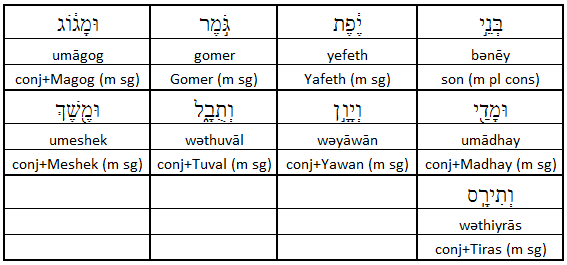
I’m definitely not somebody who skips through the “begets, begets, begets” verses. To me, this is some of the most interesting stuff the Torah has to offer. The world is being rebuilt after the flood, and this chapter lays out the world as far as the Hebrews were aware of it. The sons of Shem (the Asians), Cham (the Africans), and Yafeth (the Europeans) are cast as patriarchs of the nations and peoples who populated the world in which the Hebrews lived.
In some cases, it’s possible to identify these patriarchs with historical nations contemporary with the Hebrews. In other cases, it’s not. Jewish and Christian scholars in the centuries since the writing of the Tanakh have provided their own identifications, often with nations or territories that the ancient Hebrews would have not been aware of. For the most part, when I’m able, I’ll identify these characters with their (probably) original associations.
Gomer – Cimmerians (Gimirru)
Magog – Jospehus associates them with the Scythians (Magogia)
Madhay – Medes (Mada)
Yawan – Greeks (Iawones/Ionians)
Tuval – Luwian Hittites (Tabal)
Meshek – Josephus associates them with an Anatolian people called the Mushki. The Georgians maintain traditions of descent from Meshek.
Tiras – Thracians or Etruscans
Genesis 10:3 – The sons of Gomer were Ashkenaz, Rifath, and Togharmah.
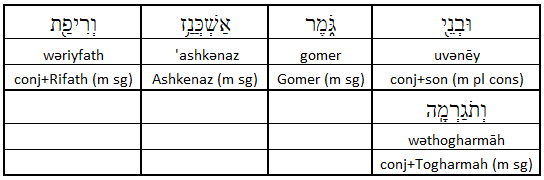
Ashkenaz – An Armenian people called the Ashkuza. Later, Ashkenaz became identified with the area of modern Germany, lending his name to the modern Ashkenazi Jews.
Rifath – Other parts of the Tanakh call him “Difath.” Josephus identified him with the Paphlagonians.
Togharmah – Anatolians, through association to the city Tegarama
Genesis 10:4 – The sons of Yawan were Elishah, Tarshish, Kittim, and Dodhanim.
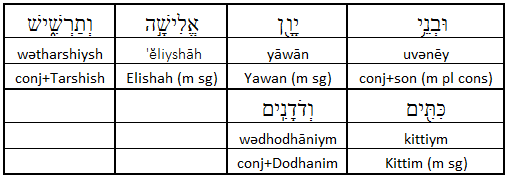
In some cases, rather than a patriarch, the name of an entire nation is used, as Kittim and Dodhanim above (with -im being the plural masculine ending).
Elishah – Cypriots (Alashiya)
Tarshish – Unsure. Tarshish is mentioned frequently in the Tanakh, and other sources, although it has never been located.
Kittim – Kition, a settlement on Cyprus, and later a general name for Mediterranean islands.
Dodhanim – Possibly the people of Rhodes, on the assumption that the initial letter should be a resh (r) and not a dalet (d). Resh and dalet are almost identical in Hebrew – this would make the original name “Rodhanim” (Rodioi in Greek), as it is spelled in some Hebrew manuscripts.
Genesis 10:5 – From these, the islands of the nations were split, each man to his language and tribe.
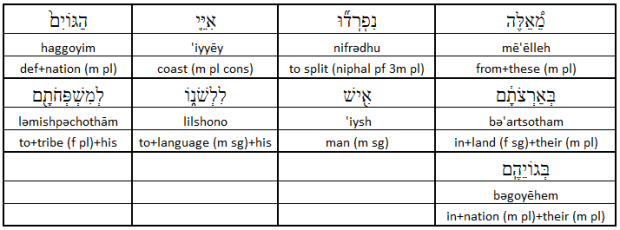
“Iy”, the word for coast above, is something like island, coastline, or habitable spot. “Goyim” is still commonly used today as a designation for non-Jews (and often translated in English bibles as the more recognizable “Gentiles”).
Genesis 10:6 – The sons of Cham were Kush, Mitsrayim, Put, and Kena’an.
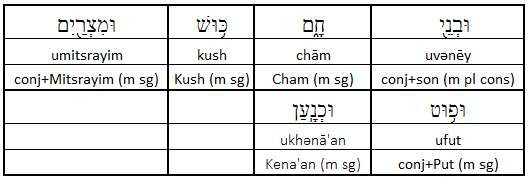
Kush – Kush/Nubia/Sudan
Mitsrayim – Egypt. Interestingly, “Mitsrayim” has the Hebrew dual ending, referring to Upper and Lower Egypt. Misr/Masr is the Arabic variant and modern name of Egypt.
Put – Land of Punt, south of Egypt, or Libya.
Kena’an – Canaan, as we saw in the last chapter
Genesis 10:7 – The sons of Kush were Seva, Chawilah, Savtah, Ra’mah, and Savtekha. The sons of Ra’mah were Sheva and Dedhan.
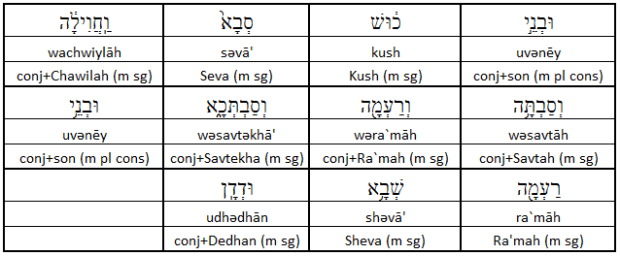
Seva – Unknown
Chawilah – Seen previously in the second creation story. There is another Chawilah descended from Shem
Savtah – Unknown
Ra’mah – Possibly in Yemen, as his son Sheva is associated with Sheba in Yemen
Savtekha – Unknown
Sheva – Sabaeans in Yemen, and the Sheba whose queen visits Solomon. There is another Sheva descended from Shem
Dedhan – Possibly in Yemen
Genesis 10:8 – Kush fathered Nimrodh, who became a champion in the land.
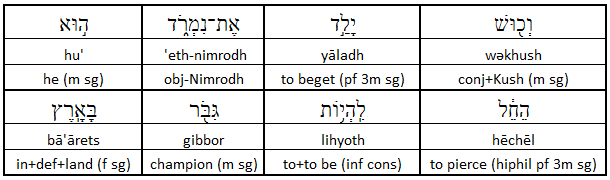
Genesis 10:9 – He was a master hunter before the face of Yahweh; thus, it is said, “Like Nimrodh, a master hunter before the face of Yahweh.”
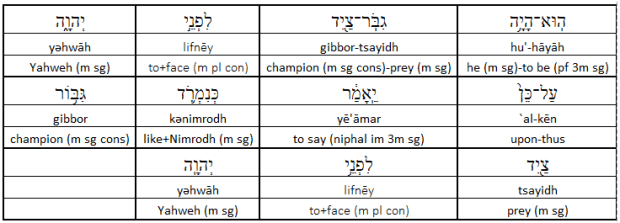
This is an interesting little bit, because it’s spelling out the origins of an idiom that was obviously common at the time. This is really what a lot of Genesis is – the explanation for names and customs and phrases, familiar to the contemporary audience but often lost on us. In some cases, the same location might be given multiple origin stories, pointing to the blending of different traditions.
Genesis 10:10 – This was the beginning of the his kingdom – Bavel, Erek, Akkadh, and Kalneh, in the land of Shin’ar.
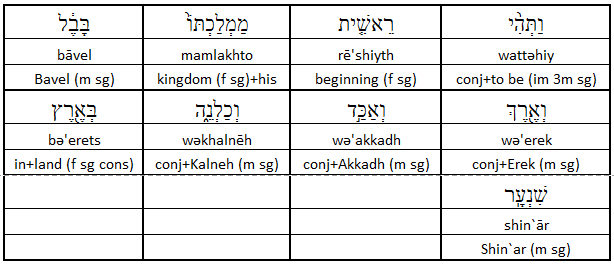
Nimrodh is a master hunter, or a “champion of prey”, who founded a kingdom in Shin’ar (Mesopotamia), centered on Bavel (Babylon). He doesn’t match up to any single historical figure.
Genesis 10:11 – Ashur went out from that land and built Nineweh, Rechovoth, Kalach…
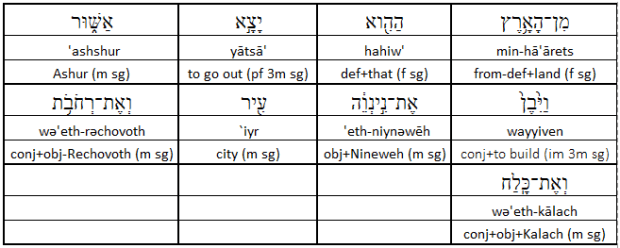
Some readings interpret this as Nimrod leaving for a land called Ashur and then building those cities there, while others see a person named Ashur leaving Nimrod’s land and building the cities. I prefer the latter, which seems more clear to me.
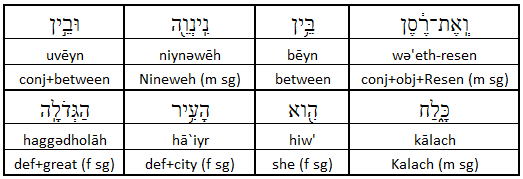
Genesis 10:12 – …and Resen, the great city, between Nineweh and Kalach.
Genesis 10:13 – Mitsrayim fathered Ludhim, Anamim, Lehavim, Naftuchim…

Ludhim – Lydians (Luddu)
Anamim – Unknown
Lehavim – Potentially the Libyans
Naftuchim – Unknown
Genesis 10:14 – …Pathrusim, Kasluchim, from whom came Pelishtim, and Kaftorim.
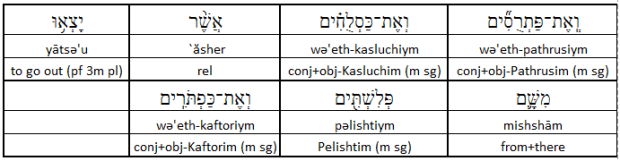
Pathrusim – Upper Egypt (Pathros)
Kasluchim – Kasluhet, a region in Egypt
Pelishtim – Philistines, origin of the word “Palestine”
Kaftorim – Crete/Cyprus
Genesis 10:15 – Kena’an fathered Tsidhon, his firstborn, and Cheth…
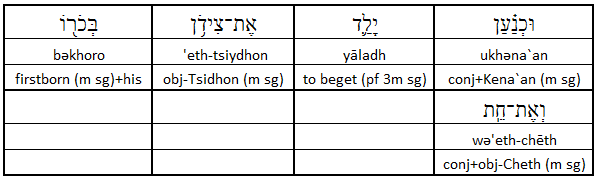
Tsidhon – Sidon, in Lebanon
Cheth – Hittites
Genesis 10:16 – …Yevusi, Emori, Girgashi…

Yevusi – Unknown, the biblical Jebusites
Emori – Amorites (Amurru)
Girgashi – Unknown, the biblical Girgashites
Genesis 10:17 – …Chiwwi, Arqi, Sini…

Chiwwi – Unknown, possibly the Hiyawa
Arqi – Irqata, a city in Lebanon
Sini – Sinna or Sini in Lebanon
Genesis 10:18 – …Arwadhi, Tsemari, and Chamathi – after this, the tribes of Kena’an were scattered.
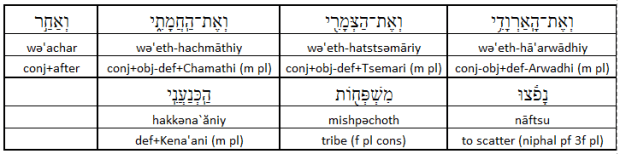
Arwadhi – Arvad, a Syrian island
Tsemari – Sumur, a city in Syria
Chamathi – Hama, a city in Syria
Genesis 10:19 – The border of Kena’an was from Tsidhon to Gerar until Azzah, to Sedhom and Amorah and Adhman and Tsevoyim until Lasha.
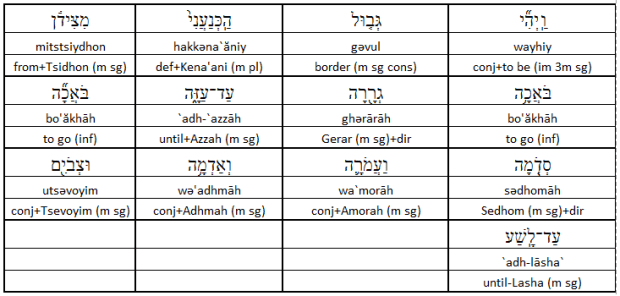
Some of these locations are more familiar in their traditional English renderings – Gaza (Azzah), Sodom (Sedhom), and Gomorrah (Amorah).
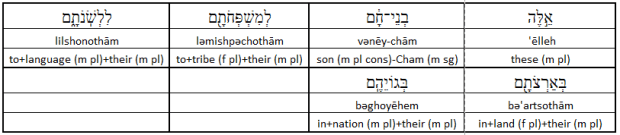
Genesis 10:20 – These were the sons of Cham, by their tribes and languages, in their lands and nations.
Genesis 10:21 – Sons were also born to Shem. He was the father of all the sons of Ever, and the elder brother of Yafeth.
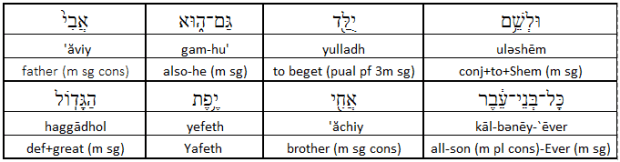
I use the word “Hebrew” narrowly, to refer to the pre-Jewish inhabitants of the kingdoms of Israel and Judah. Really, though, any descendant of Ever (or Eber/Heber) can be considered a Hebrew – Israelites, Ishmaelites, Ammonites, Moabites, Edomites, and others.
This verse is pointing out that the descendants of Ever are the descendants of Shem, himself the older or “greater” brother of Yafeth (there is some debate over whether Yafeth or Shem is the elder brother, though). Taken as Shem being the eldest, this places the Shemites above the Yafethites. As we already know, Shem and Yafeth are then both above Cham and the Chamites (especially the descendants of Kena’an), due to his sins in the previous chapter. All of this adds up to a bunch of cultural propaganda for the Hebrews.
Genesis 10:22 – The sons of Shem were Eylam, Ashur, Arpachshadh, Ludh, and Aram.
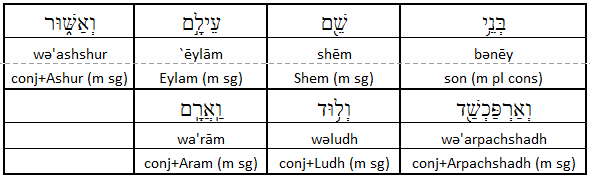
Eylam – Elamites, an Iranian people
Ashur – Assyrians (presumably the same Ashur in the Nimrodh story above). Ashur is also the chief god in the Assyrian pantheon, so Ashur son of Shem might be the same figure as the Assyrian god Ashur.
Arpachshadh – Ur Kesdim, or Ur of the Chaldees, the birth place of Abraham
Ludh – Lydian Anatolians (Luddu)
Aram – Arameans
Genesis 10:23 – The sons of Aram were Uts, Chul, Gether, and Mash.
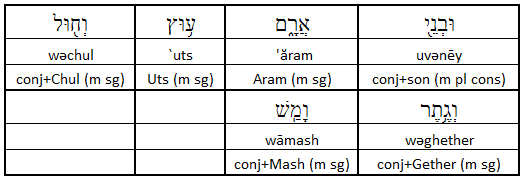
Uts – Possibly the Land of Uz
Chul – Armenians, according to Josephus
Gether – Bactrians, according to Josephus
Mash – Unknown
Genesis 10:24 – Arpachshadh fathered Qeynan, and Qeynan fathered Shelach, and Shelach fathered Ever.
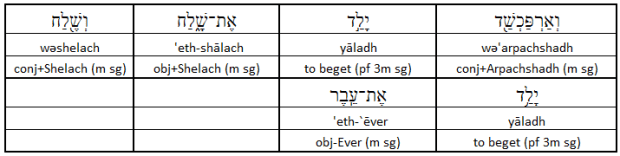
This is one of those situations where I’ve gone with the Greek Septuagint over what is shown here from the Hebrew Masoretic Text. The Septuagint mentions the character Qeynan between Arpachshadh and Shelach. The Septuagint is the older text, and Christian writing and other Hebrew texts like the Book of Jubilees also include Qeynan in this lineage, so I’ve placed him here as well.
Qeynan – Unknown
Shelach – Unknown. Traditionally associated with the prophet Salih, who according to the Qur’an preached to the Thamud.
Ever – Hebrews
Genesis 10:25 – Two sons were born to Ever. The name of the first was Peleg, for in his day the land was split. His brother’s name was Yaqetan.

Peleg – As is often the case, names are explained by puns. Pelegh sounds like “palagh”, the verb used above in the form “nifleghah”, “to split.”
Yaqetan – Unknown
Genesis 10:26 – Yaqetan fathered Almodhadh, Shalef, Chatsarmaweth, Yarach…
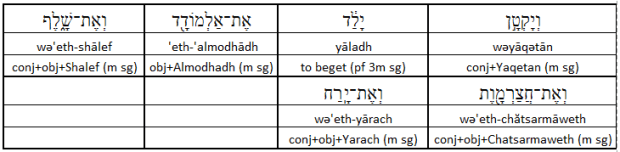
Almodhadh – Possibly southern Arabia
Shalef – Unknown
Chatsarmaweth – Hadhramaut in southern Arabia
Yarach – Unknown
Genesis 10:27 – …Hadhoram, Uzzal, Diqlah…

Hadhoram – Possibly in Yemen
Uzzal – Azal, a city in Yemen and the ancient name of Sana’a
Diqlah – Unknown
Genesis 10:28 – …Oval, Avima’el, Sheva…

Oval – Unknown
Avima’el – Unknown
Sheva – Sabaeans, or Sheba. Similar to the previously mentioned Sheva, and possibly the same character
Genesis 10:29 – …Ofir, Chawilah, and Yovav. All of these were the sons of Yaqetan.
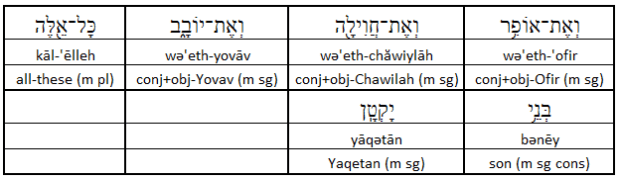
Ofir – Unknown
Chawilah – Chawilah, from the second story of creation. Similar to the previously mentioned Chawilah, and possibly the same character
Yovav – Unknown
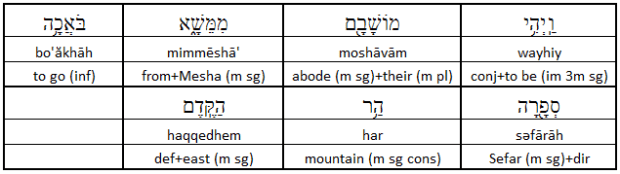
Genesis 10:30 – Their abode was from Mesha to Sefar, the mountains of the east.
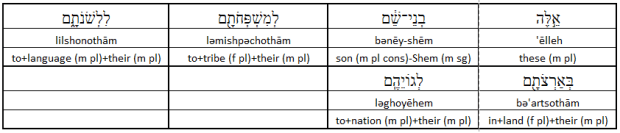
Genesis 10:31 – These were the sons of Shem, by their tribes and languages, in their lands and nations.
Genesis 10:32 – These were the tribes of the sons of Noach, by their lineages and nations, and from these the nations were split across the land after the flood.

If you include Qeynan and remove the doubled Sheva and Chawilah, then the result is 70 names or nations. This will become important later on, when the motif of the seventy sons of the gods is introduced. Long story short, the high god Elyon divides humanity into seventy nations, one nation for each god, with Yahweh being the god over Israel.
Genesis 11:1 – All the land was of a single language.
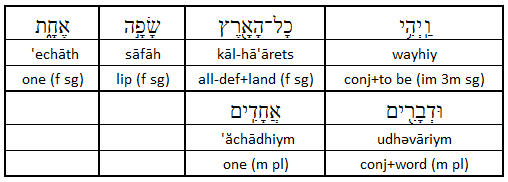
Specifically, one lip and one word.
Genesis 11:2 – As they journeyed from the east, they found a plain in the land of Shin’ar, and they dwelled there.
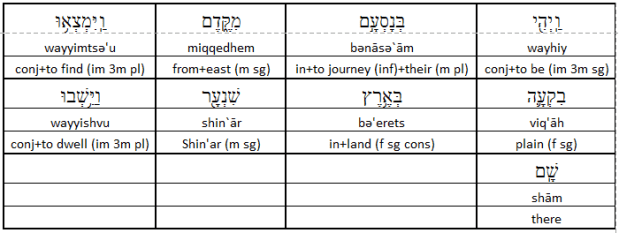
The word for “to journey” comes from the same word as to raise or pull up, as in pulling up tent pins. This is the same Shin’ar as the earlier story with Nimrodh.
Genesis 11:3 – “Let’s bake bricks,” they said to one another, using brick instead of stones and tar instead of cement.
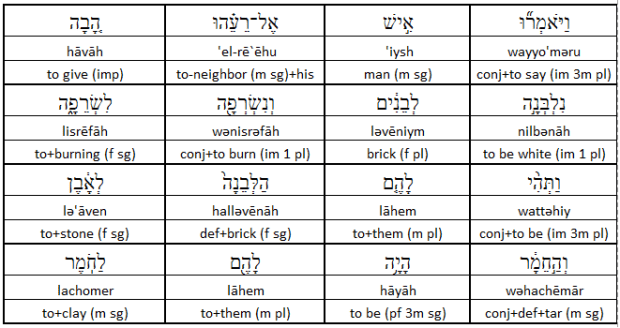
The word for brick is related to the word for white, and what’s literally being said here is something like, “let’s brick a brick and burn a burning” – in other words, bake bricks. The imperative form of “to give” used here is more like “let’s go” or “come.” “Chomer”, the word for clay, is used here in the sense of a binding agent, so “mortar” or “cement.”
Genesis 11:4 – “Let’s build a city and a tower, and its head will be in the sky. We’ll make a name for ourselves, or else we’ll be scattered across the land.”
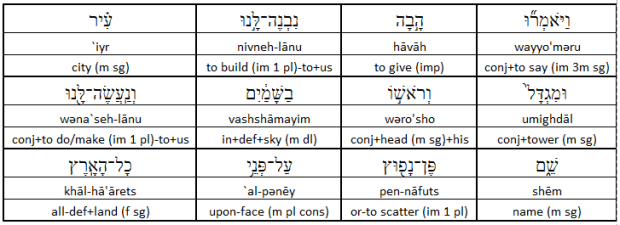
Genesis 11:5 – Yahweh came down to see the city and the tower which the sons of the humans had built.

Genesis 11:6 – “Behold,” he said. “All the people and their language are one, and they have begun to build this city and tower. Now, nothing will be impossible for them, and they will be able to do everything they devise.”
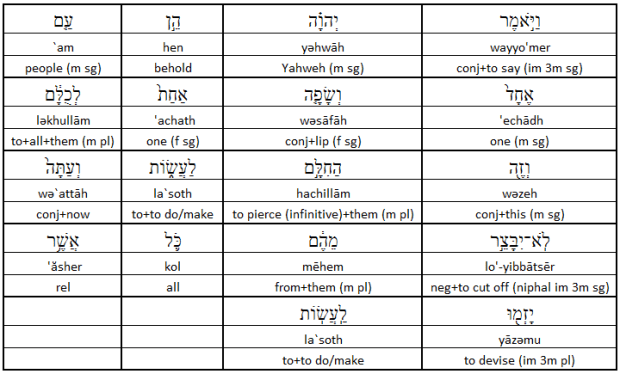
It actually just says “they have begun to do this”, but I added in the part about building the city and tower to make it a little more clear. The verb translated as “cut off” can also have a meaning of “to be impossible.”
This is definitely a Yahweh story. He’s very similar to the Yahweh in the creation story, who’s somewhat afraid of what humans can accomplish. In that story, he had to banish humans to prevent them from becoming immortal, and now he’s worried that in their unity, they might become a threat.
Genesis 11:7 – “Let’s descend and mix their language, so that they won’t be able to understand one another.”
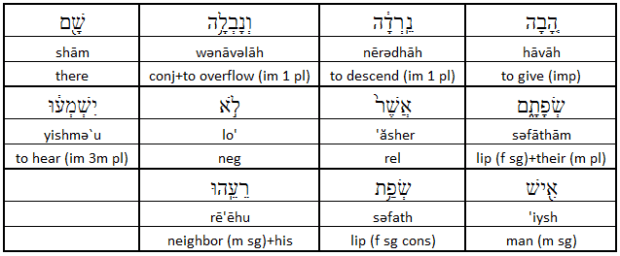
“So that a man will not hear the lip of his neighbor.” “To overflow” above has an original sense of overflowing something with oil, mixing liquids. Yahweh’s verbs here are all 1st personal plural, calling back to the oldest polytheistic/monolatristic origins of the Hebrew pantheon. It’s a different usage than the “royal plural” used for Elohim, where “Elohim” is plural to show majesty but the associated verbs are singular to show that he’s a single figure.
Genesis 11:8 – Yahweh scattered them from there across the face of the land, and they stopped building the city.
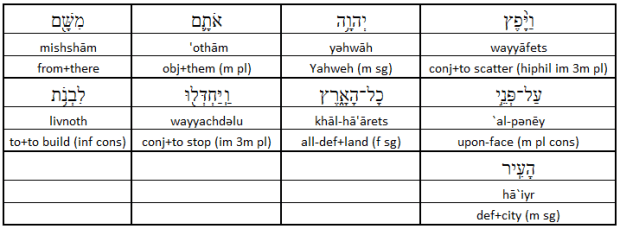
Genesis 11:9 – For that reason, it’s called Bavel, for there Yahweh mixed the language of all the land, and from there he scattered the people over the face of the land.
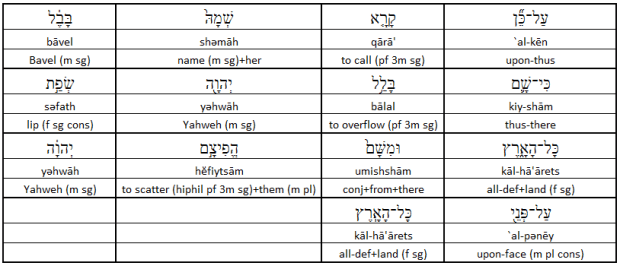
This is the same Bavel as mentioned above, so traditionally Nimrodh is seen as the builder of the Tower of Bavel/Babel.
Once again, a pun is used for the city’s name. This place is called Bavel, and it’s a story about the confusing of languages, and the word “to mix” in Hebrew is balal, which sounds kind of like Bavel, so there you go. Usually, Bavel (or Babel) is thought to be the origin of the English word “babble”, but that’s a false etymology. It probably means something like “Gate of El” or “Gate of God” from “bab”, gate, and El.
As the Hebrew name for Babylon, this syncs up nicely – Babylon in Akkadian is “Babili”, which can be interpreted as “Gate of the God(s).” This might also be incorrect, though, and the city’s original meaning might be beyond the reach of written history.
Full Text
These are the generations of the sons of Noach – Shem, Cham, and Yafeth. Sons were born to them after the flood.
The sons of Yafeth were Gomer, Magog, Madhay, Yawan, Tuval, Meshek, and Tiras. The sons of Gomer were Ashkenaz, Rifath, and Togharmah. The sons of Yawan were Elishah, Tarshish, Kittim, and Dodhanim. From these, the islands of the nations were split, each man to his language and tribe.
The sons of Cham were Kush, Mitsrayim, Put, and Kena’an. The sons of Kush were Seva, Chawilah, Savtah, Ra’mah, and Savtekha. The sons of Ra’mah were Sheva and Dedhan. Kush fathered Nimrodh, who became a champion in the land. He was a master hunter before the face of Yahweh; thus, it is said, “Like Nimrodh, a master hunter before the face of Yahweh.”
This was the beginning of the his kingdom – Bavel, Erek, Akkadh, and Kalneh, in the land of Shin’ar. Ashur went out from that land and built Nineweh, Rechovoth, Kalach, and Resen, the great city, between Nineweh and Kalach.
Mitsrayim fathered Ludhim, Anamim, Lehavim, Naftuchim, Pathrusim, Kasluchim, from whom came Pelishtim, and Kaftorim. Kena’an fathered Tsidhon, his firstborn, and Cheth, Yevusi, Emori, Girgashi, Chiwwi, Arqi, Sini, Arwadhi, Tsemari, and Chamathi – after this, the tribes of Kena’an were scattered. The border of Kena’an was from Tsidhon to Gerar until Azzah, to Sedhom and Amorah and Adhman and Tsevoyim until Lasha. These were the sons of Cham, by their tribes and languages, in their lands and nations.
Sons were also born to Shem. He was the father of all the sons of Ever, and the elder brother of Yafeth. The sons of Shem were Eylam, Ashur, Arpachshadh, Ludh, and Aram. The sons of Aram were Uts, Chul, Gether, and Mash. Arpachshadh fathered Qeynan, and Qeynan fathered Shelach, and Shelach fathered Ever.
Two sons were born to Ever. The name of the first was Peleg, for in his day the land was split. His brother’s name was Yaqetan. Yaqetan fathered Almodhadh, Shalef, Chatsarmaweth, Yarach, Hadhoram, Uzzal, Diqlah, Oval, Avima’el, Sheva, Ofir, Chawilah, and Yovav. All of these were the sons of Yaqetan. Their abode was from Mesha to Sefar, the mountains of the east. These were the sons of Shem, by their tribes and languages, in their lands and nations.
These were the tribes of the sons of Noach, by their lineages and nations, and from these the nations were split across the land after the flood.
All the land was of a single language. As they journeyed from the east, they found a plain in the land of Shin’ar, and they dwelled there.
“Let’s bake bricks,” they said to one another, using brick instead of stones and tar instead of cement. “Let’s build a city and a tower, and its head will be in the sky. We’ll make a name for ourselves, or else we’ll be scattered across the land.”
Yahweh came down to see the city and the tower which the sons of the humans had built.
“Behold,” he said. “All the people and their language are one, and they have begun to build this city and tower. Now, nothing will be impossible for them, and they will be able to do everything they devise. Let’s descend and mix their language, so that they won’t be able to understand one another.”
Yahweh scattered them from there across the face of the land, and they stopped building the city. For that reason, it’s called Bavel, for there Yahweh mixed the language of all the land, and from there he scattered the people over the face of the land.
 Translate the Torah