The Generations of Noach
Genesis 6:9 – These are the generations of Noach. Noach was a righteous man, perfect in his time; he walked with the gods.
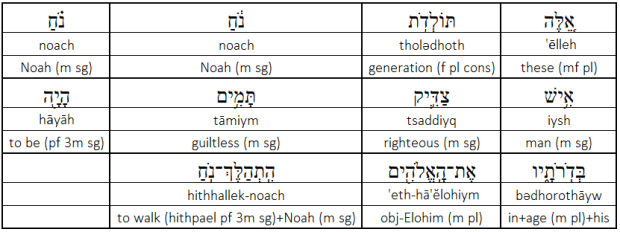
“Tāmiym” really means something more like “complete” or “perfect.” “Bǝdhorothāyw”, “in his age”, refers to the generation or time when he lived.
Like Hanok, Noach walks with the gods.
Genesis 6:10 – He fathered three sons – Shem, Cham, and Yafeth.

Genesis 6:11 – The land was corrupted before the face of the gods, and it was filled with violence.
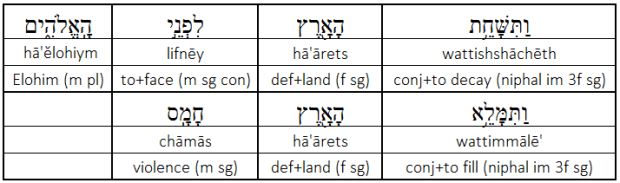
The verb shachath, used above in the form wattishshacheth, means “to decay/corrupt.” It’s used often in these chapters, with different connotations. Here, it’s in the niphal or passive form.
Genesis 6:12 – Elohim saw the land, and behold, it was corrupted, for all flesh had corrupted its way over the land.
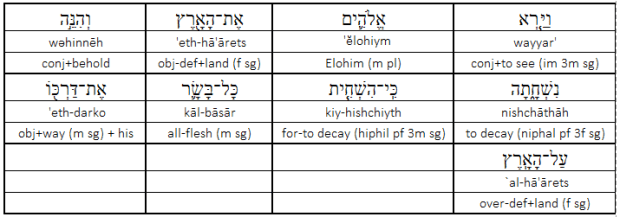
Genesis 6:13 – “The end of all flesh has come before me, for because of them the land is full of violence,” Elohim said to Noach. “Behold, I will ruin them and the land.”

The same shachath is used here in the hiphil or causative form – “cause to decay/corrupt”, or just “destroy/ruin.”
Genesis 6:14 – “Make a cedar ship with rooms in it, and cover it inside and outside with pitch.”
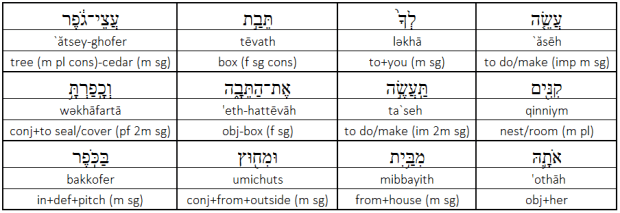
Gopher wood, or `atsey-ghofer, is one of those phrases that appears only once in Hebrew scriptures. Sometimes it appears untranslated – according to the Jewish Encyclopedia, it’s probably a corruption of the Babylonian word for “cedar.”
The word for “ark” is used only here and in the story of Moses being placed in a basket as an infant. Since “ark” conjures up specific associations to the story of Noah as understood by modern Jews and Christians, I initially wanted to go with the plainer “box.” Also, “ark” is itself just an older word for “box” that is pretty much only used today in the context of this story. However, consistently referring to the ship as a “box” sounded pretty awful in English, honestly, so I’m going with “ship.”
Genesis 6:15 – “This is how you will make it – the ship will be three hundred cubits long, fifty cubits wide, and thirty cubits high.”
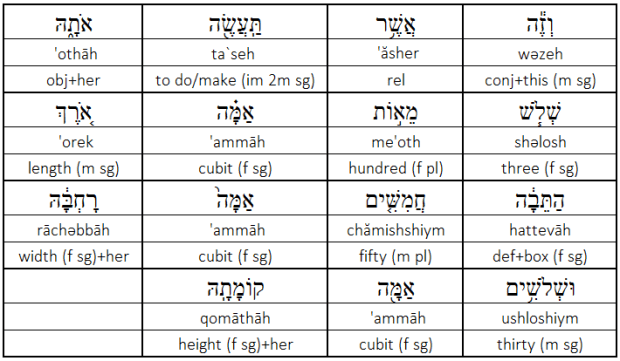
The size of a cubit could vary, but it was a unit of measurement taken from the length of the forearm.
Genesis 6:16 – “Make a lantern in the ship, and finish it a cubit from the top. Put a door in the side, and make lower, second, and third levels.”
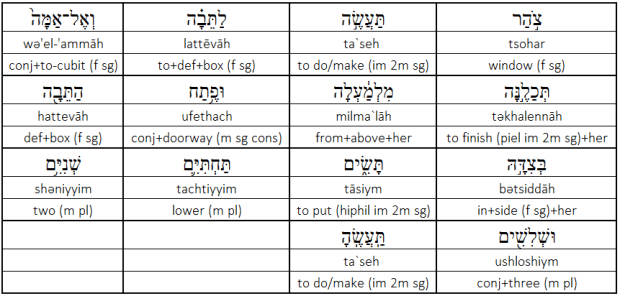
“Tsohar” also only shows up here – it’s usually translated as “window”, meaning “glisten” and ultimately coming from a root for “oil.” Some traditions interpret this as a glowing stone to provide light within the ark. Given the association to oil, I like to think of it as a lantern or lamp within the ark.
Genesis 6:17 – “Behold, I am sending a flood over the land, to ruin all flesh beneath the sky that has the breath of life in it. All that is in the land will breathe its last.”
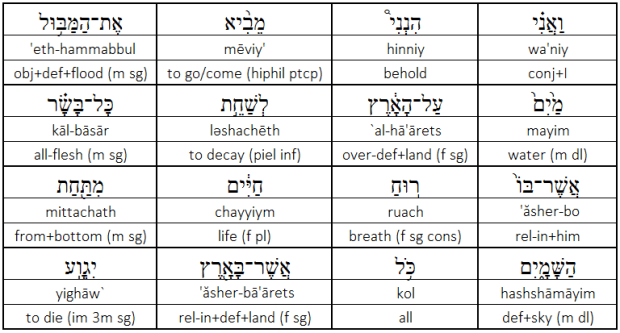 Interestingly, according to Strong’s, the word for “die” used here has a connotation of “breathing out.” Seems a good parallel for the previous line that targets anything with the “breath of life.”
Genesis 6:18 – “I will set up my covenant with you. Go into the ship, you and your sons, your wife and your sons’ wives.”
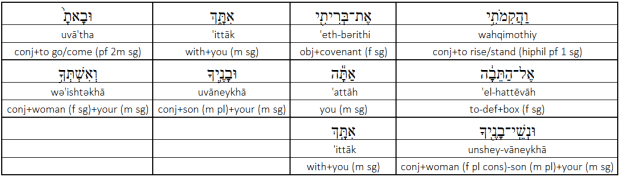
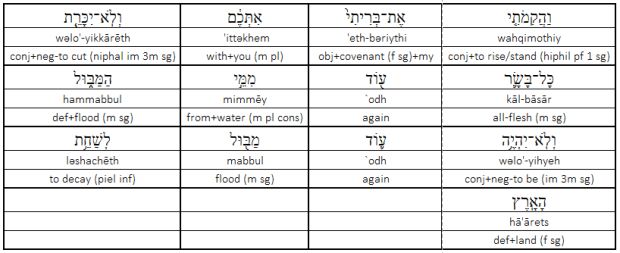
The first verb is a causative of “to rise/stand”, so “set up/cause to stand.” Berith, the word for for covenant, is related to the word for “cut.”
Genesis 6:19 – “Take two, a male and a female, from all life and all flesh, into the ship to live with you.”

Genesis 6:20 – “Two of every kind of bird, livestock, and crawling thing will go to live with you.”

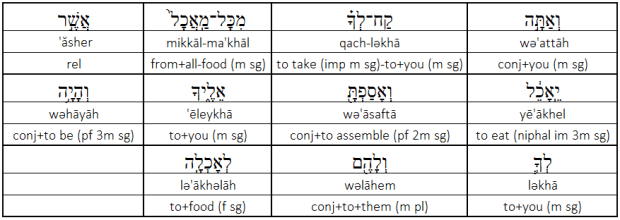
Genesis 6:21 – “Take from every kind of food and gather it to you, and it will be food for you and for them.”
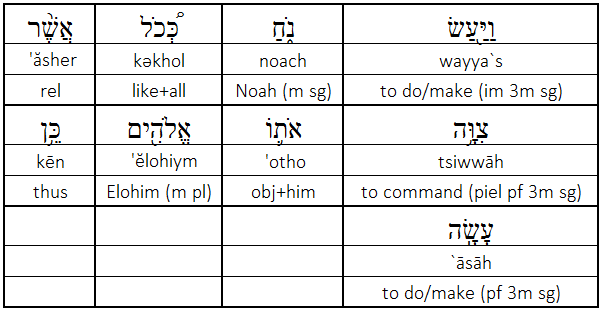
Genesis 6:22 – Noach did everything as Elohim commanded him.
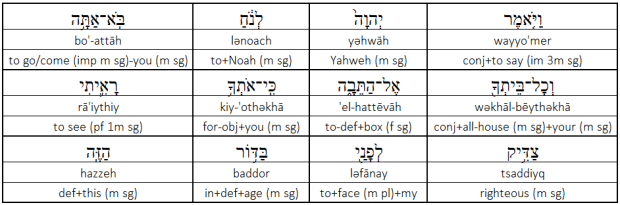
Genesis 7:1 – “Go, you and all your house, into the ship.” Yahweh said to Noach. “I have seen that you are righteous before my face in this time.”
This story blends together different sources (most easily signaled by the term used to reference the divine – notice the switch to “Yahweh” here).
Genesis 7:2 – “Take seven pairs from all the pure livestock, male and female, and one pair from all the impure livestock…”

The blending of sources is why we have two different commandments regarding how many animals to take – the divine as Elohim commands simply two of every animal, while the divine as Yahweh asks for seven pairs of pure (clean) animals and a single pair of every impure (unclean) animal. This is clearly anachronistic, as the concept of ritual purity and what constitutes a “clean” or “unclean” animal has not yet been introduced at this point in the narrative.
Genesis 7:3 – “…as well as seven pairs of the birds of the skies, to keep their seed alive over the face of the land.”

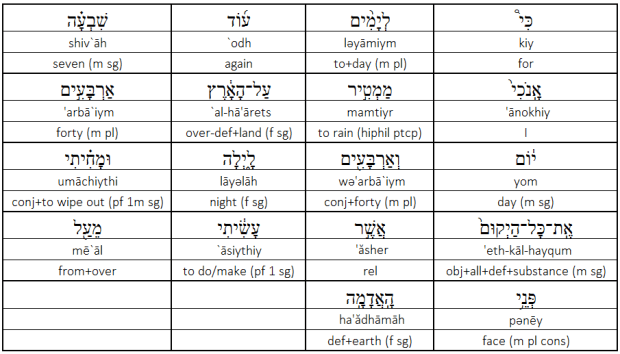
Genesis 7:4 – “…for in seven days I will cause rain to fall over the land for forty days and forty nights, to wipe out everything that I have made from the face of the earth.”
Genesis 7:5 – Noach did everything as Yahweh commanded him.
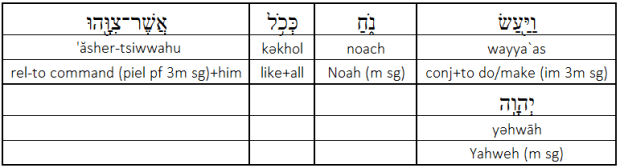
Genesis 7:6 – He was six hundred years old when the flood came over the land.
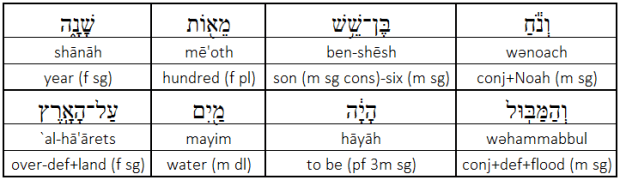
Genesis 7:7 – He took his sons, his wife, and his sons’ wives into the ship with him, away from the floodwaters.
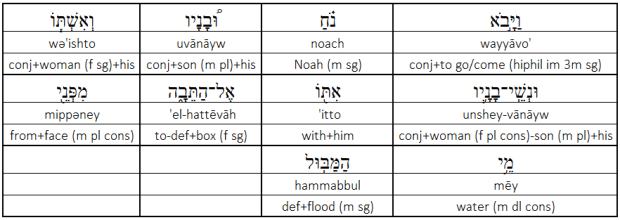
Genesis 7:8 – The pure livestock, the impure livestock, the birds, and all that crawls over the earth…
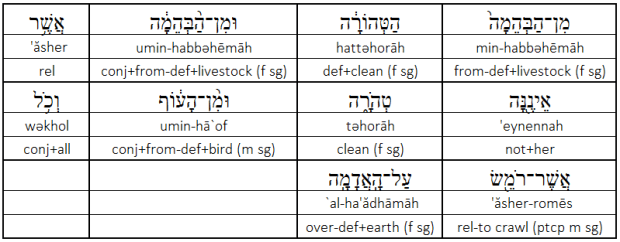
Genesis 7:9 – …came to Noach and the ship two by two, male and female, as Elohim had commanded him.

Genesis 7:10 – Seven days passed, and the floodwaters came over the land.
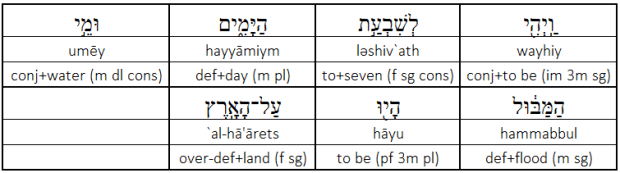
Genesis 7:11 – In the six hundredth year of Noach’s life, on the seventeenth day of the second month, the springs of the Deep burst and the floodgates opened.
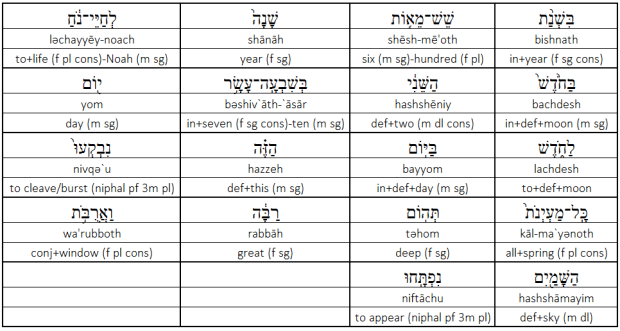
Remember the Deep from the creation stories? The world is now returning to its most ancient state, with the waters below the land and above the rāqiya` being released. The “windows of the skies” refer to the floodgates in the rāqiya`, gates that could be opened to let the waters above rain down to the earth.
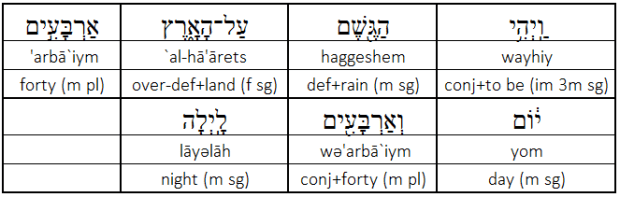
Genesis 7:12 – It rained for forty days and forty nights.
Genesis 7:13 – On that day, Noach went into the ship with his sons Shem, Cham, and Yafeth, his wife, and the three wives of his sons -…
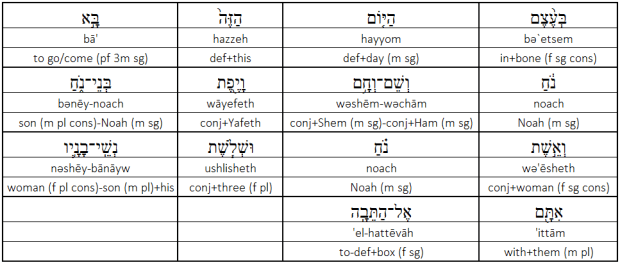
“`Etsem” means “bone/substance/self.” This construction, “in the bone/substance of this day”, means something like “On this very day” – referring to the day from two verses ago.
Genesis 7:14 – …along with every kind of life – livestock and crawling things and birds of every feather.
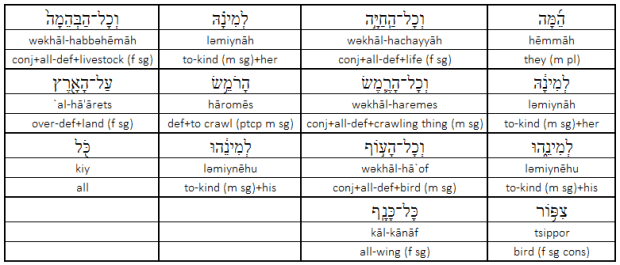
Genesis 7:15 – All flesh that had the breath of life came two by two to Noach and the ship.
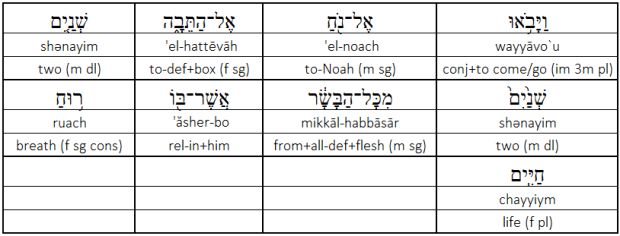
Genesis 7:16 – Those who came in were male and female of every kind, as Elohim had commanded him, and Yahweh shut them in.
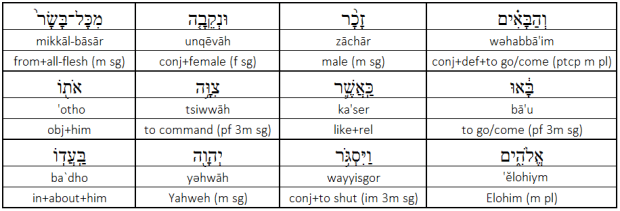
Genesis 7:17 – The flood was over the land for forty days, and the waters increased and raised the ship over the land.
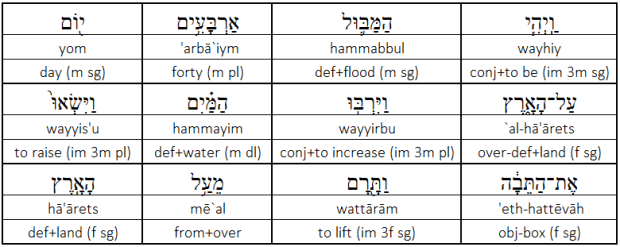
Genesis 7:18 – They strengthened and increased greatly over the land, and the ship moved over the face of the water.
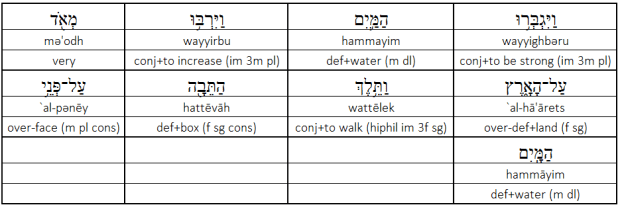
Genesis 7:19 – The waters grew more and more, until all of the high mountains under the skies were completely covered…
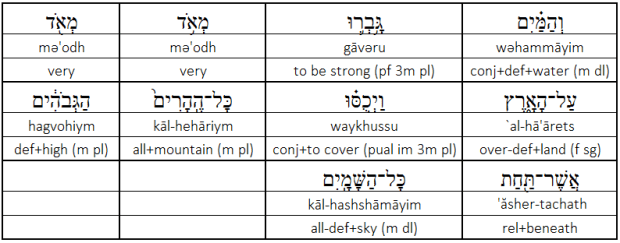
Genesis 7:20 – …beneath fifteen cubits of water.
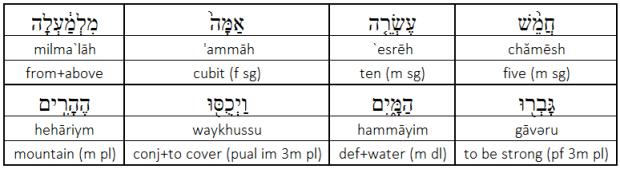
This is especially condensed, even for me…
Genesis 7:21 – All flesh that crawled over the land died – birds, livestock, everything that swarms, and humans.
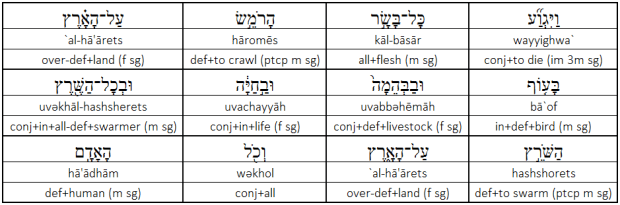
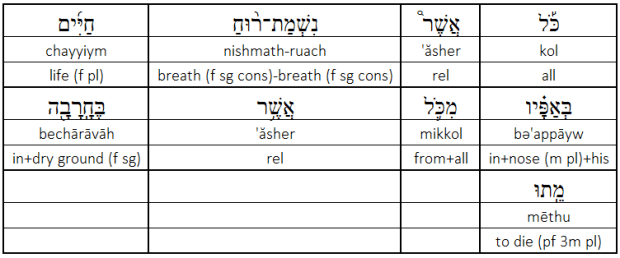
Genesis 7:22 – Everything on dry land with the breath of life in its nose died.
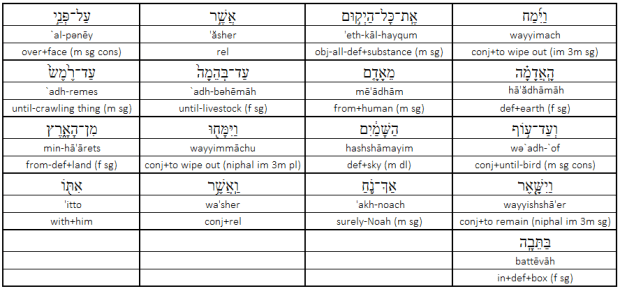
Genesis 7:23 – He wiped out everything on the face of the earth – humans, livestock, crawling things, birds of the sky. Only Noach and those with him in the ship remained.
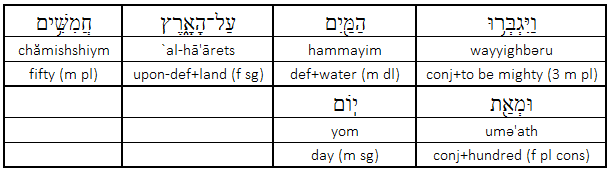
Genesis 7:24 – The waters dominated the land for one hundred and fifty days.
Genesis 8:1 – Elohim remembered Noach and the life with him in the ship, and he breathed over the land, and the waters decreased.
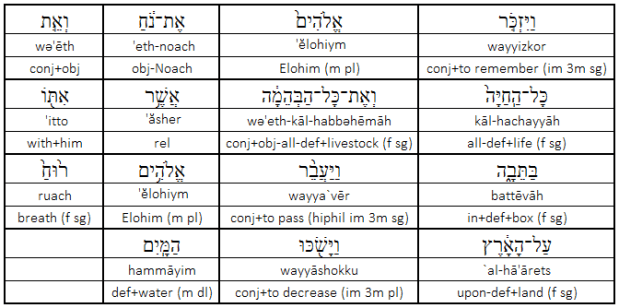
According to Strong’s, “ruach” comes from the verb for “to blow.” This is the same word used in the creation stories to refer to the “spirit of God” or the “breath of Elohim” that was over the waters of the Deep. Here, it more literally reads “Elohim caused a breath/wind/ruach to pass over the land.” As its most original meaning seems to be related to breathing, I’ve translated this simply as “he breathed.”
Genesis 8:2 – The springs of the Deep and the floodgates were shut up, and the rain was restrained.

Genesis 8:3 – The waters receded from the land, coming and going, and at the end of the one hundred and fifty days they had decreased.

Genesis 8:4 – On the seventeenth day of the seventh month, the ship rested upon the mountains of Ararat.
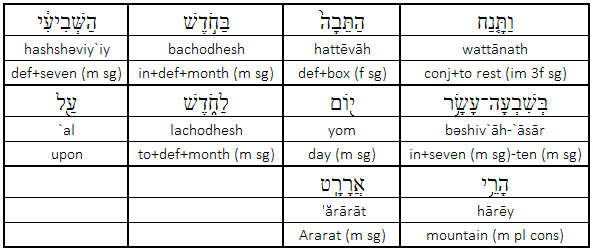
Ararat would be somewhere in Armenia or eastern Turkey.
Genesis 8:5 – The waters flowed and decreased until the tenth month. On the first day of the month, the peaks of the mountains could be seen.
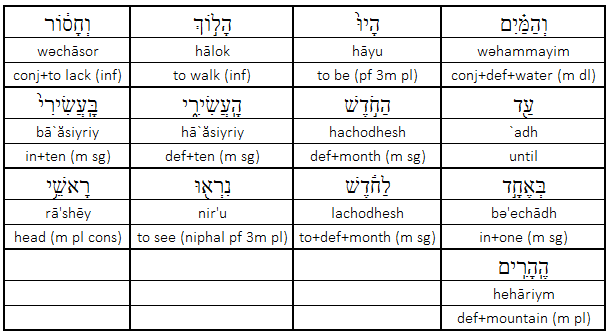
Genesis 8:6 – After forty days, Noach opened a window in the ship.
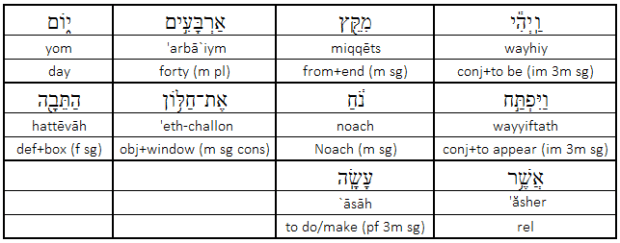
Genesis 8:7 – He sent a raven to go to and fro until the waters had dried from the land.
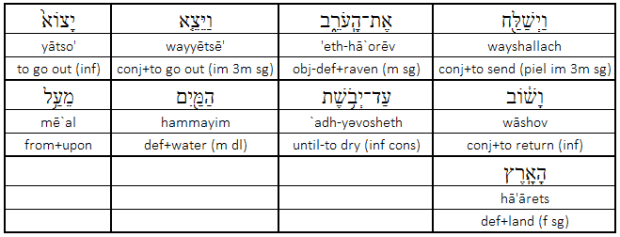
Genesis 8:8 – He then sent a dove to see if the waters had abated from the earth.
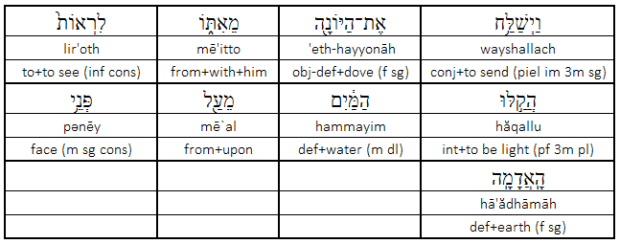
Genesis 8:9 – The dove found no resting place, and it returned to him, for the waters were still over the land. Noach reached out, took the dove, and pulled her into the ship.

Genesis 8:10 – He waited seven more days, and again sent the dove from the ship.
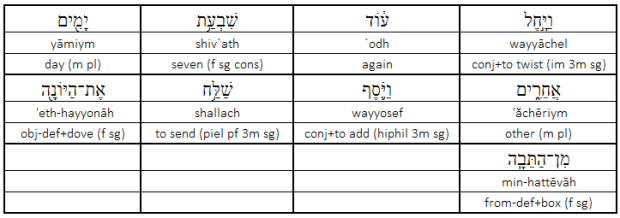
This word, wayyachel, is interesting. It means something like “twist” or “writhe”, in the sense of waiting or enduring.
Genesis 8:11 – The dove came to him in the evening, and behold, an olive leaf was plucked off in her mouth, and Noach knew that the waters had abated from the land.
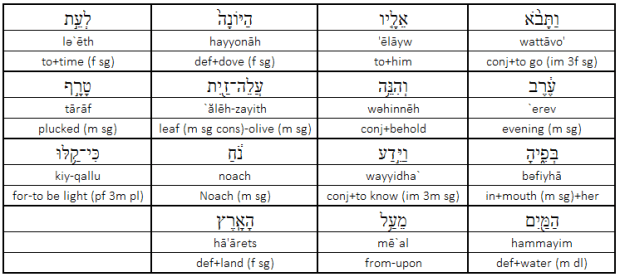
Genesis 8:12 – He waited seven more days, sent the dove out, and it never returned to him.

Genesis 8:13 – In his six hundred and first year, on the first day of the first month, the waters had dried up. Noach removed the ship’s covering, and behold, he saw that the face of the earth was dry.
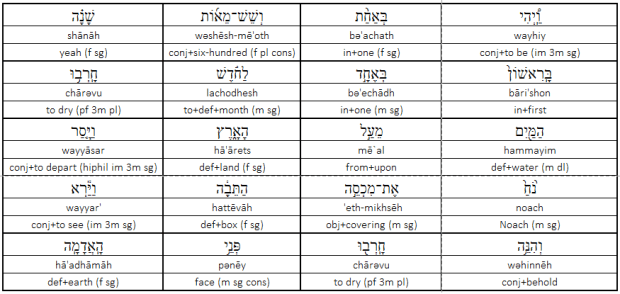
Genesis 8:14 – On the twenty seventh day of the second month, the land was dry.
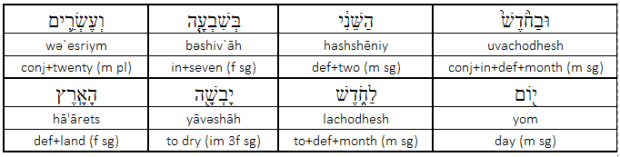
Genesis 8:15 – (…Elohim said to Noach.)

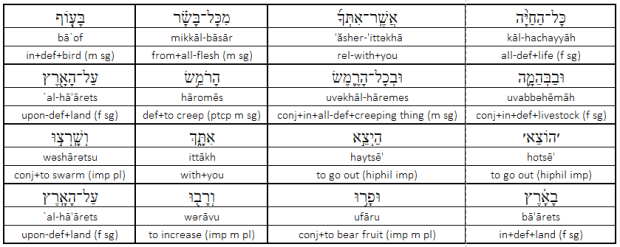
Genesis 8:16 – “Leave the ship, you and your wife, your sons and your sons’ wives.”

Genesis 8:17 – “Bring all life that is with you – birds, livestock, and crawling things – so that they will swarm over the land, bear fruit, and increase.”
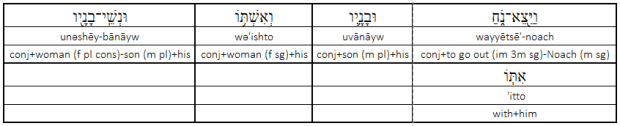
Genesis 8:18 – Noach, his sons, his wife, and his sons’ wives, went out…
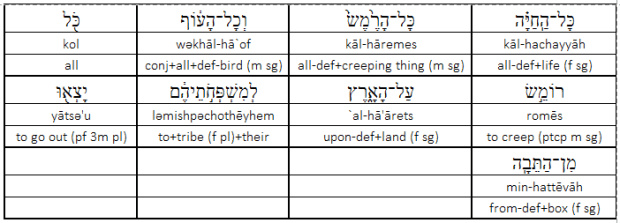
Genesis 8:19 – …as did all life, crawling things, and birds, according to their families.
Genesis 8:20 – Noach built an altar to Yahweh, and he made a sacrifice of the pure livestock and birds.
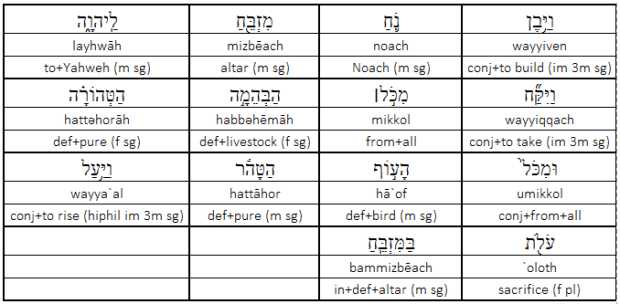
Genesis 8:21 – Yahweh smelled the soothing scent. “I will never again curse the earth on account of humanity,” he said to himself. “From youth the purpose of their hearts is evil. Never again will I strike all life as I have done.”
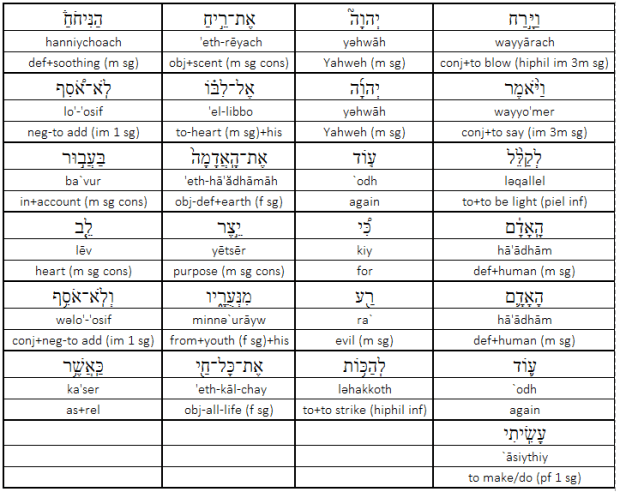
The same word I’m using here for “curse” is what I previously translated as “abated.” The core meaning is “to make/be light”, with a figurative sense of “to make trivial/easy.” Here, it’s in the piel form, which is an intensifier, and is usually understood as “to make contemptible/vile/irrelevant.”
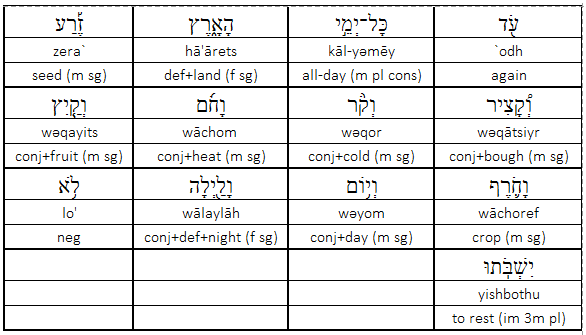
Genesis 8:22 – “For all the days of the earth, planting and harvest, cold and heat, spring and autumn, and day and night will not rest.”
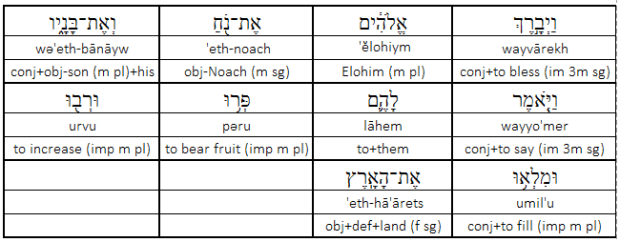
Genesis 9:1 – Elohim blessed Noach and his sons. “Bear fruit, increase, and fill the land,” he said to them.
Genesis 9:2 – “The fear and dread of you will be upon all creatures of the land, all birds of the sky, all that crawls over the earth, and all fish of the sea. They have been delivered into your hand.”

Genesis 9:3 – “All crawling things which have life in them will be your food. I have given you everything, as I had given green plants.”
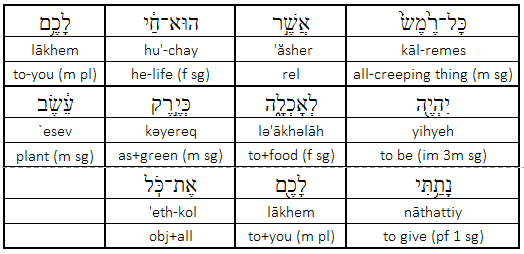
Genesis 9:4 – “You may not eat flesh that has its life, its blood, in it.”
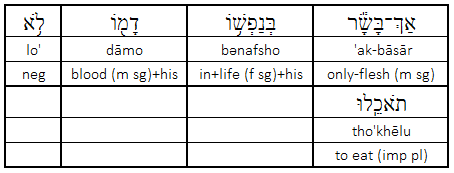
Genesis 9:5 – “I will require your blood for your lives, from the hand of every beast and person. I will require it from every man for his brother.”
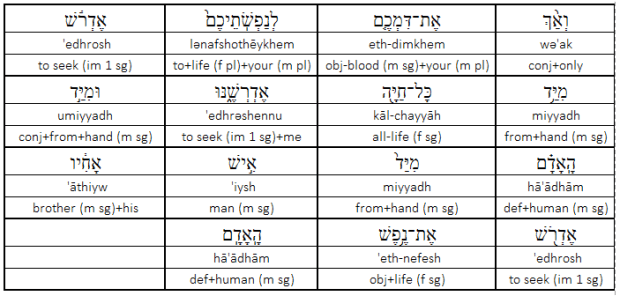
Genesis 9:6 – “Whoever spills a person’s blood will have their blood spilled by others, for humans were made in the image of Elohim. “

Genesis 9:7 – “Bear fruit, increase, swarm in the land and increase in it.”
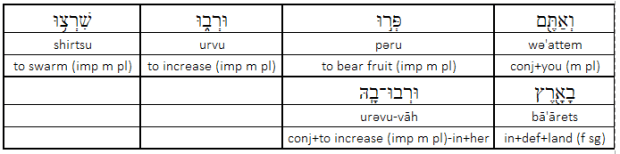
Genesis 9:8 – [Elohim spoke to Noach and his sons, saying…]
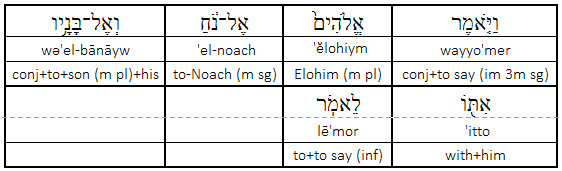
Genesis 9:9 – “Behold, I am setting up my covenant with you and with your seed that follows you…”
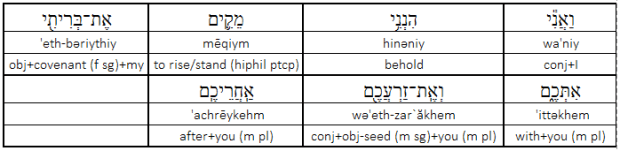
Genesis 9:10 – “…and with everything that is with you – birds and livestock and all that came out of the ship with you.

Genesis 9:11 – “I am setting up my covenant with you. Never again will all flesh be cut down by floodwaters. Never again will a flood destroy the land.”
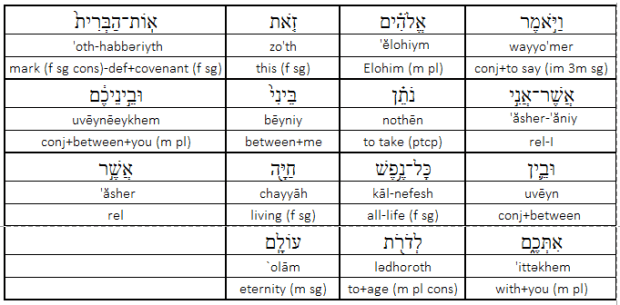
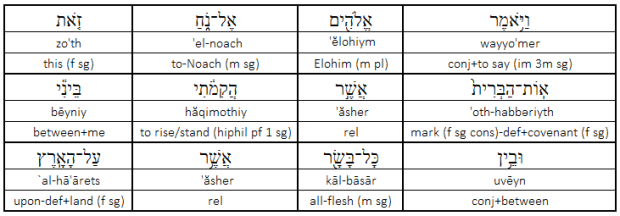
Genesis 9:12 – “This is the mark of the covenant I am taking between me, you, and all life with you, for all ages to come.”
Genesis 9:13 – “I have set my bow in the clouds, and it will be a mark of the covenant between me and the land.”

Yahweh is often understood to have originally been a storm and war god – this makes sense if the rainbow was identified as the bow he carried.
Genesis 9:14 – “When I send clouds over the land, my bow will appear…”
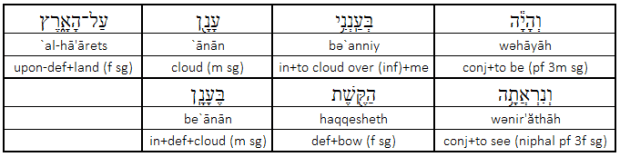
Genesis 9:15 – “…and I will remember my covenant that is between me and you and between all life, and never again will floodwaters destroy the living.”
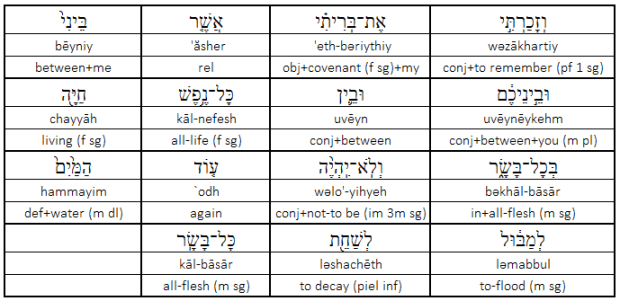
Genesis 9:16 – “The bow will be in the clouds, and I will see it and remember the eternal covenant between Elohim and all life in the land.”

Genesis 9:17 – “This is the sign of the covenant I have set up between me and all life in the land.”
Genesis 9:18 – Shem, Cham, and Yafeth were the sons of Noach who went out of the ship. Cham was the father of Kena’an.

Kena’an, or Canaan, is a nation that is constantly cast as an enemy to the Hebrews throughout the Tanakh. Much of Cham’s actions that follow are set up to demonstrate the superiority of the Hebrews (descended from Shem) over the Canaanites.
Genesis 9:19 – From these three sons of Noach, the land was filled.

Since the story of Noach is something of a factory reset of creation, a new set of lineages will need to follow in order to populate the earth. More specifics will come in later chapters, but from a very broad perspective, the Hebrews conceived of all nations being descended from either Shem, Cham, or Yafeth.
Generally speaking, Shem is the father of the Asians (the Shemites or Semites), Cham is the father of the Africans, and Yafeth is the father of the Europeans. Among many other nations, Shem will become the forebear to the Hebrews, Cham the forebear to the Egyptians, and Yafeth the forebear to the Greeks. This structure defines how the Hebrews saw the world – which nations they were aware of and how they understood other peoples in relation to themselves.
Genesis 9:20 – Noach became a man of the earth, and he planted a vineyard.
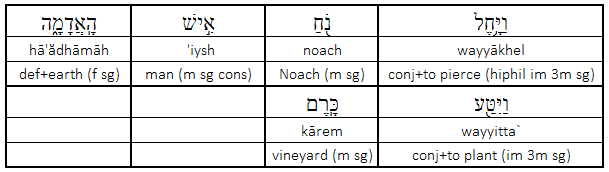
“Wayyakhel” is the hiphil, or causative, form of a verb meaning “to pierce/break.” This meaning can be extended figuratively to mean “to begin”, as in “to break open.”
Genesis 9:21 – He drank the wine and became drunk, and he became uncovered in his tent.
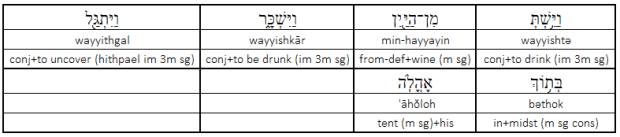
Gotta appreciate that after spending all that time at sea, Noach immediately planted a vineyard, made wine, got drunk, and passed out naked.
Genesis 9:22 – Cham, the father of Kena’an, saw his father’s nakedness, and made it known to his two brothers who were outside.
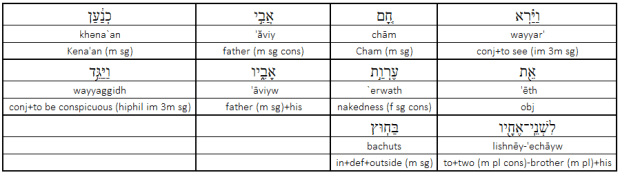
Genesis 9:23 – Shem and Yafeth took a garment and put it across their shoulders. They walked backwards and covered their father’s nakedness. Their faces were turned backwards, and they did not see their father’s nakedness.

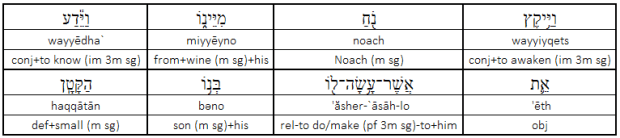
Genesis 9:24 – Noach woke up from his wine, and he knew what his youngest son had done to him.
Genesis 9:25 – “Cursed is Kena’an,” he said. “He will be a slave of slaves to his brothers.”
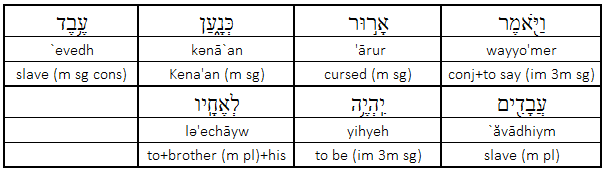
This story is designed to denigrate Kena’an, enemy of the Hebrews, not his father Cham. First of all, the story never mentioned the birth of Kena’an (that comes later), so it’s odd that Noach is talking about his unborn grandson at all. Second, Kena’an is cursed for his father’s actions, not his own. This happens in other places as well, where the patriarchs of nations (like the sons of Lot) that aren’t on friendly terms with the Hebrews are given stories that casts them as shameful and sinful.
Genesis 9:26 – “Blessed is Yahweh, god of Shem. May Kena’an be Shem’s slave.”
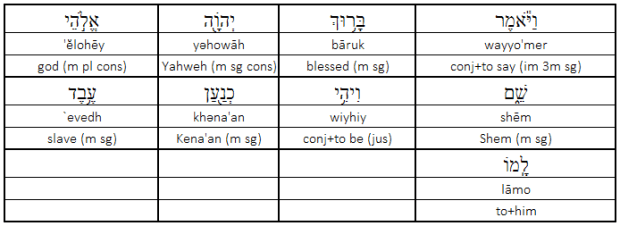
Genesis 9:27 – “Elohim will expand Yafeth, and he will dwell in Shem’s tents. May Kena’an be Yafeth’s slave.”
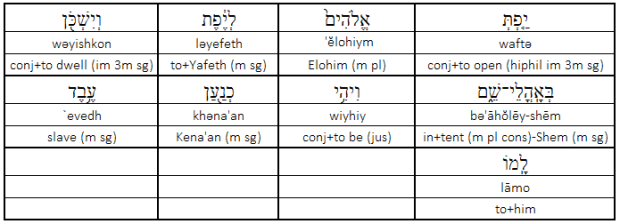
So, for Cham’s sin, the unborn Kena’an is made a slave to his older brothers. The especially unfortunate part is that this story has historically been used as justification for the enslavement of Africans, who are the descendants of Cham according to the Torah.
Specifically what Cham’s sin was is a little unclear. Taken literally, he saw his father naked and gossiped about it to his brothers. Noach was embarrassed by this, and he cursed his grandson, who did not commit the sin. Some Jewish readings have historically understood this to mean that Cham raped his unconscious father.
The sons of Lot, mentioned earlier as examples of similar patriarch-shaming stories, were conceived through drunken incest between Lot and his two daughters. If this reading of Cham’s actions is correct, then there may be some parallels between this story and Lot’s. In both cases, the Hebrews cast their rival neighbors as being descended from characters who participated in incest.
Another reading sees the “nakedness” of Noach as being his wife – in other words, her nakedness which “belongs” to Noach. Patriarchy aside, in this interpretation, Cham either saw his mother naked or had sex with her while Noach was passed out.
Either way, this story serves its purpose of making the Canaanites look bad.
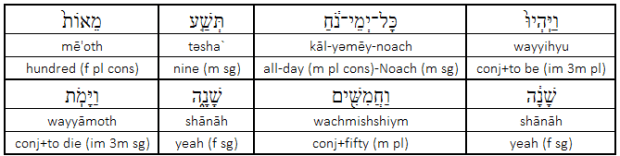
Genesis 9:28 – After the flood, Noach lived three hundred and fifty years.
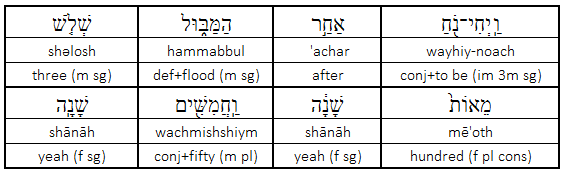
Genesis 9:29 – All the days of Noach were nine hundred and fifty years, and then he died.
Full Text
These are the generations of Noach.
Noach was a righteous man, perfect in his time; he walked with the gods. He fathered three sons – Shem, Cham, and Yafeth.
The land was corrupted before the face of the gods, and it was filled with violence. Elohim saw the land, and behold, it was corrupted, for all flesh had corrupted its way over the land.
“The end of all flesh has come before me, for because of them the land is full of violence,” Elohim said to Noach. “Behold, I will ruin them and the land. Make a cedar ship with rooms in it, and cover it inside and outside with pitch. This is how you will make it – the ship will be three hundred cubits long, fifty cubits wide, and thirty cubits high. Make a lantern in the ship, and finish it a cubit from the top. Put a door in the side, and make lower, second, and third levels.
“Behold, I am sending a flood over the land, to ruin all flesh beneath the sky that has the breath of life in it. All that is in the land will breathe its last. I will set up my covenant with you. Go into the ship, you and your sons, your wife and your sons’ wives. Take two, a male and a female from all life and all flesh, into the ship to live with you. Two of every kind of bird, livestock, and crawling thing will go to live with you. Take from every kind of food and gather it to you, and it will be food for you and for them.”
Noach did everything as Elohim commanded him.
“Go, you and all your house, into the ship,” Yahweh said to Noach. “I have seen that you are righteous before my face in this time. Take seven pairs from all the pure livestock, male and female, and one pair from all the impure livestock, as well as seven pairs of the birds of the skies, to keep their seed alive over the face of the land, for in seven days I will cause rain to fall over the land for forty days and forty nights, to wipe out everything that I have made from the face of the earth.”
Noach did everything as Yahweh commanded him. He was six hundred years old when the flood came over the land. He took his sons, his wife, and his sons’ wives into the ship with him, away from the floodwaters. The pure livestock, the impure livestock, the birds, and all that crawls over the earth came to Noach and the ship two by two, male and female, as Elohim had commanded him.
Seven days passed, and the floodwaters came over the land. In the six hundredth year of Noach’s life, on the seventeenth day of the second month, the springs of the Deep burst and the floodgates opened. It rained for forty days and forty nights.
On that day, Noach went into the ship with his sons Shem, Cham, and Yafeth, his wife, and the three wives of his sons, along with every kind of life: livestock and crawling things and birds of every feather. All flesh that had the breath of life came two by two to Noach and the ship. Those who came in were male and female of every kind, as Elohim had commanded him, and Yahweh shut them in.
The flood was over the land for forty days, and the waters increased and raised the ship over the land. They strengthened and increased greatly over the land, and the ship moved over the face of the water. The waters grew more and more, until all of the high mountains under the skies were completely covered beneath fifteen cubits of water.
All flesh that crawled over the land died – birds, livestock, everything that swarms, and humans. Everything on dry land with the breath of life in its nose died. He wiped out everything on the face of the earth – humans, livestock, crawling things, and the birds of the sky. Only Noach and those with him in the ship remained.
The waters dominated the land for one hundred and fifty days. Elohim remembered Noach and the life with him in the ship; he breathed over the land and the waters decreased. The springs of the Deep and the floodgates were shut up, and the rain was restrained. The waters receded from the land, coming and going, and at the end of the one hundred and fifty days they had decreased.
On the seventeenth day of the seventh month, the ship rested upon the mountains of Ararat. The waters flowed and decreased until the tenth month. On the first day of the month, the peaks of the mountains could be seen.
After forty days, Noach opened a window in the ship. He sent a raven to go to and fro until the waters had dried from the land. He then sent a dove to see if the waters had abated from the earth. The dove found no resting place, and it returned to him, for the waters were still over the land. Noach reached out, took the dove, and pulled her into the ship. He waited seven more days, and again sent the dove from the ship. The dove came to him in the evening, and behold, an olive leaf was plucked off in her mouth, and Noach knew that the waters had abated from the land. He waited seven more days, sent the dove out, and it never returned to him.
In his six hundred and first year, on the first day of the first month, the waters had dried up. Noach removed the ship’s covering, and behold, he saw that the face of the earth was dry. On the twenty seventh day of the second month, the land was dry.
“Leave the ship,” Elohim said to Noach. “You and your wife, your sons and your sons’ wives. Bring all life that is with you – birds, livestock, and crawling things – so that they will swarm over the land, bear fruit, and increase.”
Noach, his sons, his wife, and his sons’ wives, went out, as did all life, crawling things, and birds, according to their families. Noach built an altar to Yahweh, and he made a sacrifice of the pure livestock and birds.
Yahweh smelled the soothing scent.
“I will never again curse the earth on account of humanity,” he said to himself. “From youth the purpose of their hearts is evil. Never again will I strike all life as I have done. For all the days of the earth, planting and harvest, cold and heat, spring and autumn, and day and night will not rest.”
Elohim blessed Noach and his sons.
“Bear fruit, increase, and fill the land,” he said to them. “The fear and dread of you will be upon all creatures of the land, all birds of the sky, all that crawls over the earth, and all fish of the sea. They have been delivered into your hand. All crawling things which have life in them will be your food. I have given you everything, as I had given you the green plants. You may not eat flesh that has its life, its blood, in it. I will require your blood for your lives, from the hand of every beast and person. I will require it from every man for his brother. Whoever spills a person’s blood will have their blood spilled by others, for humans were made in the image of Elohim. Bear fruit, increase, swarm in the land, and increase in it.
“Behold, I am setting up my covenant with you and with your seed that follows you, and with everything that is with you – birds and livestock and all that came out of the ship with you. I am setting up my covenant with you. Never again will all flesh be cut down by floodwaters. Never again will a flood destroy the land.
“This is the mark of the covenant I am taking between me, you, and all life with you, for all ages to come. I have set my bow in the clouds, and it will be a mark of the covenant between me and the land. When I send clouds over the land, my bow will appear, and I will remember my covenant that is between me and you and between all life, and never again will floodwaters destroy the living. The bow will be in the clouds, and I will see it and remember the eternal covenant between Elohim and all life in the land. This is the sign of the covenant I have set up between me and all life in the land.”
Shem, Cham, and Yafeth were the sons of Noach who went out of the ship. Cham was the father of Kena’an. From these three sons of Noach, the land was filled.
Noach became a man of the earth, and he planted a vineyard. He drank the wine and became drunk, and he became uncovered in his tent. Cham, the father of Kena’an, saw his father’s nakedness, and made it known to his two brothers who were outside.
Shem and Yafeth took a garment and put it across their shoulders. They walked backwards and covered their father’s nakedness. Their faces were turned backwards, and they did not see their father’s nakedness.
Noach woke up from his wine, and he knew what his youngest son had done to him.
“Cursed is Kena’an,” he said. “He will be a slave of slaves to his brothers. Blessed is Yahweh, god of Shem. May Kena’an be Shem’s slave. Elohim will expand Yafeth, and he will dwell in Shem’s tents. May Kena’an be Yafeth’s slave.”
After the flood, Noach lived three hundred and fifty years. All the days of Noach were nine hundred and fifty years, and then he died.
 Translate the Torah