The Generations of Adham
Genesis 5:1 – This is the record of the generations of Adham; on the day Elohim fashioned humans, he made them in his likeness.
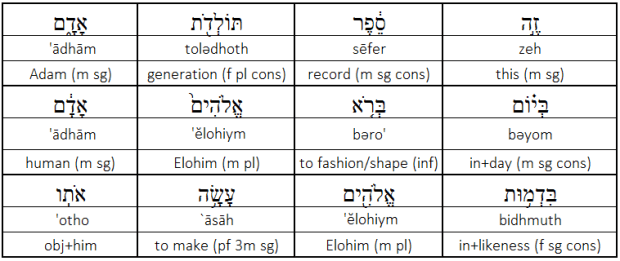
Genesis 5:2 – He fashioned them male and female, and he blessed them, and he named them “human.”

Genesis 5:3 – Adham lived 130 years, and then he fathered a child in his image, like him, and he named him Sheth.
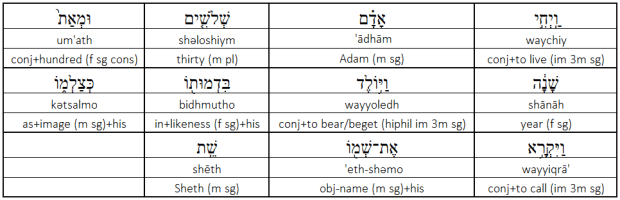
It starts getting pretty repetitive here; there are a handful of generations to work through, and for the most part, the same language is used over and over again. Interestingly, the same language is used here as in Chapter 1 – Elohim creates humans “in his image, like him”, and Adham fathers his son in the same manner.
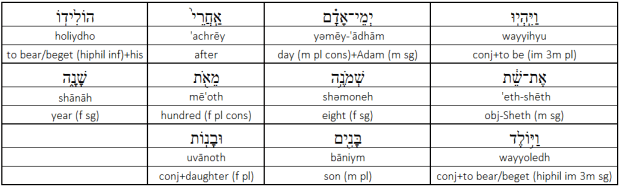
Genesis 5:4 -The days of Adham after he fathered Sheth were 800 years, and he fathered sons and daughters.
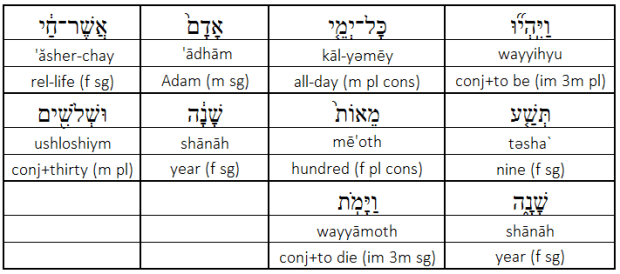
Genesis 5:5 – All the days that Adham lived were 930 years, and then he died.
Genesis 5:6 – Sheth lived 105 years, and then he fathered Enosh.
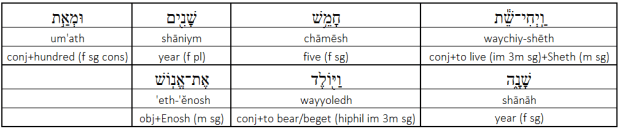
Genesis 5:7 -He lived 807 years after he fathered Enosh, and he fathered sons and daughters.
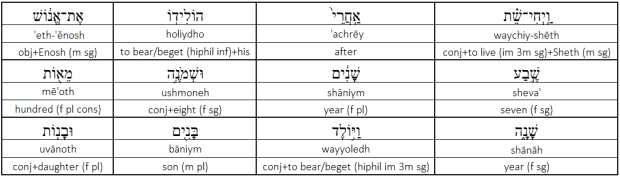
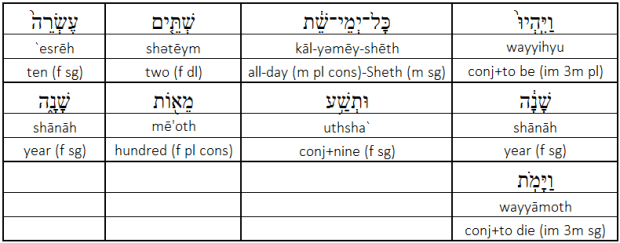
Genesis 5:8 – All the days of Sheth were 912 years, and then he died.
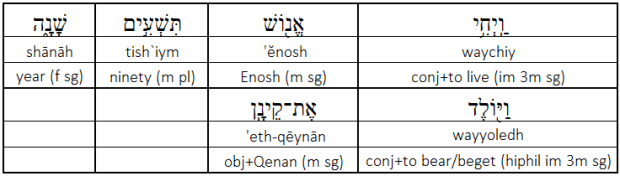
Genesis 5:9 – Enosh lived 90 years, and then he fathered Qenan.
Genesis 5:10 – He lived 815 years after he fathered Qenan, and he fathered sons and daughters.

Genesis 5:11 – All the days of Enosh were 905 years, and then he died.

Genesis 5:12 – Qeynan lived 70 years, and then he fathered Mahlalel.
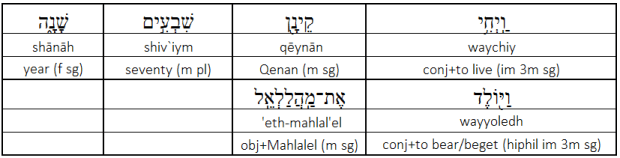
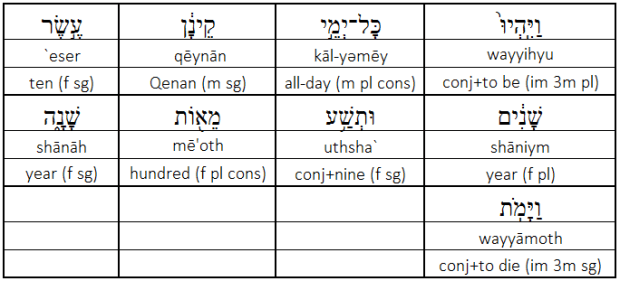
Genesis 5:13 – He lived 840 years after he fathered Mahlalel, and he fathered sons and daughters.

Genesis 5:14 – All the days of Qeynan were 910 years, and then he died.
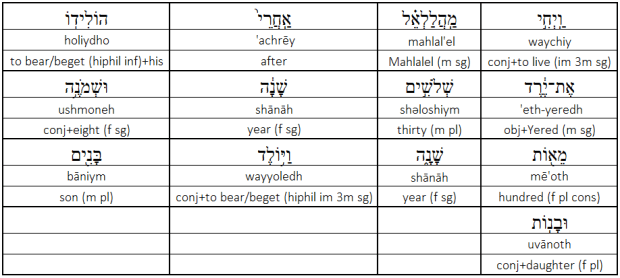
Genesis 5:15 – Mahlalel lived 65 years, and then he fathered Yered.

Genesis 5:16 – He lived 830 years after he fathered Yered, and he fathered sons and daughters.
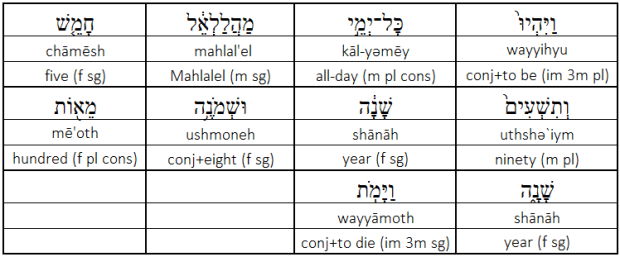
Genesis 5:17 – All the days of Mahlalel were 895 years, and then he died.
Genesis 5:18 – Yered lived 162 years, and then he fathered Hanok.
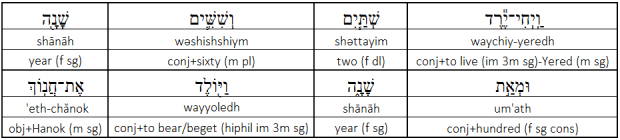
Genesis 5:19 – He lived 800 years after he fathered Hanok, and he fathered sons and daughters.

Genesis 5:20 – All the days of Yered were 962 years, and then he died.

Genesis 5:21 – Hanok lived 65 years, and then he fathered Methushelah.
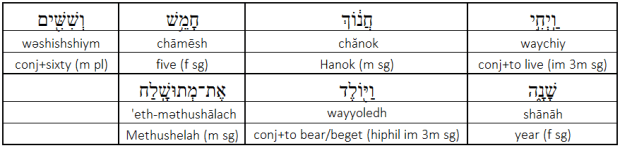
Genesis 5:22 – Hanok walked with the gods for 300 years after he fathered Methushelah, and he fathered sons and daughters.
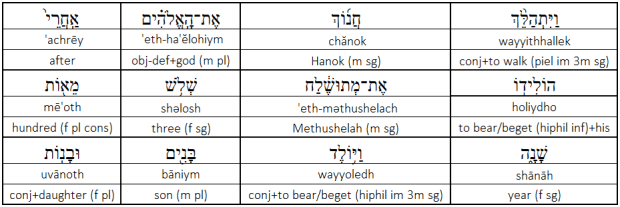
Hebrew, as far as I know, doesn’t allow a proper noun to take a definite article, as proper nouns are by definition definite. There may be some debate as to whether or not “Elohim” constitutes a proper noun, as it isn’t the name of god in Judaism, but I interpret it as such – even if it isn’t a personal name, it’s still used as a proper noun.
In a construct chain, the definite article is attached to the last element in the chain in order to make it definite. In Chapter 1, in the phrase “ruach ‘ĕlohiym”, the second component ‘ĕlohiym takes no article, but the phrase is generally interpreted as definite (“the breath of Elohim”) by virtue of ‘ĕlohiym being a proper noun.
Ha’ĕlohiym above includes a definite article with the word ‘ĕlohiym, so I interpret the word ‘ĕlohiym as being the plural common noun “gods” plus the definite article “ha” – in other words, not the proper noun Elohim.
Genesis 5:23 – All the days of Hanok were 365 years.

Genesis 5:24 – Hanok walked with the gods, and he was not, for Elohim took him.

Of all these patriarchs, Hanok is the only one who does not die – he simple “is not”, and Elohim (singular and proper now, by virtue of the lack of article and the singular noun “laqach”) takes him. Hanok’s more familiar English name is Enoch, and Enoch is a big figure in Jewish and Christian mythology. While Enoch doesn’t get much more than a mention here, his legend extends into other works like the Book of Enoch.
Eleven fragments of the Book of Enoch were found among the Dead Sea Scrolls at Qumran, and a complete copy of the text exists only in Ge’ez, the classical language of Ethiopia. It’s considered canonical by Ethiopian Orthodox Church, and it tells the story of a group of angels called Watchers who had children with human women. The Watchers brought all kinds of new and dangerous knowledge with them, and their half-human children were giants who caused chaos on the earth until God destroyed the world in a flood. During the course of the book, Enoch is taken up into heaven and given a tour of the celestial world.
While we’re on the subject…one of my favorite moments from the Book of Enoch involves Cain and Abel. The angel Raphael shows Enoch the valleys where the dead gather and wait until Judgement Day. Enoch asks Raphael about a particular dead man whose voice is crying up to heaven – Raphael tells him that it’s the voice of Abel, demanding the destruction of Cain and all his descendants. Definitely makes that whole “your brother’s blood is crying to me from the earth” line a hell of a lot creepier.
Genesis 5:25 – Methushelah lived 187 years, and then he fathered Lemek.
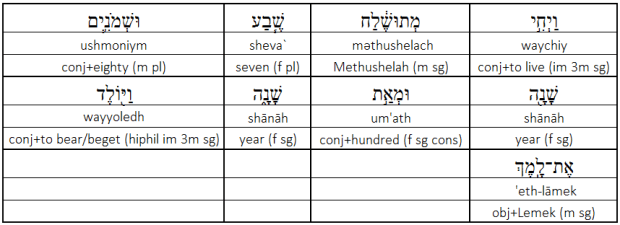
Genesis 5:26 – He lived 782 years after he fathered Lemek, and he fathered sons and daughters.
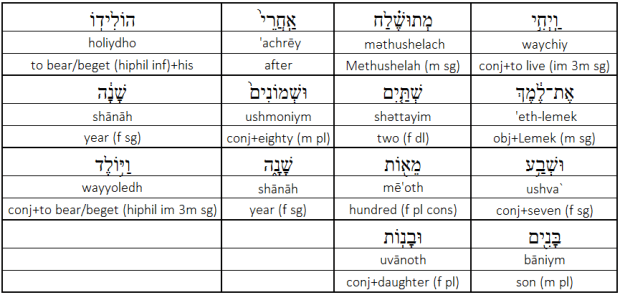
Genesis 5:27 – All the days of Methushelah were 969 years, and then he died.

Genesis 5:28 – Lemek lived 182 years, and then he fathered a son.
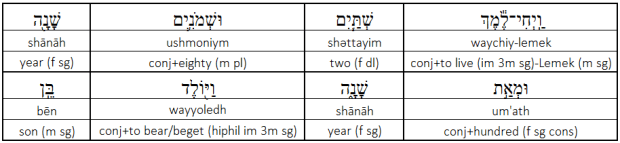
Genesis 5:29 – He named him Noach. “He will comfort us in our deeds and in the sorrow of our hands which comes from the earth Yahweh cursed,” Lemek said.
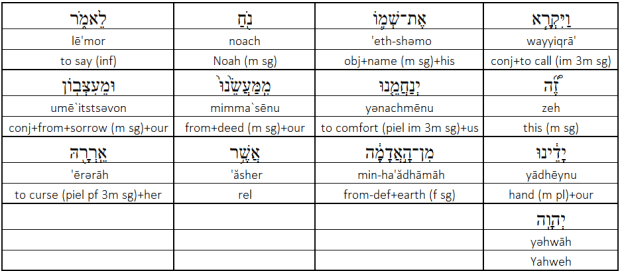
“Noach” sounds like “nacham”, meaning “to comfort.”
Genesis 5:30 – He lived 595 years after he fathered Noach, and he fathered sons and daughters.
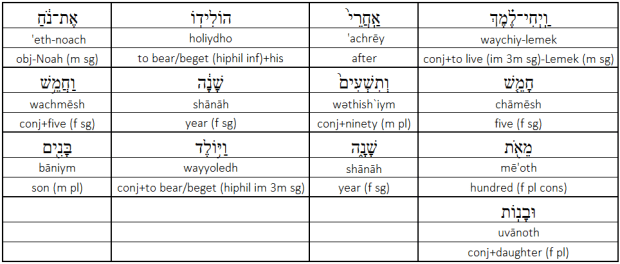
Genesis 5:31 – All the days of Lemek were 777 years, and then he died.
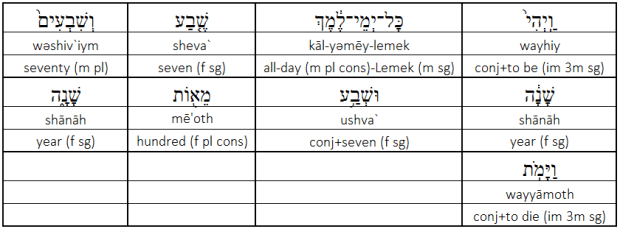
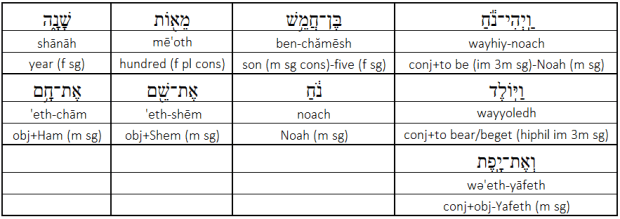
Genesis 5:32 – Noach lived 500 years, and then he fathered Shem, Ham, and Yafeth.
If any of these names seem familiar to you, there’s a reason. Chapter 4 provided the descendants of Qayin, while this chapter follows the descendants of Sheth. To compare:
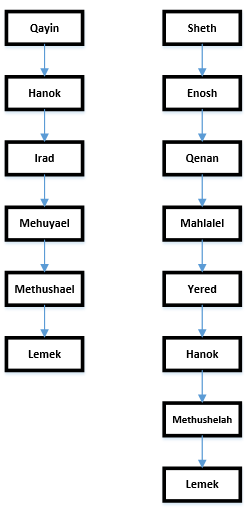
The names “Hanok” and “Lemek” show up in both, and all of the names between Qayin and Lemek have similar sounding names on Sheth’s side, starting with Qenan.

If the divine name and writing style are indicators of which tradition a section of the Torah came from, then the genealogy of Chapter 4 is a different tradition than the genealogy of Chapter 5. Both lists may share a similar origin, or one might borrow from the other.
Genesis 6:1 – Humans began to increase over the face of the earth, and daughters were born to them.
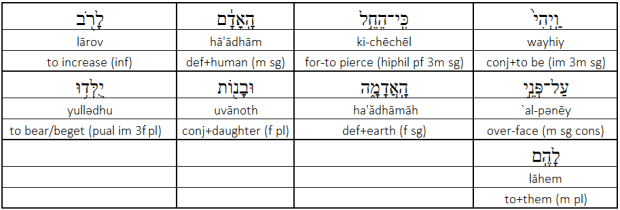
Genesis 6:2 – The sons of the gods saw that the daughters of the humans were beautiful, and they took wives for themselves from whomever they chose.

The phrases “Sons of Elohim” or “Sons of El”, here as “sons of the gods” for their usage of a definite article, are used in Ugaritic literature to refer to a council of divine beings, the offspring of the gods El and Asherah. The concept of a divine council is not uncommon in the Torah or Tanakh, most explicitly in the Book of Job, where the divine beings are often interpreted as angels. This association between angels and the sons of the gods is potentially at least as old as the Book of Enoch, which features the Watchers as the heavenly beings that took human women as wives. The text itself doesn’t suggest this connection at all, though, and there’s a separate word for the class of beings we call angels.
Going by the suggestion of the Hebrew text itself (such as the episode in Psalm 82 when Elohim specifically refers to the members of the divine council as gods) and the Ugaritic accounts (which refer to the Sons of El/Elohim as the children of El and Asherah), I interpret them not as angels but as divine or semi-divine relics of the monolatristic portion of Hebrew thought, when the nations were each appointed a god from the heavenly council, over which ruled their father El.
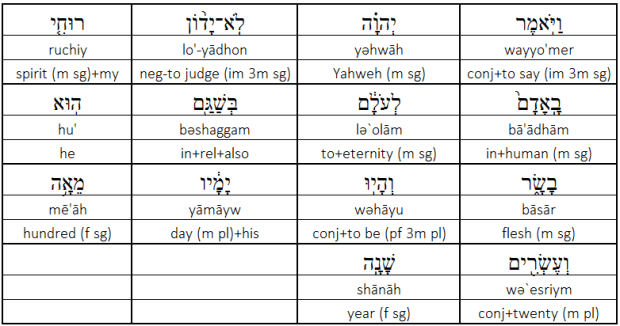
Genesis 6:3 – “My spirit will not judge humans forever, for they are also flesh,” Yahweh said. “Their days will be 120 years.”
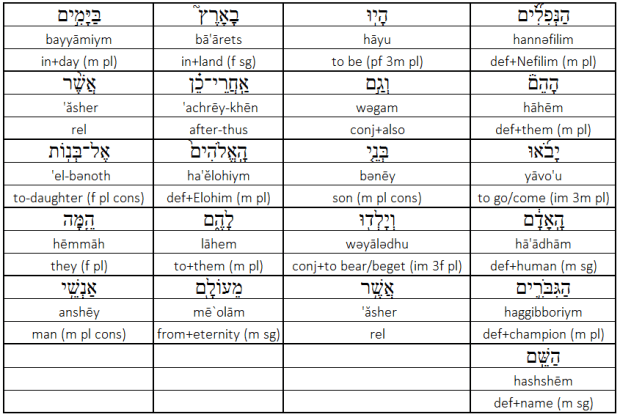
Genesis 6:4 – The Nefilim were in the land in those days, and also afterward, when the sons of the gods came to the daughters of the humans, who bore for them those champions who of old were men of fame.
The Nefilim (or the usual transliteration “Nephilim”) were, according to the Septuagint and other early translations, giants. This interpretation comes from their only other mention in the Torah, in the Book of Numbers, when spies sent to scope out Canaan prior to invasion refer to the land being filled with the Nefilim and the sons of Anak, against whom the spies are like grasshoppers. In the Book of Enoch, they’re three thousand cubits tall.
Usually, “Nefilim” is thought to come from the verb for “to fall”, either meaning “the fallen ones” or the “those who cause others to fall.” They are the children of the Sons of Elohim and the Daughters of Adham – in the Book of Enoch, they would be the children of the angelic Watchers and their mortal wives. Another interpretation is that they aren’t supernatural demigod-like figures and are instead just humans born of the mixing between the children of Qayin and the children of Sheth. Considering the Enochian legends that have developed around them and the fact that there is very significant precedence in the Tanakh itself and in the older Ugaritic literature that the Sons of Elohim are gods or divine children of El/Elohim, I think it’s a stretch to say that the Sons of Elohim and the Daughters of Adham are coded references to the two lineages proceeding from Adham and Chawwah. The Sons of Elohim are undoubtedly celestial in origin, and the daughters of humans are just that – human women. Their children would half to be half-mortal, half-divine.
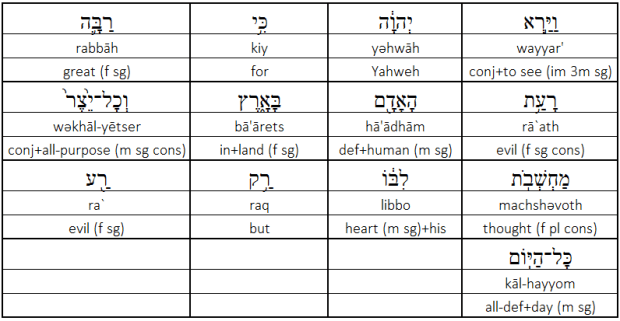
Genesis 6:5 – Yahweh saw that humanity’s evil was great across the land, and all purposes of their hearts’ thoughts were evil, all the time.
Presumably, it’s after the sons of the gods father children with the mortal women, giving rise to the (giant or otherwise) Nefilim, that humanity really takes a downturn. In the Book of Enoch, the Watchers brought secret knowledge from heaven (spells, astrology, metallurgy, cosmetics), which resulted in humanity turning toward wickedness.
Genesis 6:6 – Yahweh was sorry that he had made them, and his heart was grieved.
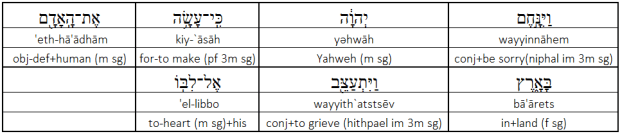
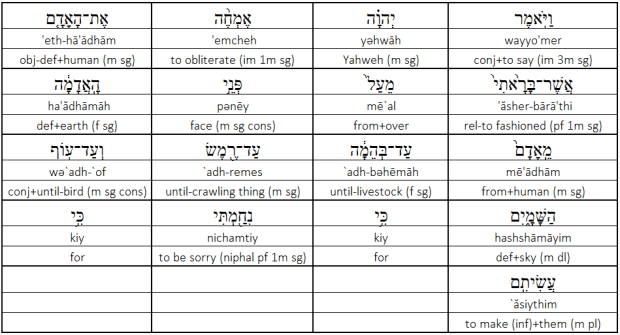
Genesis 6:7 – “I will obliterate from the face of earth the humans whom I fashioned,” Yahweh said. “Humans, livestock, the crawling things, and the birds of the sky, for I am sorry I made them.”
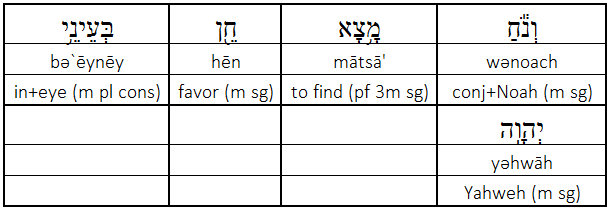
Genesis 6:8 – But, Noach found favor in the eyes of Yahweh.
Full Text
This is the record of the generations of Adham; on the day Elohim fashioned humans, he made them in his likeness. He fashioned them male and female, and he blessed them, and he named them “human.”
Adham lived 130 years, and then he fathered a child in his image, like him, and he named him Sheth. The days of Adham after he fathered Sheth were 800 years, and he fathered sons and daughters. All the days that Adham lived were 930 years, and then he died.
Sheth lived 105 years, and then he fathered Enosh. He lived 807 years after he fathered Enosh, and he fathered sons and daughters. All the days of Sheth were 912 years, and then he died.
Enosh lived 90 years, and then he fathered Qenan. He lived 815 years after he fathered Qenan, and he fathered sons and daughters. All the days of Enosh were 905 years, and then he died.
Qeynan lived 70 years, and then he fathered Mahlalel. He lived 840 years after he fathered Mahlalel, and he fathered sons and daughters. All the days of Qeynan were 910 years, and then he died.
Mahlalel lived 65 years, and then he fathered Yered. He lived 830 years after he fathered Yered, and he fathered sons and daughters. All the days of Mahlalel were 895 years, and then he died.
Yered lived 162 years, and then he fathered Hanok. He lived 800 years after he fathered Hanok, and he fathered sons and daughters. All the days of Yered were 962 years, and then he died.
Hanok lived 65 years, and then he fathered Methushelah. Hanok walked with the gods for 300 years after he fathered Methushelah, and he fathered sons and daughters. All the days of Hanok were 365 years. Hanok walked with the gods, and he was not, for Elohim took him.
Methushelah lived 187 years, and then he fathered Lemek. He lived 782 years after he fathered Lemek, and he fathered sons and daughters. All the days of Methushelah were 969 years, and then he died.
Lemek lived 182 years, and then he fathered a son. He named him Noah.
“He will comfort us in our deeds and in the sorrow of our hands which comes from the earth Yahweh cursed,” Lemek said.
He lived 595 years after he fathered Noah, and he fathered sons and daughters. All the days of Lemek were 777 years, and then he died.
Noah lived 500 years, and then he fathered Shem, Ham, and Yafeth.
Humans began to increase over the face of the earth, and daughters were born to them. The sons of the gods saw that the daughters of the humans were beautiful, and they took wives for themselves from whomever they chose.
“My spirit will not judge humans forever, for they are also flesh,” Yahweh said. “Their days will be 120 years.”
The Nefilim were in the land in those days, and also afterward, when the sons of the gods came to the daughters of the humans, who bore for them those champions who of old were men of fame. Yahweh saw that humanity’s evil was great across the land, and all purposes of their hearts’ thoughts were evil, all the time. Yahweh was sorry that he had made them, and his heart was grieved.
“I will obliterate from the face of the earth the humans whom I fashioned,” Yahweh said. “Humans, livestock, the crawling things, and the birds of the sky, for I am sorry I made them.”
But, Noah found favor in the eyes of Yahweh.
 Translate the Torah