The Generations of the Skies and the Land
The phrase “these are the generations”, or some variation thereof, appears ten times throughout Genesis. Usually, each “generations” introduces a patriarch and his descendants, though Chapter 2 is the story of “the generations of the sky and the land” rather than an individual. It may have been the original marker of divisions within the book.
The creation narrative of Chapter 2 is from the Jahwist source, unlike the Priestly creation narrative of Chapter 1. While Chapter 1 showed the power of Elohim through his conquest of chaos, Chapters 2-4 are more about the conditions and role of humanity. The depiction of the divine is also quite different – Yahweh is a far more anthropomorphic figure who walks in the Garden of Eden and interacts in with humans.
Genesis 2:4 – These are the generations of the skies and the land when they were fashioned, on the day Yahweh Elohim made them.

Throughout these next few chapters, a few different names are used to refer to the divine. For the most part, when characters speak, they refer to god as Elohim, excluding the personal name Yahweh. In the narrative, the divine name is Yahweh or Yahweh Elohim.
Yahweh Elohim is, obviously, a combination of the personal Hebrew name for god and the generic plural for “god.” Usually, following the Jewish practice of replacing Yahweh with Adonai (“my lords”), Yahweh Elohim is translated as “the LORD God.”
Genesis 2:5 – All of the shrubs and plants of the field had not yet sprouted, for Yahweh Elohim had not caused it to rain over the land, and there was no human to serve the earth. 
For two reasons, vegetation hasn’t yet grown on the land – Yahweh hasn’t brought the rain, and humans have not yet been created to care for the earth. The purpose of humans, in this story at least, is to care for the land.
I feel this urge to point out every time I condense and consolidate in my translation for, but I won’t. Sometimes the Hebrew just comes out too repetitive and meandering for me in English.
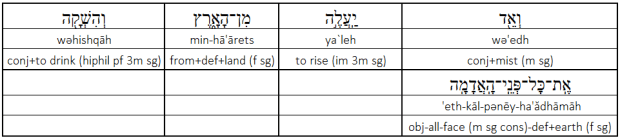
Genesis 2:6 – A mist rose from the land, and it watered the face of the earth.
Genesis 2:7 – He formed a man from the dust of the earth, breathed the breath of life into his nose, and the man became a living being.

The phrase nefesh chayyāh shows up again, here as the state of the man after Yahweh breathes life into him. Also, I’ve previously translated ‘ādhām as human, but I’ve switched to “man” here because the focus is on the first created man himself now – he will be differentiated later from his wife, so I start using gendered language.
For the rest of this story, I use “the man” in place of the proper name Adam, because he’s consistently referred to as “hā’ādhām”, “the human.” It does come across a little strange later in Genesis when ‘ādhām shows up without the definite article as just Adam, but I’m striving for consistency within each “generations” story.
Genesis 2:8 – He then planted a garden in Eden, in the east. There he put the man whom he had formed…

Genesis 2:9 – …and he caused every beautiful tree with delicious fruit to sprout from the earth. The Tree of Life was in the middle of the garden, and also the Tree of the Knowledge of Good and Evil.

Genesis 2:10 – A river going out from Eden watered the garden, and from there it split into four rivers.
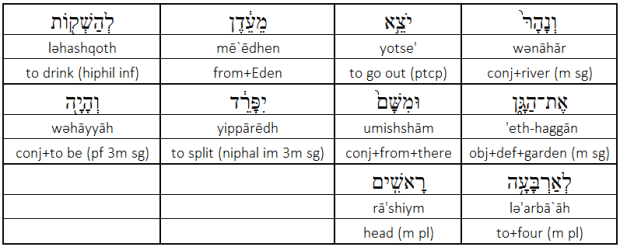
Genesis 2:11 – The name of the first was Pishon – it encircled all the land of Chawilah, where there was gold.

Genesis 2:12 – The gold of that land was good, and there was also resin and onyx.
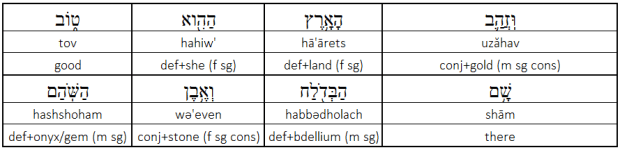
This is usually translated as “bdellium and onyx.” The Hebrew word is in fact “bdellium”, which is a type of resin. I had no idea what bdellium actually is, and when I hear that word it has no meaning to me. I do, however, know what resin is, so I’ve opted for a more general word that’s more meaningful to me.
Genesis 2:13 – The name of the second river was Gihon – it encircled all the land of Kush.

Genesis 2:14 – The name of the third river was Hiddeqel – it flowed east of Ashur. The fourth river was Perath.
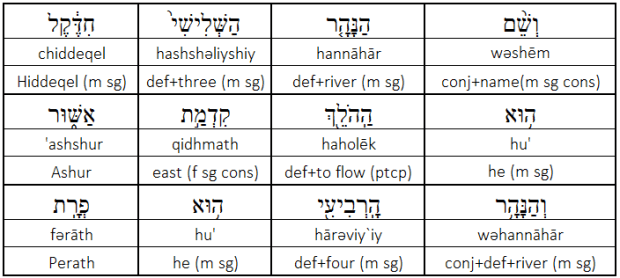
While the first two rivers, the Pishon and Gihon, have never been successfully identified with any real rivers, the Hiddeqel and the Perath and the Tigris and the Euphrates in Mesopotamia.
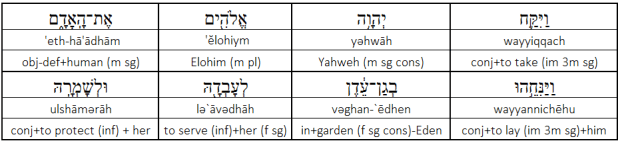
Genesis 2:15 – Yahweh Elohim took the man and laid him in the Garden of Eden to serve and protect it.
Genesis 2:16 – “You are free to eat from every tree of the garden,” he commanded the man.
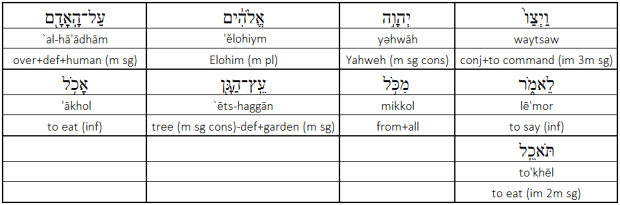
The command is “from all tree[s] of the garden, to eat you may eat.” This repetition, with a verb’s conjugated form and infinitive bundled together, is used as a form of emphasis.
Genesis 2:17 – “But, you may not eat from Tree of the Knowledge of Good and Evil, for on the day you eat from it, you will certainly die…”
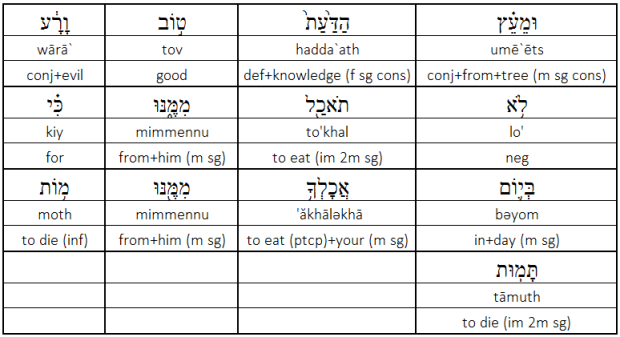
“To die you will die.” The same emphasis is used here.
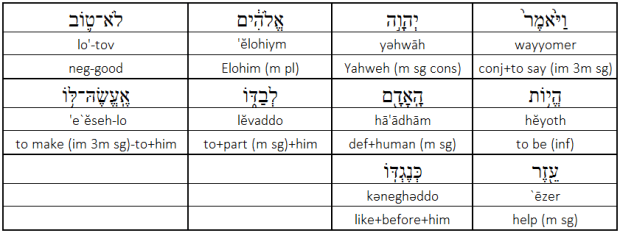
Genesis 2:18 – “…Now, it is not good that the man is by himself. I will make a helper for him, corresponding to him.”
Genesis 2:19 – He formed from the earth every beast of the field and every bird of the sky, and he brought them to the man to see what he would call them. Whatever the man called them, that was their name.
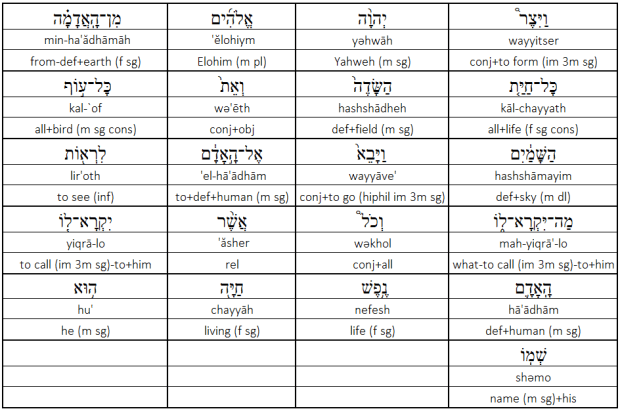
The order of creation is different here than in the first creation story. Rather than begin with the Tehom and pull the earth from it, Yahweh starts with the land and opens up a spring of water. After the ground is watered, vegetation grows, and then a man is created to tend to it. Humans precede animals and birds in Chapter 2, while they’re the last to be created in Chapter 1. Once Yahweh notices that the man is alone, he sets out to make a helper for him.
Genesis 2:20 – The man named all the livestock, the birds of the sky, and the beasts of the field, but he did not find a helper corresponding to him.
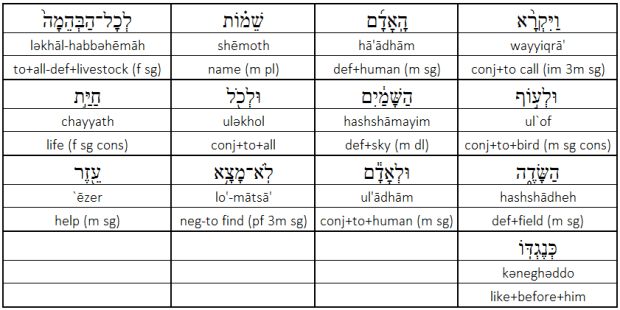
Genesis 2:21 – Yahweh Elohim caused a trance to fall over the man, and he slept. He took one of his ribs, and he shut the flesh beneath it.
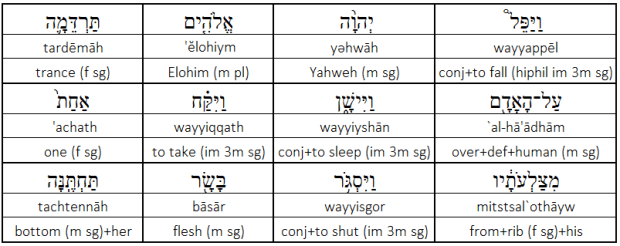
Genesis 2:22 – He built a woman from the rib which he had taken from the man, and he brought her to the man.

Genesis 2:23 – “This is now bone of my bones and flesh of my flesh,” the man said. “She will be called ‘woman’, for she was taken from man….”
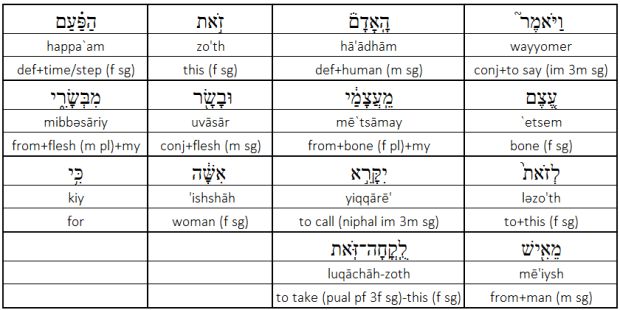
In Hebrew, the word for woman is just the feminine form of the word for man, hence the justification for why she’s called what she’s called. Luckily, the pun also works in English because “man” and “woman” are obviously related, though the etymology behind those words isn’t as clear-cut as they are in Hebrew.
Genesis 2:24 – “…Thus, a man will forsake his father and mother and cling to his wife, and they will be one flesh.”
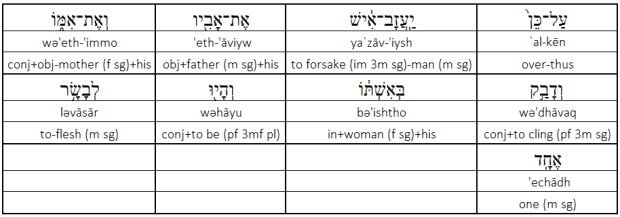
It doesn’t really makes any sense, in the internal context, for the man to be talking about his mother and father. He has no mother or father. These stories are oriented toward their readers and their readers’ world, explaining customs or giving justification for why things are as they are.
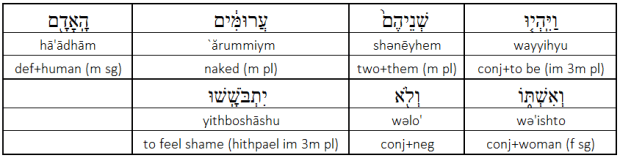
Genesis 2:25 – The man and his wife were naked, and they did not feel shame.
Genesis 3:1 – The serpent was craftier than all the beasts of the field which Yahweh Elohim had made. “Did Elohim truly say you may not eat from every tree of the garden?” he asked the woman.
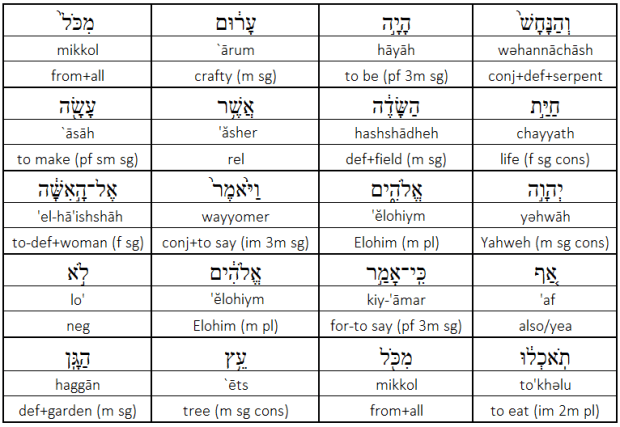
Christian tradition equates the serpent with Satan, the angel who rebelled against God and tempts humanity to sin. There’s really no concept of any figure quite like that in the Tanakh. When Satan (hassatan, “the adversary”) does appear, he’s a member of the divine council, not a fallen angel. Here, there’s really nothing to suggest that the serpent is anything more than a serpent.
Genesis 3:2 – “We may eat from the fruit of the trees of the garden,” the woman said to the serpent.

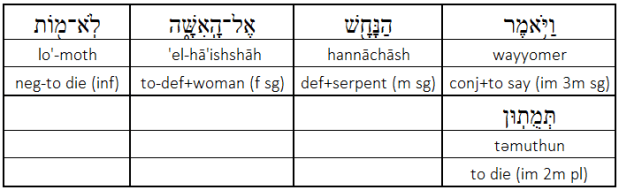
Genesis 3:3 – “But Elohim said, ‘You may not eat from the fruit of the tree which is in the middle of the garden, or touch it, or you will die.'”

Genesis 3:4 – “You certainly will not die,” the serpent said.
Genesis 3:5 – “…Elohim knows that on the day you eat it, your eyes will be opened and you will be like gods, knowing good and evil.”
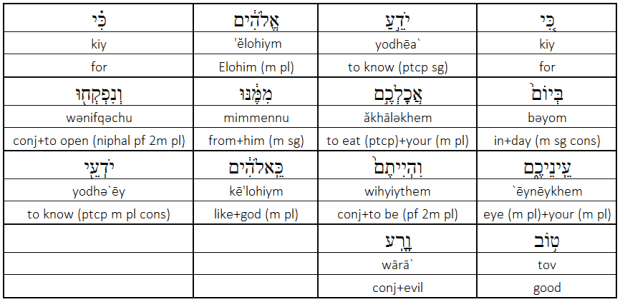
The phrase “wihyiythem kē’lohiym yodhǝ`ēy tov wārā`” is sometimes translated as either “you will be like God, knowing good and evil” or “you will be like gods, knowing good and evil.” The word is just plain ol’ Elohim (plus a preposition), so why translate it as a common plural noun and not a proper singular noun?
The participle yodhǝ`ēy is a plural construct, so I take it to be describing kē’lohiym (it could also possibly be describing the man and his wife, the subjects of wihyiythem). When Elohim is otherwise used as a proper name, it’s associated with singular verbs and adjectives despite the noun itself being grammatically plural. Here, though, it seems to be described by a plural participle, so I take it in its common plural meaning.
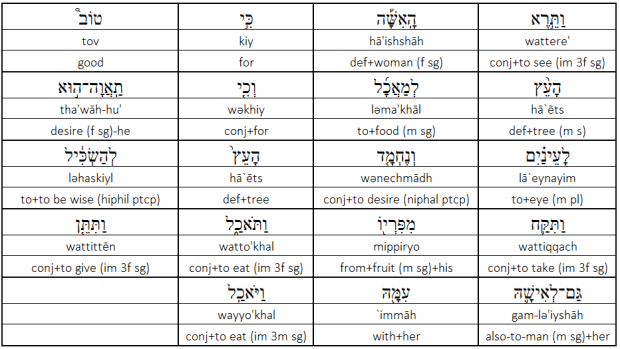
Genesis 3:6 – The woman saw that the tree was good for food, beautiful, and desirable for wisdom. She took the fruit and ate it. She also gave some to her husband, who was with her, and he ate.
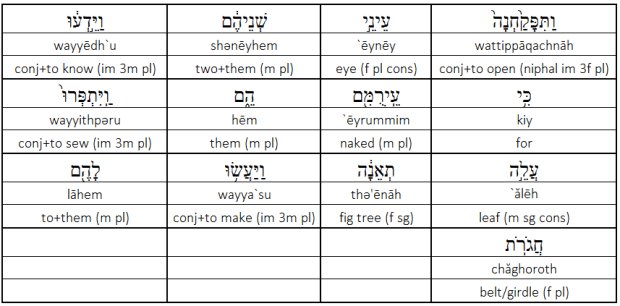
Genesis 3:7 – Their eyes were opened, and they knew that they were naked. They sewed fig leaves and made garments for themselves.
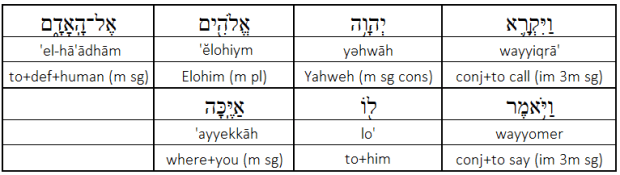
Genesis 3:8 – They heard the voice of Yahweh Elohim as he walked in the garden in the day’s breeze, and they hid themselves from his face in the trees of the garden.

Genesis 3:9 – “Where are you?” he called to the man.
Genesis 3:10 – “I heard your voice in the garden,” the man said. “I was afraid because I was naked, and I hid.”
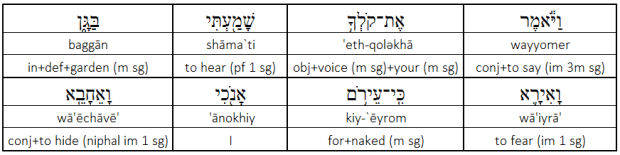
Genesis 3:11 – “Who told you that you were naked? Did you eat from the tree which I commanded you to not eat from?”

Unlike the more majestic Elohim, Yahweh walks around and asks rhetorical questions.
Genesis 3:12 – “The woman you gave to me gave me the fruit, and I ate.”
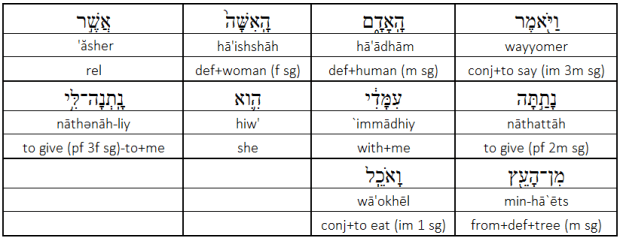
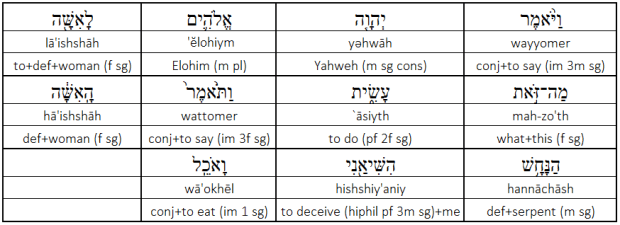
Genesis 3:13 – “What have you done?” Yahweh Elohim said to the woman. “The serpent deceived me, and I ate,” the woman replied.
Genesis 3:14 – “Because you have done this, you are cursed beyond all the livestock and all the beasts of the field,” Yahweh Elohim said to the serpent. “You will walk on your belly, and you will eat dust all the days of your life…”
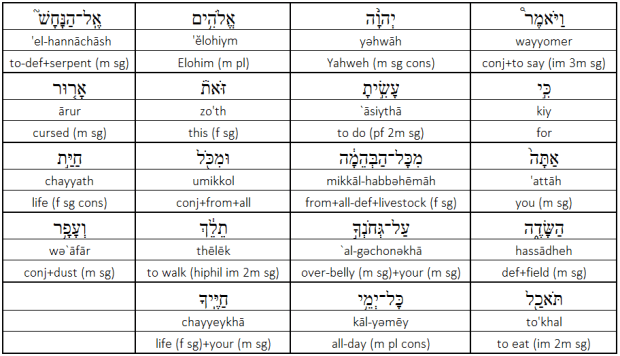
Genesis 3:15 – “…I will put hostility between you and the woman, between your seed and hers. He will bruise your head, and you will bruise his heel.”

Genesis 3:16 – “I will greatly increase your sorrow and your childbearing,” he said to the woman. “You will bear children in pain. Your desire will be for your husband, and he will rule you.”

Genesis 3:17 – “The earth will be cursed on your account because you listened to your wife’s voice and ate from the tree which I commanded you to not eat from,”
he said to the man. “You will eat in sorrow all the days of your life…”

Yes, I split my infinitives.
Genesis 3:18 – “…The earth will sprout thorns and thistles for you, and you will eat the plants of the field…”
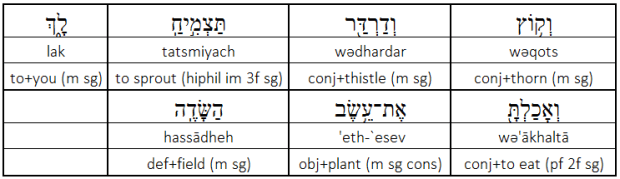
Genesis 3:19 – “..You will only eat bread by the sweat of your brow, until you return to the earth, for you were taken from it. You are dust, and you will return to dust.”
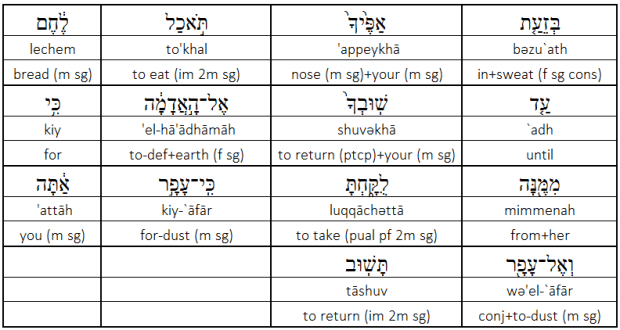
Af, used earlier for “nose”, can also refer to the whole front of the face – the nose, the brow, and the face itself.
Genesis 3:20 – The man named his wife Chawwah, for she became the mother of all life.
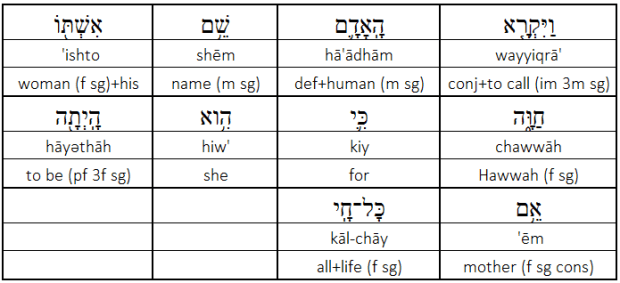
Chawwah (Eve) is a pun on hayah, both meaning “life/to live.” There may be some connection between Chawwah and Ninti, a Sumerian goddess who helped cure the god Enki. Ninti healed the pain Enki had in his side, and her name can mean both “Lady of Life” and “Lady of the Rib.” Chawwah was made from a rib, and she was destined to be the mother of all who live. The Hebrew and Sumerian stories are otherwise pretty different, but may point to the general shared cultural framework (like the parallels between Elohim/Tehom and Marduk/Tiamat, or Yahweh/Leviathan and Baal/Lotan).
Genesis 3:21 – Yahweh Elohim made tunics of skin for the man and his wife, and he clothed them.
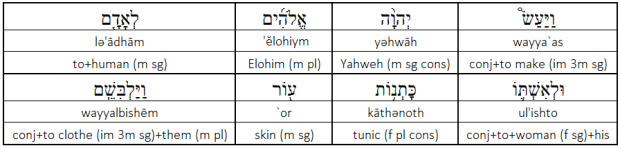
Genesis 3:22 – “Behold,” he said. “The man has become like one of us, knowing good and evil. If he stretches out his hand, takes from the the Tree of Life, and eats, he will live forever.”
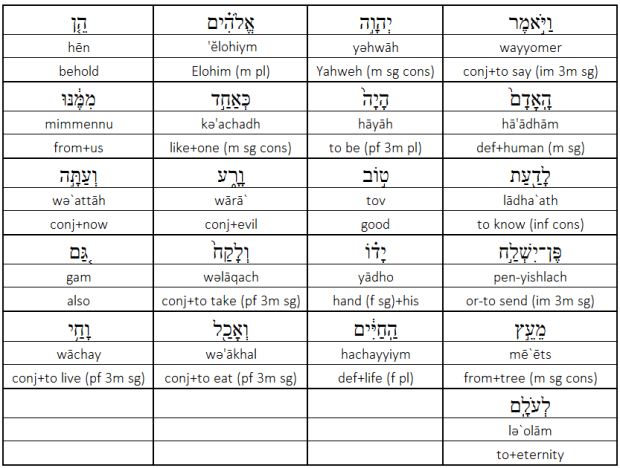
Yahweh also seems to lack the total omnipotence that Elohim displays in Chapter 1. When Elohim speaks, things happen. Yahweh is currently at the mercy of the trees he’s planted. One has made his first humans like gods, and the other might make them immortal. To prevent this, he has to expel them. In order to be like Yahweh, humans had to break his commandments, while Elohim created them “like [him]” from the beginning.
Genesis 3:23 – He sent him from the Garden of Eden, to serve the earth from which he had been taken.
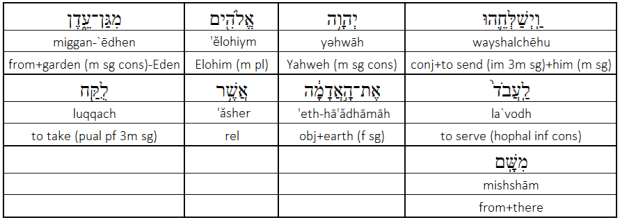
Genesis 3:24 – He expelled the man, and he placed cherubim and the flame of a spinning sword east of the Garden of Eden, to guard the way to the Tree of Life.
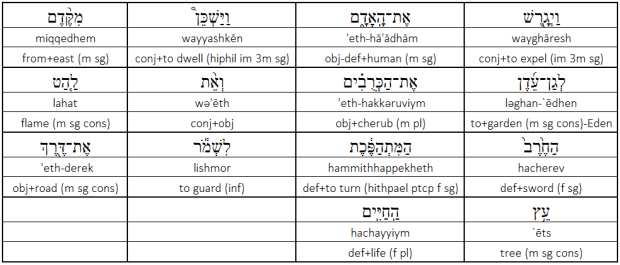
Genesis 4:1 – The man slept with his wife Chawwah, and she conceived, and she bore Qayin. “I have gotten a man,” she said to Yahweh.
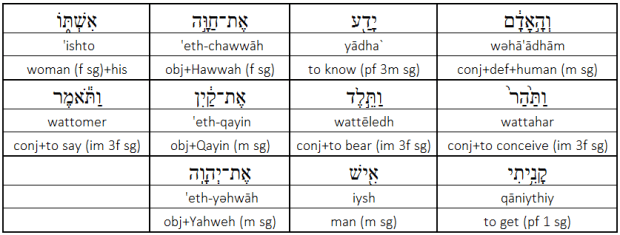
In Hebrew, “to know” is a euphemism for sex. Eve names their son Qayin, a pun on “qāniythiy”, “I have gotten.” Most names in the Torah are puns.
Genesis 4:2 – Then, she bore his brother Hevel. Hevel was a herder of flocks, and Qayin was a servant of the earth.

Genesis 4:3 – When the time had come, Qayin brought an offering to Yahweh from the fruit of the earth.

The phrase “wayhiy miqqēts yāmiym” means “and it was from the end of days.” I interpret this as an indication that a period of time had come to a close, and maybe the sacrifice that followed was appointed ahead of time – “when the time had come.”
Genesis 4:4 – Hevel also brought the firstborn of his flock and their fat. Yahweh gazed upon Hevel and his offering…
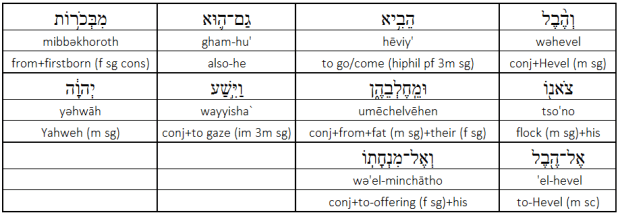
Genesis 4:5 – …but not upon Qayin and his offering. Qayin burned with anger, and his face fell.
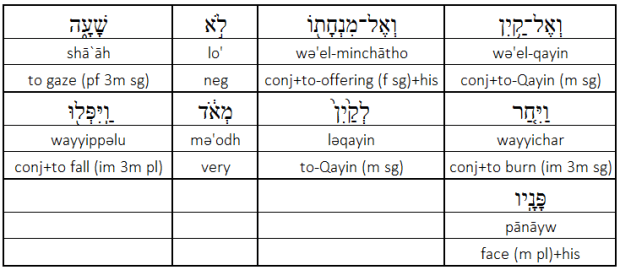
The verb translated “gaze” generally means “to look at”, but with the idea of being transfixed or enchanted. Hevel’s sacrifice caught Yahweh’s attention. Qayin’s reaction was “to burn”, or more generally, “burn/be kindled with anger.”
Genesis 4:6 – “Why do you burn with anger?” Yahweh said to Qayin. “Why has your face fallen?..”
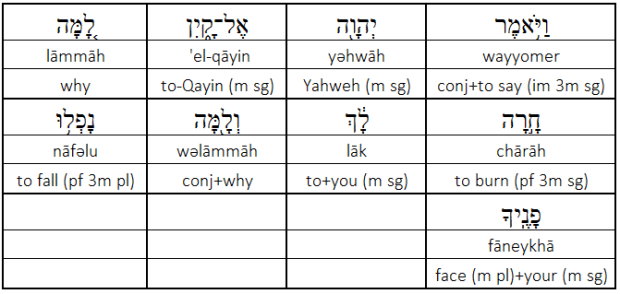
Genesis 4:7 – “…Will you not be exalted if you do well? If you do not do well, sin is lying at the doorway. Its longing will be for you; you must rule over it.”
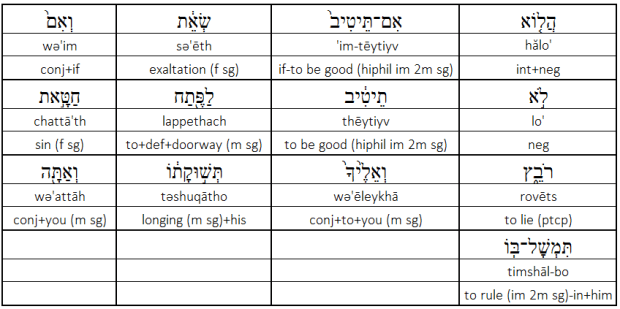
“Is there not, if you do well, exaltation?” Sǝ’ēth, the word translated as “exaltation”, comes from a verb meaning “to raise.”
Genesis 4:8 – Qayin spoke to his brother Hevel. When they were in the field, Qayin stood against him, and he killed him.
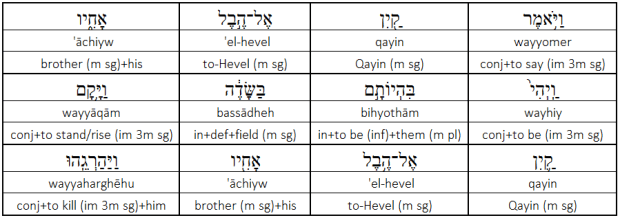
“And it was in their being in the field.” I’m not sure if this immediately follows the sacrifice, or if this is a later time, but it doesn’t seem to imply the usually translated interpolation of Qayin luring Hevel out by saying “Let’s go out into the field.”
Genesis 4:9 – “Where is your brother Hevel?” Yahweh said to Qayin. “I don’t know,” he said. “Am I my brother’s guardian?”

Genesis 4:10 – “What have you done? The voice of your brother’s blood is crying out to me from the earth…”
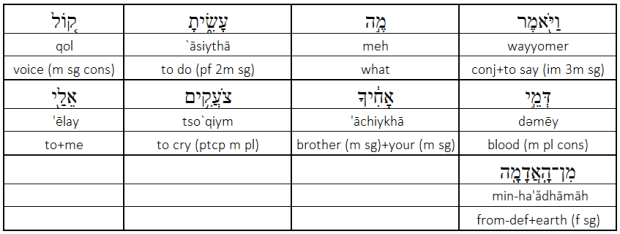
Genesis 4:11 – “..Now you are more cursed than the earth which has opened its mouth to take your brother’s blood from your hand…”
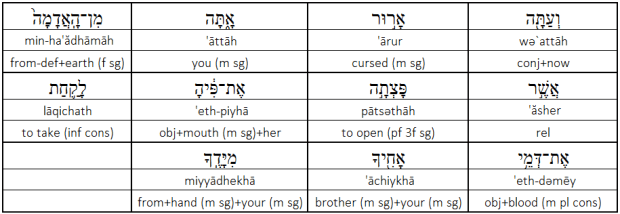
The earth was already cursed because of the man and Chawwah’s actions – now Qayin is cursed even more than the earth is.
Genesis 4:12 – “..When you serve the earth, it will not give its strength to you. You will be a pitiful wanderer in the land.”

Qayin will be a na` wanadh. Both of these words are participles – the first has the idea of trembling/quivering/or moving, and the second comes from a word meaning grief or mourn. This is usually translated as something like “vagabond and fugitive” or “wanderer and vagrant.” I’ve gone with “pitiful wanderer.”
Genesis 4:13 – “My iniquity greater than I can carry,” Qayin said.
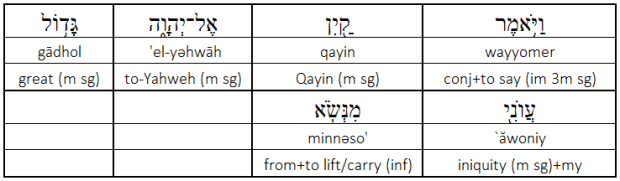
Genesis 4:14 – “…Behold, today you have expelled me from the face of the earth. I will be hidden from your face, and I will become a pitiful wanderer throughout the land. Anyone who finds me will kill me.”
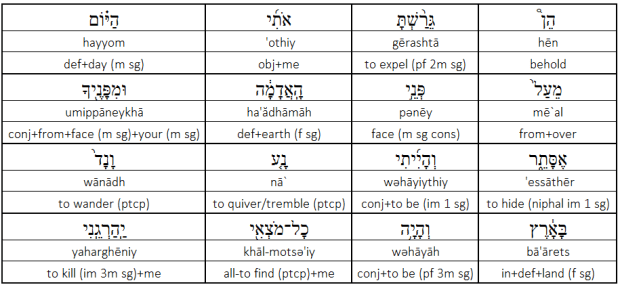
The earth was cursed because of the man’s actions, and he was driven from the Garden of Eden. Now, his son is even more cursed than the earth, and he’s driven away from the earth itself. The man would have to toil to bring food from the earth, but it won’t give anything to his son.
Genesis 4:15 – “For that reason, anyone who kills Qayin will suffer vengeance seven times,” Yahweh said. He put a mark on Qayin, so that anyone who found him would not strike him.
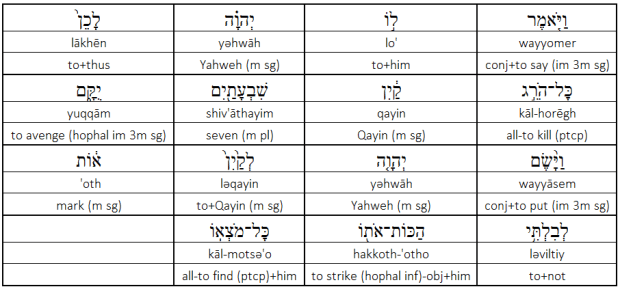
Genesis 4:16 – Qayin left the face of Yahweh, and he dwelt east of Eden in the Land of Nod.
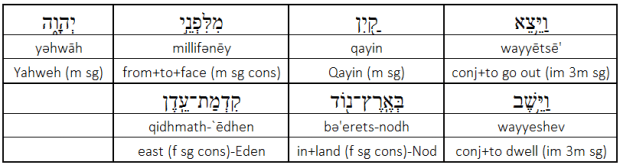
“Nod” might be related to the words used earlier to describe Qayin’s status as a wandering – the Land of Wandering.
Genesis 4:17 – He slept with his wife, and she conceived. She bore Hanok, and Qayin built a city. He named the city Hanok, like the name of his son.

Genesis 4:18 – Irad was born to Hanok, and Irad fathered Mehuyael. Mehuyael fathered Methushael, and Methushael fathered Lemek.
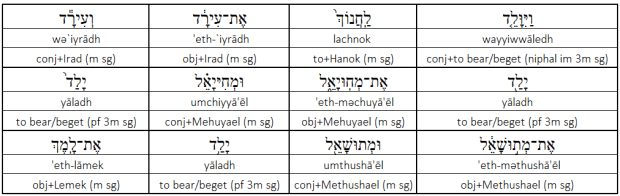
Begat, begat, begat.
Genesis 4:19 – Lemek took two wives. The name of the first was Adhah, and the name of the second was Tsillah.
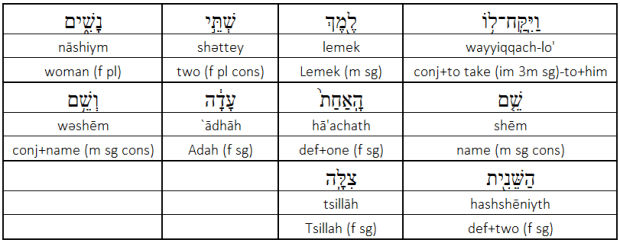
Genesis 4:20 – Adhah bore Yaval – he became the father of those who dwell in tents with cattle.
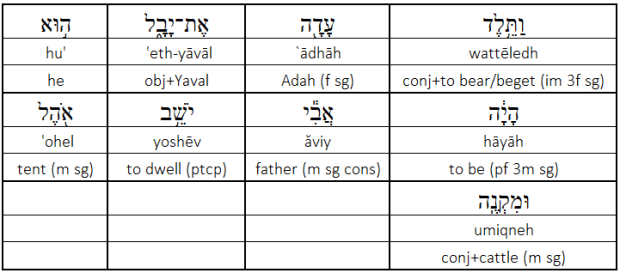
Genesis 4:21 – The name of his brother was Yuval. He became the father of all who play strings and pipes.
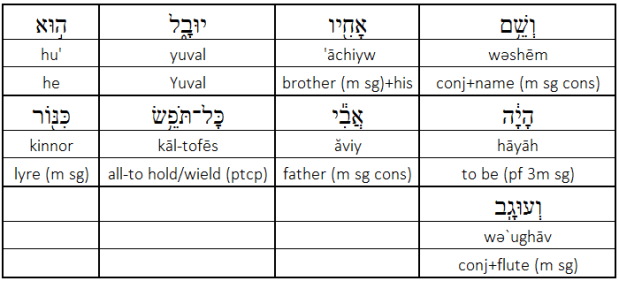
Genesis 4:22 – Tsillah bore Tuval-Qayin. He forged every tool of bronze and iron. His sister was Na’mah.

Genesis 4:23 – “Adhah and Tsillah,” Lemek said to his wives. “Hear my voice. Wives of Lemek, give ear to my speech. I have killed a man for wounding me, and a youth for bruising me…”
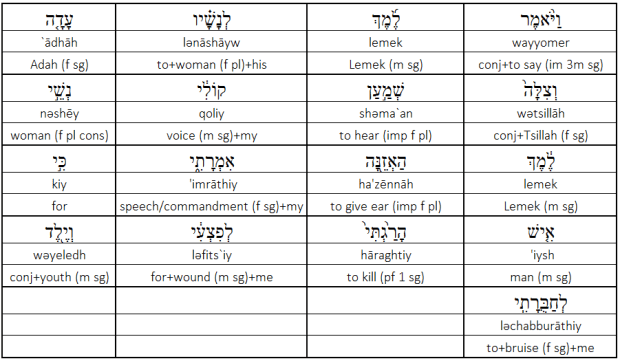
Genesis 4:24 – “…If Qayin is avenged seven times, then Lemek is avenged seventy-seven times.”

Genesis 4:25 – The man slept with his wife again, and she bore a son. She named him Sheth, “because Elohim has given me another seed in the place of Hevel, whom Qayin killed.”
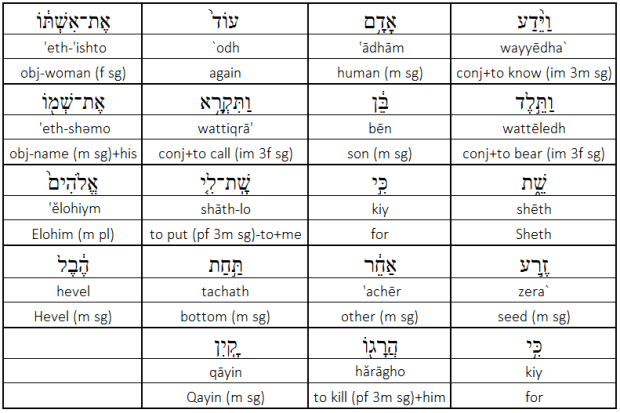
“Sheth” is a pun on “shāth-lo”, “[he has] put/given to me.”
Genesis 4:26 – A son was born to Sheth, and he named him Enosh; then, Yahweh’s name began to be invoked.

Full Text
These are the generations of the skies and the land when they were fashioned, on the day Yahweh Elohim made them.
All of the shrubs and plants of the field had not yet sprouted, for Yahweh Elohim had not caused it to rain over the land, and there was no human to serve the earth. He formed a man from the dust of the earth, breathed the breath of life into his nose, and the man became a living being. He then planted a garden in Eden, in the east. There he put the man whom he had formed, and he caused every beautiful tree with delicious fruit to sprout from the earth. The Tree of Life was in the middle of the garden, and also the Tree of the Knowledge of Good and Evil.
A river going out from Eden watered the garden, and from there it split into four rivers. The name of the first was Pishon – it encircled all the land of Chawilah, where there was gold. The gold of that land was good, and there was also resin and onyx. The name of the second river was Gihon – it encircled all the land of Kush. The name of the third river was Hiddeqel – it flowed east of Ashur. The fourth river was Perath.
Yahweh Elohim took the man and laid him in the Garden of Eden to serve and protect it.
“You are free to eat from every tree of the garden,” he commanded the man. “But, you may not eat from Tree of the Knowledge of Good and Evil, for on the day you eat from it, you will certainly die. Now, it is not good that the man is by himself. I will make a helper for him, corresponding to him.”
He formed from the earth every beast of the field and every bird of the sky, and he brought them to the man to see what he would call them. Whatever the man called them, that was their name. The man named all the livestock, the birds of the sky, and the beasts of the field, but he did not find a helper corresponding to him.
Yahweh Elohim caused a trance to fall over the man, and he slept. He took one of his ribs, and he shut the flesh beneath it. He built a woman from the rib which he had taken from the man, and he brought her to the man.
“This is now bone of my bones and flesh of my flesh,” the man said. “She will be called ‘woman’, for she was taken from man. Thus, a man will forsake his father and mother and cling to his wife, and they will be one flesh.”
The man and his wife were naked, and they did not feel shame.
The serpent was craftier than all the beasts of the field which Yahweh Elohim had made.
“Did Elohim truly say you may not eat from every tree of the garden?” he asked the woman.
“We may eat from the fruit of the trees of the garden,” the woman said to the serpent, “but Elohim said, ‘You may not eat from the fruit of the tree which is in the middle of the garden, or touch it, or you will die.'”
“You certainly will not die,” the serpent said. “Elohim knows that on the day you eat it, your eyes will be opened and you will be like gods, knowing good and evil.”
The woman saw that the tree was good for food, beautiful, and desirable for wisdom. She took the fruit and ate it. She also gave some to her husband, who was with her, and he ate. Their eyes were opened, and they knew that they were naked. They sewed fig leaves and made garments for themselves.
They heard the voice of Yahweh Elohim as he walked in the garden in the day’s breeze, and they hid themselves from his face in the trees of the garden.
“Where are you?” he called to the man.
“I heard your voice in the garden,” the man said. “I was afraid because I was naked, and I hid.”
“Who told you that you were naked? Did you eat from the tree which I commanded you to not eat from?”
“The woman you gave to me gave me the fruit, and I ate.”
“What have you done?” Yahweh Elohim said to the woman.
“The serpent deceived me, and I ate,” the woman replied.
“Because you have done this, you are cursed beyond all the livestock and all the beasts of the field,” Yahweh Elohim said to the serpent. “You will walk on your belly, and you will eat dust all the days of your life. I will put hostility between you and the woman, between your seed and hers. He will bruise your head, and you will bruise his heel.”
“I will greatly increase your sorrow and your childbearing,” he said to the woman. “You will bear children in pain. Your desire will be for your husband, and he will rule you.”
“The earth will be cursed on your account because you listened to your wife’s voice and ate from the tree which I commanded you to not eat from,” he said to the man. “You will eat in sorrow all the days of your life. The earth will sprout thorns and thistles for you, and you will eat the plants of the field. You will only eat bread by the sweat of your brow, until you return to the earth, for you were taken from it. You are dust, and you will return to dust.”
The man named his wife Chawwah, for she became the mother of all life. Yahweh Elohim made tunics of skin for the man and his wife, and he clothed them.
“Behold,” he said. “The man has become like one of us, knowing good and evil. If he stretches out his hand, takes from the the Tree of Life, and eats, he will live forever.”
He sent him from the Garden of Eden, to serve the earth from which he had been taken. He expelled the man, and he placed cherubim and the flame of a spinning sword east of the Garden of Eden, to guard the way to the Tree of Life.
The man slept with his wife Chawwah, and she conceived, and she bore Qayin.
“I have gotten a man,” she said to Yahweh.
Then, she bore his brother Hevel. Hevel was a herder of flocks, and Qayin was a servant of the earth.
When the time had come, Qayin brought an offering to Yahweh from the fruit of the earth. Hevel also brought the firstborn of his flock and their fat. Yahweh gazed upon Hevel and his offering, but not upon Qayin and his offering. Qayin burned with anger, and his face fell.
“Why do you burn with anger?” Yahweh said to Qayin. “Why has your face fallen? Will you not be exalted if you do well? If you do not do well, sin is lying at the doorway. Its longing will be for you; you must rule over it.”
Qayin spoke to his brother Hevel. When they were in the field, Qayin stood against him, and he killed him.
“Where is your brother Hevel?” Yahweh said to Qayin.
“I don’t know,” he said. “Am I my brother’s guardian?”
“What have you done? The voice of your brother’s blood is crying out to me from the earth. Now you are more cursed than the earth which has opened its mouth to take your brother’s blood from your hand. When you serve the earth, it will not give its strength to you. You will be a pitiful wanderer in the land.”
“My iniquity greater than I can carry,” Qayin said. “Behold, today you have expelled me from the face of the earth. I will be hidden from your face, and I will become a pitiful wanderer throughout the land. Anyone who finds me will kill me.”
“For that reason, anyone who kills Qayin will suffer vengeance seven times,” Yahweh said. He put a mark on Qayin, so that anyone who found him would not strike him.
Qayin left the face of Yahweh, and he dwelt east of Eden in the Land of Nod. He slept with his wife, and she conceived. She bore Hanok, and Qayin built a city. He named the city Hanok, like the name of his son. Irad was born to Hanok, and Irad fathered Mehuyael. Mehuyael fathered Methushael, and Methushael fathered Lemek.
Lemek took two wives. The name of the first was Adhah, and the name of the second was Tsillah. Adhah bore Yaval – he became the father of those who dwell in tents with cattle. The name of his brother was Yuval. He became the father of all who play strings and pipes. Tsillah bore Tuval-Qayin. He forged every tool of bronze and iron. His sister was Na’mah.
“Adhah and Tsillah,” Lemek said to his wives. “Hear my voice. Wives of Lemek, give ear to my speech. I have killed a man for wounding me, and a youth for bruising me. If Qayin is avenged seven times, then Lemek is avenged seventy-seven times.”
The man slept with his wife again, and she bore a son. She named him Sheth, “because Elohim has given me another seed in the place of Hevel, whom Qayin killed.”
A son was born to Sheth, and he named him Enosh; then, Yahweh’s name began to be invoked.
 Translate the Torah