The Six Days of Creation
Genesis begins with two creation stories – the first of these, which I’m focusing on in this post, comes from the Priestly source. As such, it follows a very orderly pattern of events. Creation takes place over a period of six days, guided by an omniscient, transcendent god (Elohim) who has absolute authority. At the beginning of the story, the world is a dark, formless ocean, and Elohim gradually demonstrates his authority over the primordial chaos until the world is populated, organized, and purposeful.
This Hebrew cosmogony shares some characteristics with other Near Eastern stories that describe the battle of a storm god with a chaos monster as a representation of order being imposed upon disorder. Upon winning the battle, the god’s right to rule is confirmed. In most cases, the monster is a serpent or dragon associated with the ocean. For example, in the Baal Cycle from the Canaanite city of Ugarit, the sky god Baal kills the sea god Yam and the dragon Lotan after Yam challenges his authority. In Babylonian mythology, Marduk kills the sea goddess Tiamat; he then divides her into pieces to create the world.
In both stories the monsters personify the ocean, and they overlap with figures and concepts in the Hebrew texts. Yam, for example, is the Hebrew word for “sea”, while Lotan is cognate with Leviathan, a dragon or serpent who is mentioned throughout the Tanakh. Tiamat, meanwhile, shares linguistics origins with the Tehom, the formless ocean or “Deep” that Elohim gives shape to.
As the Tehom is the ocean itself, not a personification, the connection between Elohim/Tehom and Marduk/Tiamat is more abstract, but parallels can also be drawn between the Psalms and the Baal Cycle. For example, in Psalm 74, the speaker recalls an ancient battle between Yahweh and Leviathan:
It was you who split open the sea by your power;
you broke the heads of the monster in the waters.
It was you who crushed the heads of Leviathan
and gave it as food to the creatures of the desert.
It was you who opened up springs and streams;
you dried up the ever-flowing rivers.
The day is yours, and yours also the night;
you established the sun and moon.
It was you who set all the boundaries of the earth;
you made both summer and winter.
Just as Baal slays Yam and Lotan, Yahweh splits the sea and crushes Leviathan, after which he has control over the waters. He then brings order by setting the boundaries of the seasons, the days, and the Earth itself. Elohim follows the same basic pattern in Genesis 1 by asserting his authority over the Tehom, though “dividing the waters” isn’t nearly as fun to read as “split[ting] open the sea/Yam.” After Elohim divides the waters of Tehom, he produces dry land, just as Marduk defeats Tiamat and then divides her into pieces to form the world.
Marduk fights Tiamat, Elohim conquers the Tehom, Yahweh fights the sea and Leviathan, and Baal fights Yam and Lotan. The ruling right of the deity, in all of these situations, rests upon his ability to conquer chaos.
Genesis 1:1 – When Elohim began to fashion the sky and the land…
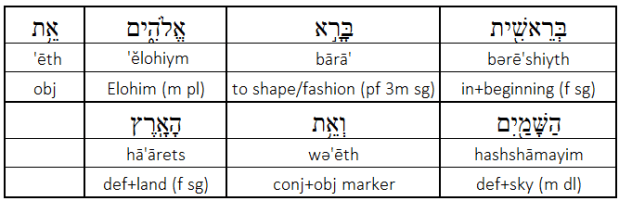
The opening word of the Torah, bǝrē’shiyth, is composed of two elements – the preposition for “in/on” and the word rē’shiyth, meaning “first/beginning.” This is usually translated into English as simply “in the beginning.” Technically speaking, there’s not actually a definite article in this phrase; this is indicated by the shva vowel under the first letter of the word. If the word were definite, it would be spelled bārē’shiyth, not bǝrē’shiyth. A more accurate reading is “in a beginning.”
Interestingly, elsewhere in the Tanakh, bǝrē’shiyth is usually interpreted as a construct noun (in the beginning of). In this case, the definite status of rē’shiyth would be confirmed by virtue of its inclusion in a construct phrase with a second definite noun. In Genesis 1:1, however, there is no second noun to complete the construct phrase. The verse almost reads like it’s missing a word, as construct phrases in Hebrew require at least two nouns. Here, though, bǝrē’shiyth is immediately followed by a verb. It would be very uncharacteristic for a construct noun to introduce a verb phrase, but that’s almost what seems to be happening here.
As this account of creation seems to be in the tradition of Near Eastern stories of order triumphing over chaos, then the point of this story isn’t to show creation ex nihilo (out of nothing), but rather the power of Elohim through his authority over a chaotic but preexisting world. For that reason, I chose to translate this phrase as a subordinate clause, merging it with the following verse.
Even if this isn’t a construct, the indefinite “in a beginning” seems to imply that the story isn’t describing the beginning of everything, but rather the beginning of Elohim’s activity in bringing order. Later in the story, the sky and the land are both created and named, so it would seem strange to begin the story with a definite “Elohim fashioned the sky and the land”, and then later describe their creation and naming a second time. Rather, I think the opening verses describe the state of the world when Elohim began to do his work – “When Elohim began to fashion the sky and the land” – then, the details are provided through the six-day framework.
Another reason I don’t think this story supports creation ex nihilo is the use of the verb bārā’. This is the word typically translated as “create” in English, but it can also mean “to shape/fashion”, and it comes from a root meaning “cut.” This verb always describes divine activity, never human activity, and it seems to denote the manipulation of preexisting material. To bārā’ something is to cut or shape it, not form it from nothing.
Genesis 1:2 – …the land was desolate and empty. Darkness was over the face of the Deep, and the breath of Elohim shook over the waters.
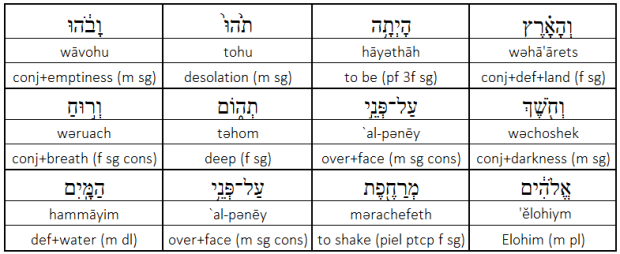
Biblical Hebrew includes a handful of words or phrases with ambiguous meanings. The phrase tohu wāvohu, usually translated as something like “formless and void”, is one of these phrases. According to Strong’s, the first element comes from a root meaning “desolate”, while the second means “empty.” Despite being nouns, I prefer the way they sound as adjectives.
This verse also gives the first mention of the Tehom, the “abyss” or the “Deep.” When Elohim starts doing his work, the world is entirely water, and it’s not a very friendly place. Dark, desolate, and empty.
There’s also ruach, which means “breath” and is usually translated “spirit.” Since “spirit” itself comes from the Latin word for “breath”, I prefer to translate ruach as just “breath.”
Genesis 1:3 – “May light appear,” Elohim said, and light appeared.

Hebrew narrative, as you’ll see, tends to string together phrases beginning with the conjunction “and.” And Elohim did this…and Elohim did that…and Elohim did this other thing. I don’t love the repetition in English, so I generally ignore the conjunction when I translate.
The verb hayah, “to be”, is a little bit stronger than the English “be.” It can mean “be/appear/come to pass/happen.” When possible, I try to give it a little more strength in English than just “be”, hence my translation of “may light appear” rather than the more traditional “let there be light.”
Genesis 1:4 – He saw that the light was good, and he separated the light from the darkness.

In this verse, Elohim performs his first act of dividing. After light has been created, the light and the darkness are separated from one another.
Genesis 1:5 – He called the light “day” and the darkness “night.” Evening came, and morning came: the first day.
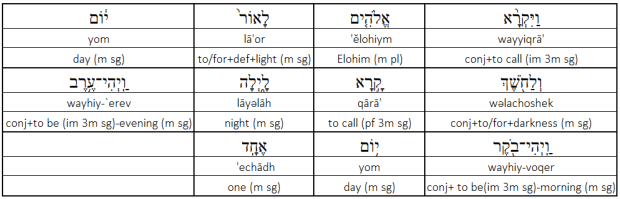
If you’ve been following the Hebrew alongside my translation, you’ll notice that I prefer to be as succinct as possible. More literally, this verse reads “And Elohim called the light ‘day’, and the darkness he called ‘night.'”
Genesis 1:6 – “May an expanse appear in the midst of the waters, and may it be a division between them,” Elohim said.
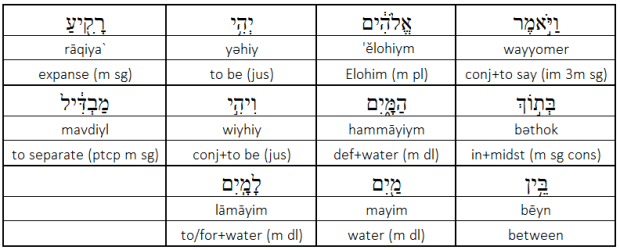
Elohim is now performing his second act of separation: splitting the sea. You might be familiar with the word rāqiya` in its traditional English rendering: “firmament.” Rāqiya` comes from a root meaning “to beat/hammer”, as in beating out a piece of metal. The rāqiya`, something like a dome or shell, divided the Tehom in half with waters below and the waters above (except in the event of rain, when water was allowed to pass through). Interestingly, the Hebrew word for water, mayim, is one letter away from its word for sky, shāmayim – the blue of the sky and the blue of the ocean might have figured into this perception of the world. This incredibly crude MS Paint drawing might help you visualize this view of the world.
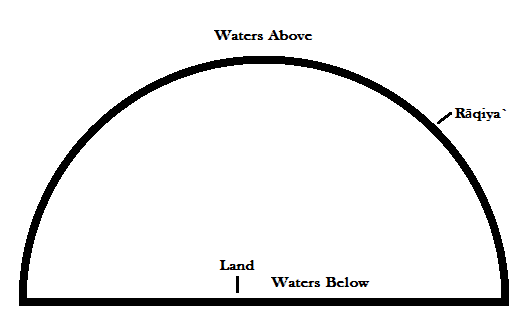
I translate rāqiya` as “expanse”, to capture the image of a piece of metal that has been hammered out.
Genesis 1:7 – He made the expanse to separate the waters beneath from the waters above, and it was so…

Genesis 1:8 – …and he called it “sky.” Evening came, and morning came: the second day.

Here’s an example of why I translated the opening of the chapter as I did . If the rāqiya` is the sky, then it seems strange to me that Elohim would make it first in verse 1 and again in verses 7-8. He really couldn’t have made the sky/rāqiya` in verse 1 anyway – the purpose of the rāqiya` is to separate the waters, but that doesn’t even happen until verse 7.
Genesis 1:9 – “May the waters beneath the sky be bound to one place, and may dry ground appear,” Elohim said. It was so.
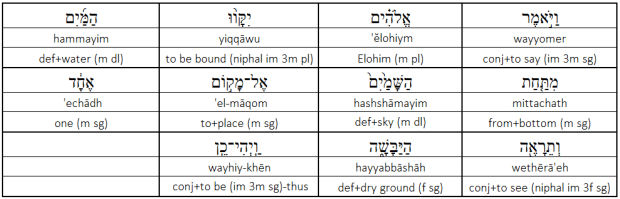
In order to bring out dry ground, all of the water beneath the rāqiya` is gathered to one place. This might be a reference to the Mediterranean, which the Hebrews would have been familiar with as a great “world ocean” in the center of the land.
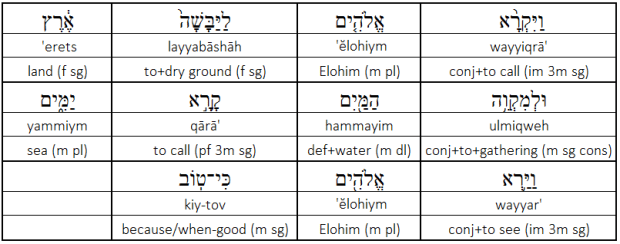
Genesis 1:10 – He called the dry ground “land” and the gathering of waters “sea”, and he saw that it was good.
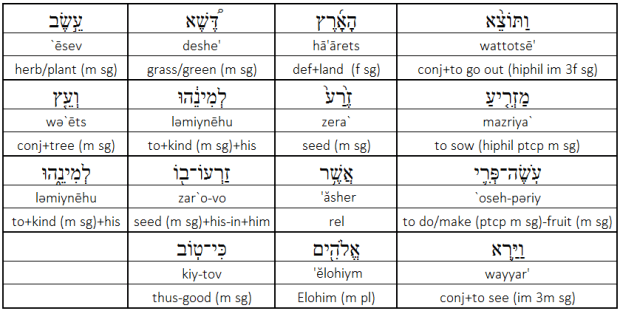
Genesis 1:11 – “May the land burst with green: every kind of seed-bearing plant and fruit bearing tree.” It was so…
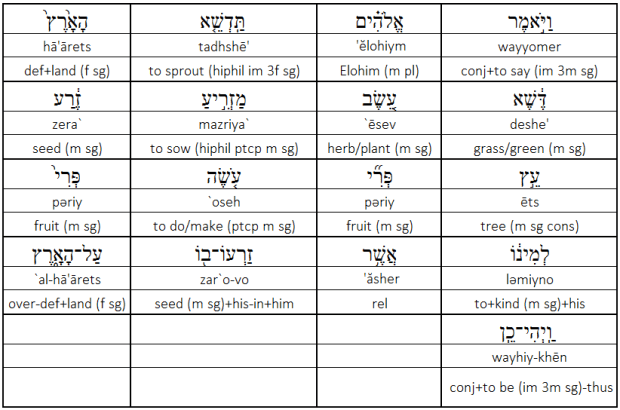
I take a lot of liberties with this one. The verb tadhshē’ and the first object deshe’ both come from the same root meaning “green/sprout/grass”, and I see this as an introduction to the two specific types of deshe’ that follow.
First, there’s `ēsev mazriya` zera`. `ēsev is just “herb/plant”, followed by a participle and an object. Both of these words come from the same root for “seed/sow”, so the literal translation is something like “plant(s) sowing seed.”
The second is a little more complicated – ēts pǝriy `oseh pǝriy lǝmiyno ‘ăsher zar`o-vo `al-hā’ārets. As best as I can tell, this is “tree(s) of fruit making fruit to its kind which has its seed in it over the land.” Ignoring the “to its kind” phrase, which I’ll address shortly, this seems to be referring to trees that produce fruit that has seed inside it. Honestly, I just render both of these phrases in a very simple and parallel way – “seed-bearing plants and fruit-bearing trees.” I like the way it sounds in English.
“To its kind” is a phrase that shows up a lot in this chapter. In Hebrew, “kind” seems to be some sort of understanding of species. Vegetation and animals are all made according to their kinds – unspecified subcategories of the more general categories of trees, livestock, birds, etc. I tend to translate this as “every kind of”, and in verses where it’s frequently repeated after each large category is mentioned, I usually prefer to use it once to refer to all the categories mentioned in the verse. Here, it looks like it might only be referring to the trees, not the other plants, but I use it to cover both.
Genesis 1:12 – …the land brought forth green: every kind of seed-bearing plant and fruit-bearing tree, and Elohim saw that it was good.
Genesis 1:13 – Evening came, and morning came: the third day.

Genesis 1:14 – “May there be luminaries in the expanse of the sky, to divide the day and the night,” Elohim said. “May they mark seasons, days, and years…”
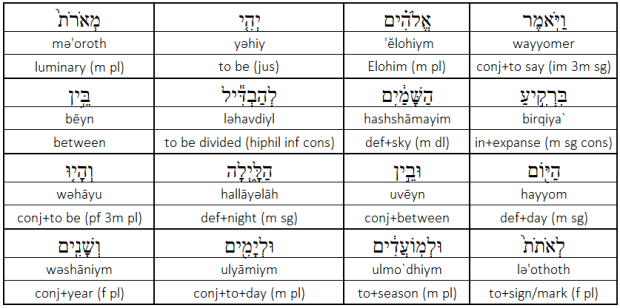
The last part of this verse literally reads “and may [the luminaries] be for signs, and for seasons, and for days, and years.” Since ‘oth, the word for “sign” comes from the verb “to mark”, I translate this part as “and may they mark seasons, days, and years.”
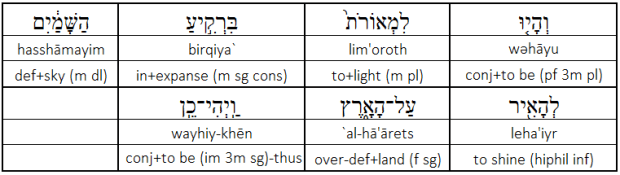
Genesis 1:15 – …and may they be lights in the expanse of the sky to shine over the land. It was so…
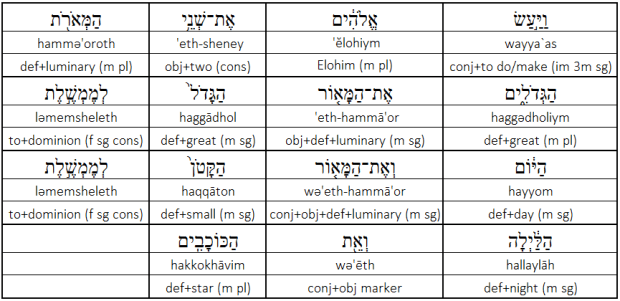
Genesis 1:16 – …he made two great luminaries, the greater to have dominion over the day and the lesser to have dominion over the night, and also the stars…
Genesis 1:17 – …and he set them in the expanse of the sky to shine over the land…

Genesis 1:18 – …to rule over the day and the night, and to divide the light from the darkness, and he saw that it was good.

Genesis 1:19 – Evening came, and morning came: the fourth day.

In the Psalm I mentioned at the beginning of this post, Yahweh triumphs by splitting the sea, after which he has power over the waters and is able to establish luminaries and boundaries. Elohim follows a similar pattern here. Once the waters are divided, he sets the sun, moon, and stars in the rāqiya` to mark the passage of time.
Genesis 1:20 – “May the waters swarm with life,” Elohim said. “May birds soar over the land, over the face of the expanse of the sky.”
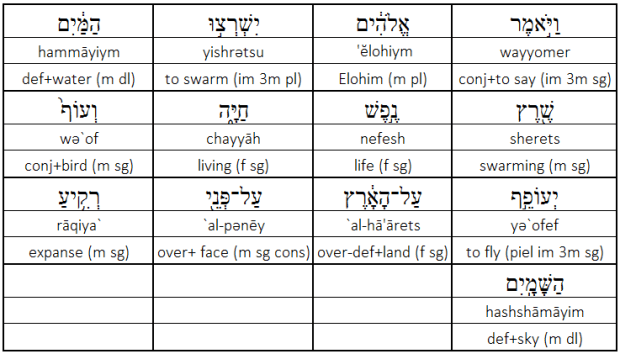
Earlier, we encountered the word ruach, or breath. Another “spirity” word is nefesh, which is usually translated as “soul” or “life.” Nefesh, like ruach, also comes from a root meaning “breathe” (technically, ruach is more like “blow”). In this verse, the full phrase is nefesh chayyah, “living breath” or “living life.” I translate nefesh chayyah as simply “life.”
Genesis 1:21 – He fashioned the great serpents, all life that swarms in the waters, and every kind of winged bird, and he saw that it was good.

The first of the three categories of life made in this verse are the tanninim. Tannin, as a proper singular noun, is yet another serpent that shows up in the Ugaritic stories and is defeated by Baal, while the plural (tanninim) is a class of creatures in Hebrew. Once again referring to Psalm 74:
It was you who split open the sea by your power;
you broke the heads of the monster in the waters.
In Hebrew, the word translated as “monster” above is tanninim. This account with Yahweh parallels the Ugaritic account of Baal, while in the Genesis story Elohim creates the tanninim rather than destroy them.
Genesis 1:22 – He blessed them, saying, “Bear fruit, increase, and fill the waters of the sea, and may the birds increase over the land.”
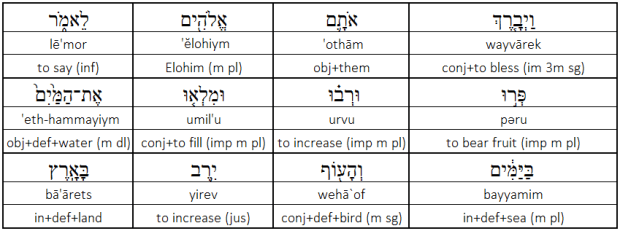
Genesis 1:23 – Evening came, and morning came: the fifth day.

Genesis 1:24 – “May the land bring forth life: every kind of livestock, crawling thing, and wild animal,” Elohim said. It was so…
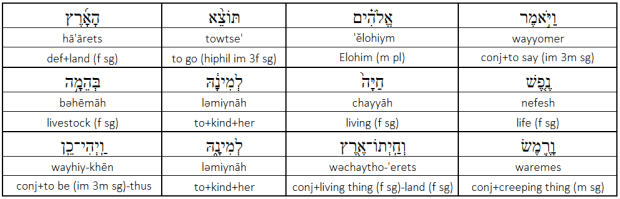
Again, Elohim commands the creation of nefesh chayyah. The three categories here are bǝhēmāh (“livestock”), remes (“creeping things”), and chaytho-‘erets (“life of the land”). These are usually thought to correspond with large domesticated animals, smaller “creeping” animals, and non-domesticated animals, respectively. I prefer “crawl” to “creep”, so that’s how I translate remes.
Genesis 1:25 – …he made every kind of wild animal and livestock, and everything that crawls along the earth, and he saw that it was good.
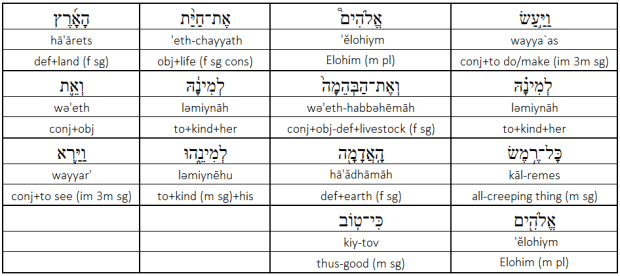
Genesis 1:26 – “May we make humans in our image, like us,” he said. “May they subjugate the fish of the sea, the birds of the sky, the livestock, and everything that crawls across the land.”
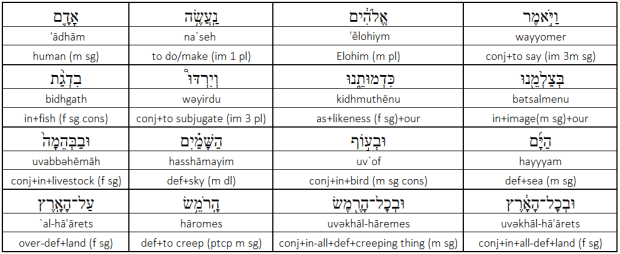
You may notice that the word I’ve translated as “humans” is ‘ādhām. This is the source of the name Adam, and in the next chapter, the concept of ‘ādhām is singular, referring a single human (Adam). Here, it’s being used collectively (similar to other classes of created things), and is distinct from the characters of Adam and Eve who show up in the Jahwist creation story of Genesis 2. In other words, Elohim is making humans as a group, just as he made birds, livestock, and other creatures as groups. As a side note, in the previous chapter, the ground is referred to as ‘ădhāmāh. Both of these words, human and ground, ādhām and ‘ădhāmāh, come from the same source and are related to the name Edom, all meaning “red” or “ruddy.”
Genesis 1:27 – He fashioned humans in his image, male and female.
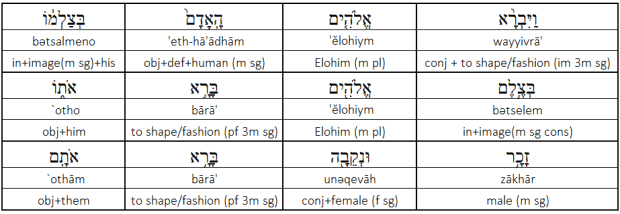
This is another verse I’ve condensed. The full text is “And Elohim fashioned humans in his image; in the image of Elohim he fashioned them; male and female he fashioned them.”
Genesis 1:28 – He blessed them, and he said to them, “Bear fruit, increase, and fill the land. Enslave it, and rule the fish of the sea, the birds of the sky, and all life that crawls across the land.”
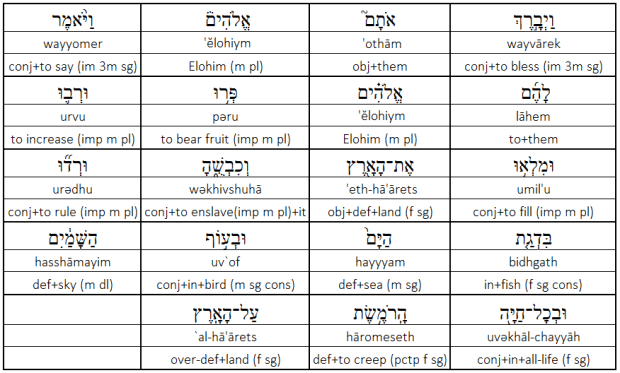
Genesis 1:29 – “Behold, I have given you every seed-bearing plant and fruit-bearing tree for food…”
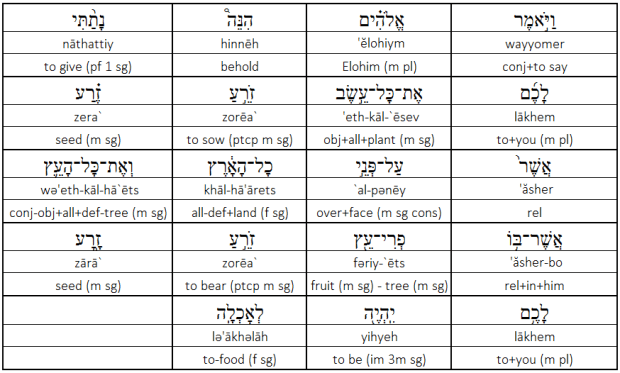
Genesis 1:30 – …”and I have given every green plant as food to to all the wild animals, all the birds of the sky, and everything that crawls across the land.”
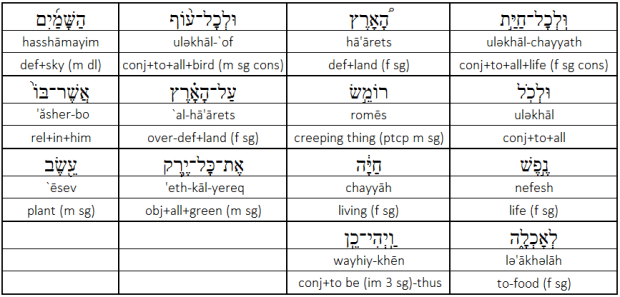
Genesis 1:31 – He saw all that he had made, and behold, it was very good. Evening came, and morning came: the sixth day.
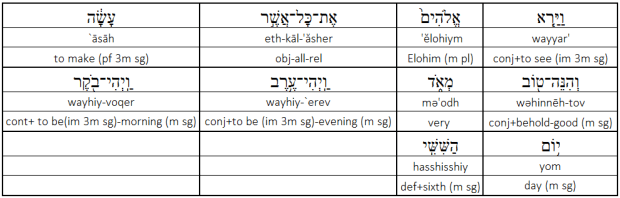
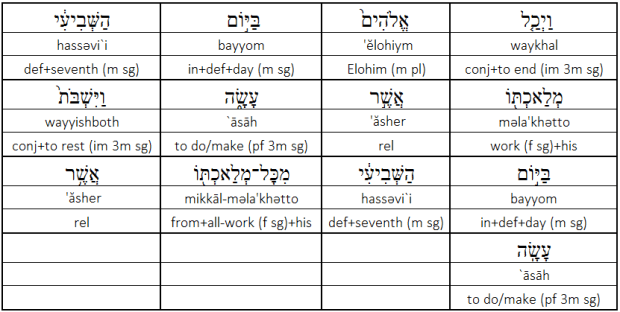
Genesis 2:1 – The sky, the land, and all their host were completed.

Genesis 2:2 – Elohim finished his work on the seventh day, and he rested from all that he had done.
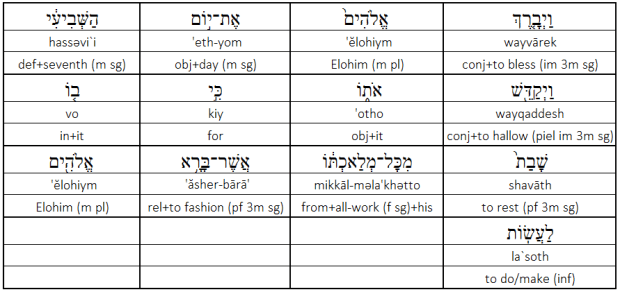
Genesis 2:3 – He blessed and hallowed the seventh day, for on it he rested from all his work that he had done.
Full Text
When Elohim began to fashion the sky and the land, the land was desolate and empty. Darkness was over the face of the Deep, and the breath of Elohim shook over the waters.
“May light appear,” Elohim said, and light appeared. He saw that the light was good, and he separated the light from the darkness. He called the light “day” and the darkness “night.” Evening came, and morning came: the first day.
“May an expanse appear in the midst of the waters, and may it be a division between them,” Elohim said. He made the expanse to separate the waters beneath from the waters above, and it was so, and he called it “sky.” Evening came, and morning came: the second day.
“May the waters beneath the sky be bound to one place, and may dry ground appear,” Elohim said. It was so. He called the dry ground “land” and the gathering of waters “sea”, and he saw that it was good.
“May the land burst with green: every kind of seed-bearing plant and fruit bearing tree.”
It was so; the land brought forth green: every kind of seed-bearing plant and fruit-bearing tree, and Elohim saw that it was good. Evening came, and morning came: the third day.
“May there be luminaries in the expanse of the sky, to divide the day and the night,” Elohim said. “May they mark seasons, days, and years, and may they be lights in the expanse of the sky to shine over the land.”
It was so; he made two great luminaries, the greater to have dominion over the day and the lesser to have dominion over the night, and also the stars, and he set them in the expanse of the sky to shine over the land, to rule over the day and the night, and to divide the light from the darkness, and he saw that it was good. Evening came, and morning came: the fourth day.
“May the waters swarm with life,” Elohim said. “May birds soar over the land, over the face of the expanse of the sky.”
He fashioned the great serpents, all life that swarms in the waters, and every kind of winged bird, and he saw that it was good. He blessed them, saying, “Bear fruit, increase, and fill the waters of the sea, and may the birds increase over the land.” Evening came, and morning came: the fifth day.
“May the land bring forth life: every kind of livestock, crawling thing, and wild animal,” Elohim said. It was so; he made every kind of wild animal and livestock, and everything that crawls along the earth, and he saw that it was good.
“May we make humans in our image, like us,” he said. “May they subjugate the fish of the sea, the birds of the sky, the livestock, and everything that crawls across the land.”
He fashioned humans in his image, male and female. He blessed them, and he said to them, “Bear fruit, increase, and fill the land. Enslave it, and rule the fish of the sea, the birds of the sky, and all life that crawls across the land. Behold, I have given you every seed-bearing plant and fruit-bearing tree for food, and I have given every green plant as food to to all the wild animals, all the birds of the sky, and everything that crawls across the land.”
He saw all that he had made, and behold, it was very good. Evening came, and morning came: the sixth day.
The sky, the land, and all their host were completed. Elohim finished his work on the seventh day, and he rested from all that he had done. He blessed and hallowed the seventh day, for on it he rested from all his work that he had done.
 Translate the Torah